★ 🆕 Agriculture 1st Edition ⚡️ Order Now! ★                      ★ 🆕 Environment 4th Edition ⚡️ Order Now! ★                      ★ Download Prelims Magnum 2026 — Yearly [FREE] ★                      ★ Prelims Cracker 2026 Combo Deal ⚡️ Magnum Crash Course + Test Series ★                      ★ PMF IAS Impact 🎯 53 Direct Hits in Prelims 2025 ★

Current Affairs – June 05, 2025

Prelims Cracker

{GS1 – IS – Population} Census 2027

  • Context (IE): Government has announced that data collection for India’s next Population Census, along with a nationwide caste enumeration, will begin in early 2026.
  • The notification for the intent of conducting the Population Census will be published in the official gazette as per the provisions of section 3 of the Census Act 1948.

Brief Background of Census

  • Census of India is conducted under the provisions of the Census Act, 1948 and the Census Rules, 1990.
  • The census is conducted by the Office of the Registrar General and Census Commissioner, under the Ministry of Home Affairs.
  • 1st census in India was conducted in 1872 non-synchronously in different parts of India. Since 1881, censuses have been conducted every 10 years.
  • Census is a subject listed in the Union List of the Seventh Schedule under Article 246 of the IC.
  • Last Census was conducted in 2011. The 2021 Census was postponed due to the COVID-19 pandemic.

Key Features of Census 2027

  • India’s Census is likely to commence on April 1, 2026, culminating on March 1, 2027. The Census will be carried out in two phases:
    1. Phase 1: House Listing (5–6 months from April 1, 2026).
    2. Phase 2: Population Enumeration (February 2027 – completed by March 1, 2027).
  • It will be India’s 1st digital census, marking a shift from paper-based enumeration to a digital format using mobile apps and online platforms.
  • Reference Dates:
    • October 1, 2026: For hilly and snow-bound regions (e.g., Ladakh, J&K, Himachal, Uttarakhand).
    • March 1, 2027: For the rest of India.
  • Caste Enumeration: For the 1st time in post-Independence India, caste data beyond SC/ST categories will be collected. The last complete caste enumeration was conducted in 1931.
    • Post-Independence, censuses excluded detailed caste enumeration, recording only Scheduled Castes (SCs) and Scheduled Tribes (STs).

Significance

  • Enables Delimitation: The Census will form the basis for the delimitation of Lok Sabha and State Assembly constituencies, as mandated by Article 82 of the IC.
    • Delimitation has been frozen since 1976 (based on 1971 Census data), and extended again in 2001 till 2026. As per the constitutional mandate, the 1st census after 2026 can be used as the basis to redraw Lok Sabha constituencies.
  • Women’s Reservation: The implementation of the 33% reservation for women in Parliament and Assemblies is linked to the completion of the new Census and delimitation process.
  • Data for Policy and Planning: Provides crucial demographic, social, and economic data used for development planning, welfare schemes, health, education, and infrastructure.
    • Help track urbanisation, migration trends, literacy, gender ratio, housing, & access to public amenities.
  • Foundation for Governance: Census data supports resource allocation, subsidy distribution, and implementation of schemes like MGNREGA, National Food Security Act etc.
  • Basis for Reservation Policies: Caste enumeration may guide affirmative action policies by providing updated data on OBCs and other backward communities.

Concerns

  • Political Impact: Redrawing of constituencies could alter political power dynamics, especially between northern and southern states, potentially sparking regional discontent.
    • Several southern states have raised concerns about using population size alone as the basis for seat allocation, fearing a reduction in their relative representation due to successful population control efforts.
  • Caste Enumeration Sensitivities: Enumerating castes can deepen caste identities and reinforce social divisions. It may lead to increased caste-based mobilization, identity politics, and communal tension.
  • Impact on Governance: Shifting focus from class-based or economic indicators to caste may dilute development-based policymaking.
  • Risk of Misuse: Detailed data on caste, religion, and community could be misused for political or communal purposes, especially during elections, fuelling inter-caste tensions.

Way Forward

  • Decoupling Caste Data from Political Use: While caste data can help in targeted welfare, care must be taken to avoid its use for political mobilization or divisive electoral strategies.
  • Address Regional Concerns on Delimitation: Engage in dialogue with states especially from the south on population-based delimitation to ensure equitable representation and preserve the spirit of cooperative federalism.
  • Data Protection and Privacy: Robust legal and technological safeguards must be implemented to ensure that sensitive caste data is not misused and individuals’ privacy is protected.
  • Synchronize with Development Goals: Use caste data to identify gaps in education, health, employment, and housing to frame evidence-based policies and promote inclusive development.

Also Read> Caste Census in India and Delimitation Process in India.

{GS2 – Governance – Laws} Unified approach to CAPF and IPS integration

  • Context (TOI): SC decreed that Group ‘A’ cadres of Central Armed Police Forces (CAPFs) be recognised as ‘Organised Services’ for all purposes.
  • Also instructed a phased reduction of IPS officers deputed to CAPFs over 2 years to empower CAPF cadres and resolve long-standing promotion grievances.

Organised Services are Central Group ‘A’ services with structured career progression and cadre management.

Central Armed Police Forces (CAPFs)

  1. BSF, ITBP, SSB: Guard international borders, prevent infiltration, smuggling, and cross-border crimes.
  2. Central Industrial Security Force (CISF): Secures critical infrastructure like airports, nuclear plants, PSUs.
  3. Central Reserve Police Force (CRPF): Handles internal unrest, assists state police in counter-insurgency, election duty, etc.

Indian Police Service (IPS)

  1. An All-India Service (Article 312) under the Constitution.
  2. Acts as a bridge between state police and central forces, offering national cohesion.
  3. IPS officers hold leadership roles in both state and central internal security organisations.

Background of the Ruling: Discontent within CAPFs

  • Historical Structure:
    • Senior posts filled mainly by IPS officers, with CAPF cadres recruited only at Group B level.
    • Cadre Strength Fixation (40% Reserve): Allowed IPS officers to be posted in central organisations like CAPFs.
  • Changing Operational Needs:
    • More Direct Recruitment: Direct Group “A” officers now promoted to senior roles like Commandant, DIG, IG.
    • Present Scenario: 100% posts at Commandant level filled by CAPF cadre and 80% DIG and 50% IG posts also held by CAPF officers.
  • Legitimate Grievances: Denied Organised Service Status despite being Group “A” recruits. Stagnant Promotions and limited leadership opportunities vis-à-vis IPS officers.

Proposed Solution

  • Integration Model: Create a separate IPS cadre for CAPFs, as suggested in the Sixth Report of the National Police Commission. Designate all senior posts (Commandant & above) as ‘Senior Duty Posts’ under this cadre.
  • Integrated Cadre: Results into One unified cadre (IPS) across internal security forces. Officers from:
    1. Direct IPS recruits (through CSE) allotted to CAPFs.
    2. Promoted Group B CAPF officers absorbed into IPS.
    3. Deputations IPS officers from state cadres.

Benefits

  • Unity of Command: Senior leadership in all internal security wings will have a shared institutional ethos via IPS.
  • Career Growth for CAPF Officers: Resolves stagnation; provides clear, structured career paths with organised service benefits.
  • Better Coordination: Ensures cohesive functioning of IPS officers across state police and CAPFs.
  • Deputation to States: IPS-CAPF officers with all-India experience can enhance the capabilities of State Armed Police forces.
  • Institutional Stability: Avoids disruption caused by blanket removal of IPS deputation and preserves operational effectiveness.

{GS2 – IR – India-Australia} India-Australia defence ties

  • Context (TH | TH): India and Australia agreed to intensify and diversify defence industry collaboration.

India-Australia Defence Ties: Institutional Frameworks & Cooperation

  • Comprehensive Strategic Partnership (CSP) 2020: Elevated bilateral ties between India and the partner country, focusing on defense, trade, technology, and strategic cooperation.
  • 2+2 Ministerial Dialogue (2021): Institutionalized dialogue mechanism between foreign and defense ministers of both countries to coordinate on security and diplomatic issues.
  • Mutual Logistics Support Agreement (MLSA): Enables reciprocal access to each other’s military bases for logistics support, enhancing operational readiness and joint exercises.
  • Australia’s 2023 Defence Strategic Review designated India as a “top-tier security partner”
  • Air-to-Air Refuelling Deal (2024): Agreement allowing mutual in-flight refueling of military aircraft, extending the range and endurance of air operations.
  • Regular military exercises: AUSTRAHIND, AUSINDEX, participation in multilateral exercises like Malabar and Pitch Black.
  • AUSTRAHIND: Annual bilateral army exercise between India and Australia focusing on counter-terrorism and joint operational readiness.
  • AUSINDEX: Biennial naval exercise between Indian and Australian navies emphasizing maritime security and interoperability.
  • Multilateral Exercises (Malabar and Pitch Black): India and Australia jointly engage in these large-scale multilateral drills to enhance regional security cooperation and combat readiness.

Significance of India-Australia Defence Ties

  • Complementary Strategic geography: Australia’s geographic position bridges Indian and Pacific Oceans, complementing India’s maritime ambitions.
  • Enhance India’s operational capabilities through Australian Defence Force strong coalition experience. E.g. Air-to-air refuelling arrangement extends the range of Indian aircraft.
  • Indo-Pacific security: Australia’s ties with Pacific Island nations align with India’s increasing regional involvement & strengthening collective influence in a China-contested zone.
  • Counter emerging threats like cybersecurity, space security and hybrid warfare tactics.

Challenges

  • Different threat perceptions: India focuses on continental threats (China, Pakistan) while Australia is more concerned about Maritime and Pacific security.
  • Limited collaboration: Actual joint projects and technology transfers remain limited.
  • Geopolitical complexities: Evolving roles of alliances like Quad & AUKUS influencing relations.
  • Limited interoperability: differences in military doctrines and equipment standards pose challenges to seamless operational integration.
  • AUKUS is a trilateral security pact between Australia, the United Kingdom, and USA focusing to enhance security and defence cooperation in the Indo-Pacific region to counter China’s growing influence.

Recommendations for Deepening Ties

  • Rebalance defence engagement beyond comfortable silos as the defence ties remain naval-centric.
  • Enhance India’s defence presence in Australia: India currently posts only a Naval Adviser in Canberra; upgrading to tri-service attachés aligns with Australia’s 2023 Defence Review.
  • Promote operational-level engagement: Strategic dialogues lack operational military input.
  • Initiate war-gaming exchanges on similar lines of U.S.-INDOPACOM war games.
  • Cooperation in Maintenance, Repair, and Overhaul (MRO): Joint MRO and patrol boat manufacturing for Indian Ocean and Pacific Island in line with India’s Defence Production and Export Promotion Policy, 2020 (supports international MRO collaboration).

{GS2 – Social Sector – Health} Exposomics

  • Context (TH): Exposomics is an emerging scientific approach that transforms our understanding and management of environmental determinants of health.
  • Exposomics is the scientific study of the exposome—the totality of environmental and lifestyle exposures an individual encounters from the prenatal stage to death and their impact on health.
  • Complements genomics by capturing dynamic, time-varying exposures like pollution, diet, occupation, behavior, and socioeconomic factors.
    • While the genome is fixed, the exposome is variable, influenced by time, place, and biology.
  • Significance: Genetics explains only ~10% of disease risk; exposomics helps uncover the remaining role of environmental and lifestyle factors.
    • Enables targeted prevention, personalized interventions, and evidence-based public health policies.

Relevance to India

  • Environmental Health Burden: India bears ~25% of the global environmental disease burden, with around 3 million deaths annually linked to environmental and occupational health (OEH) risks.
  • Non-Communicable Disease (NCDs) Crisis: OEH factors contribute to over 50% of NCDs like heart disease, stroke, asthma, and chronic kidney disease.
  • Inadequate Global Monitoring: Current Global Burden of Disease estimates track only ~11 exposure categories, missing key risks like microplastics, chemical mixtures, & complex environmental interactions.

{GS3 – Envi – Degradation} Exemption of Flue Gas Desulphurisation (FGD)

  • Context (TH): A high-powered committee has recommended removing the mandatory requirement for Flue Gas Desulphurisation (FGD) units in most of India’s coal-fired thermal power plants (TPPs).

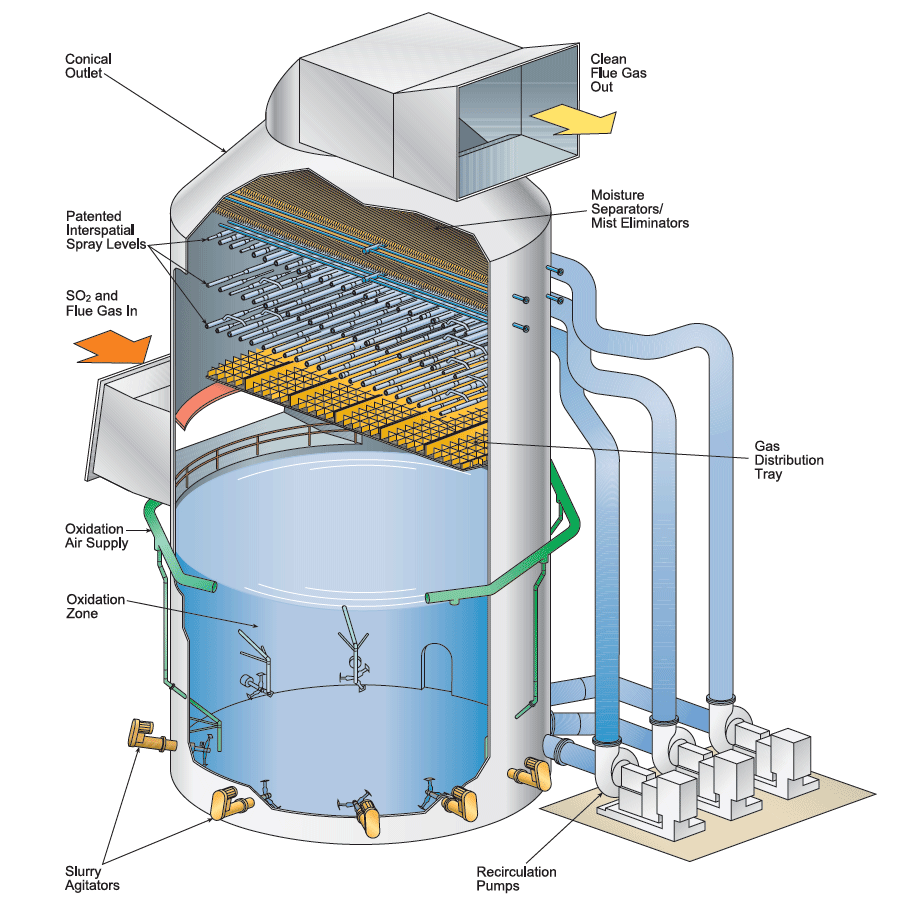
Flue Gas Desulphurisation

Credit: bc

About Flue Gas Desulphurisation (FGD)

  • FGD is a technology that removes sulphur dioxide (SO₂) from flue gas before its atmospheric release.
  • The process involves passing flue gas through a scrubbing system, often using limestone or ammoniabased slurry, which converts SO₂ into gypsum or other neutral compounds.
  • It utilises various methods to filter emissions, including wet scrubbing and dry methods.
  • MoFECC guidelines require coal-based power plants to install flue-gas desulfurisation systems.
    • Only 22 GW (~8%) of India’s coal-based capacity has installed FGD plants.
  • Modern FGD systems can eliminate up to 95% of SO₂ emissions.
  • FGD helps reduce acid rain, improves ambient air quality, and ensures compliance with the National Ambient Air Quality Standards (NAAQS) and the Air (Prevention and Control of Pollution) Act, 1981.

About Flue gas

  • Flue gas is the exhaust emitted from burning fossil fuels in thermal power plants & industrial processes.
  • It contains a mixture of gases, including carbon dioxide (CO₂), carbon monoxide (CO), water vapour, nitrogen oxides (NOx), sulphur dioxide (SO₂), particulate matter (PM), and other trace pollutants.
  • Its composition varies depending on the type of fuel and the combustion conditions.
  • Released through chimneys or flues, the gas contains pollutants that require treatment before release.

Implications of Flue Gas

  • Environmental: Contributes to air pollution, acid rain, smog formation, and climate change.
  • Health: Exposure to particulate matter can lead to respiratory and cardiovascular diseases, particularly affecting lung health.
  • Industrial/Economic: Pollutants accelerate equipment corrosion and increase maintenance costs; pollution control technologies such as FGDs add to operational expenses.

Also Read,> Air Quality Monitoring | Air Quality Index | NAAQS | SAFAR

{GS3 – Envi – PA} New Ramsar Sites in Rajasthan

  • Context (PIB): Khichan and Menar wetlands in Rajasthan have been designated as new Ramsar Sites, increasing India’s total to 91 Ramsar Sites.

Menar Wetland

  • Freshwater monsoon wetland complex located in Udaipur, Rajasthan.
  • Formed by Braham talab or pond, Dhand talab, Kheroda talab, and adjoining farmland.
  • Ecological Role: Flooded farmlands become bird habitats during the monsoon.
  • Biodiversity: Hosts White-rumped vulture (Gyps bengalensis), Long-billed vulture (Gyps indicus), 70+ plant species; Indian flying fox (Pteropus giganteus) colonies in mango trees.
  • Conservation: Exemplary community-led initiative—locals actively protect wildlife & prevent poaching.

Khichan Wetland

  • Location: Northern Thar Desert, Phalodi, Jodhpur, Rajasthan.
  • Type: Desert wetland includes Ratri nadi or river, Vijaysagar talab, riparian zones, and scrublands.
  • Biodiversity: Supports desert-adapted flora, supports 150+ bird species, ~22,000 migratory Demoiselle Cranes (Anthropoides virgo) visit annually.
  • Significance: Globally renowned wintering site; popular for eco-tourism and research.

Also Read,> 89 Ramsar Sites in India | State-wise List With Map, Ramsar Convention on Wetlands, Ramsar Site, Montreux Record

{GS3 – Envi – RE} Role of BESS in shaping India’s Energy Transition

  • Context (TH): Battery Energy Storage Systems (BESS) emerge as a critical enabler for grid stability and sustainable energy security. GoI aims to achieve 47 GW of BESS capacity by 2032.

What is Battery Energy Storage Systems (BESS)?

  • BESS are infrastructures that use rechargeable batteries to store electrical energy.
  • Key Features:
    • Rapid Deployment: BESS units can be installed and commissioned quickly, enabling faster integration with existing grids.
    • Affordability: Average cost of batteries has fallen by 90%, making BESS an economical option.
    • Decentralisation-Friendly: BESS supports distributed energy resources by allowing energy storage close to the point of consumption, facilitating localized energy management.
    • Peak Load Management: BESS can store energy during periods of low demand and release it during peak demand hours.
    • Grid Balancing and Frequency Regulation: BESS helps maintain grid stability, ensuring consistent voltage and frequency levels, which is essential for reliable electricity supply.

Significance

  • Stable power supply: Batteries help maintain steady electricity in isolated or off-grid areas by supporting local energy systems like microgrids.
  • GHG emission reductions: By enabling greater use of renewables and reducing reliance on fossil fuels, BESS lowers greenhouse gas emissions.
  • Supports SDG 7: Contributes to universal energy access by making clean power more affordable.
  • Cost-efficient: Battery prices fell by 90% over the last 15 years due to technological advances.
  • Rural electrification: In Delhi, BESS project powered 12,000 low-income households.
  • India’s climate commitments: Net Zero by 2070 by reducing import dependence and promoting clean energy.

Challenges

  • Regulatory delays: Slow approvals and unclear policies hinder timely project implementation.
  • Lack of investment: Insufficient funding for modernizing the grid and expanding storage limits.
  • Supply chain risks: Reliance on foreign sources for essential battery materials (e.g. lithium, cobalt).
  • Slow large-scale deployment: Lack of capacity among power utilities and distribution companies delays widescale BESS adoption.
  • Technological gaps: India faces challenges in developing advanced, cost-effective battery production domestically, impacting self-reliance.

Government Initiatives

  • Waiver of Inter-State Transmission System Charges: Exemption for projects commissioned by June 2025, reducing transmission costs.
  • PLI Scheme for Advanced Chemistry Cell (ACC) Batteries: Encourages domestic manufacturing of advanced battery cells through financial incentives.
  • National Electricity Plan (2022–32): Calls for significant investments in power generation and storage infrastructure, highlighting BESS capacity addition.
  • PM-Surya Ghar Muft Bijli Yojana: Integrates rooftop solar with potential battery storage to promote decentralized clean energy access.
  • GEAPP BESS Pilot Project: Delhi’s 20 MW/40 MWh battery storage project at Kilokari demonstrates practical implementation of grid-scale BESS.
  • National Green Hydrogen Mission (NGHM): Explores synergy between green hydrogen production and battery storage for clean energy ecosystems.
  • Global collaboration: India’s active participation in the BESS Consortium under the Global Energy Alliance for People and Planet (GEAPP). Strategic hydrogen partnerships with UAE, France, and Australia.

Way Forward

  • Boost BESS Deployment & Manufacturing: Expand domestic gigafactories via PLI and implement long-term storage mandates to ensure steady growth.
  • Enhance Decentralised Energy & Grid Management: Promote rooftop solar, microgrids, and use AI-based tools like GEAPP for real-time grid optimization.
  • Secure Critical Minerals Supply: Invest in global mining partnerships and domestic exploration of key minerals like lithium and cobalt.
  • Mobilize Finance, Innovation & Skill Development: Leverage concessional funding, foster R&D through innovation hubs, and reskill workers for a sustainable energy transition.

India’s Present Energy Status

  • India’s energy sector combines conventional (coal, oil, gas) and renewables (solar, wind, hydro, biomass, nuclear), making it highly diversified.
    • It ranks 3rd in energy and oil consumption and 4th in oil refining globally.
  • Renewable Targets: Total capacity reached 442.85 GW by April 2024, with 125 GW from renewables.
    • India aims for 500 GW non-fossil capacity by 2030, aligning with clean energy commitments.
  • Rural Electrification: Over 18,000 villages and 2 crore households electrified via Saubhagya and DDUGJY.
  • Biofuel & Infrastructure Growth: Ethanol blending rose from 1.5% to 19.7%. Energy infrastructure includes 24,000 km of pipelines, with 24% of ₹111 lakh crore National Infrastructure Pipeline investments in the energy sector.
  • Global Partnerships: Collaborations like the ONGC-BP joint venture and ties with the University of Houston boost technological progress and attract international investment.

{GS3 – IE – Securities} Niveshak Shivir

  • Context (PIB): Investor Education & Protection Fund Authority (IEPFA) & SEBI launched “Niveshak Shivir”.
  • “Niveshak Shivir” is a one-stop investor grievance redressal and awareness program designed to:
    1. Assist investors in recovering unclaimed dividends and shares and enhance financial literacy.
    2. Help with KYC and nomination updates.
    3. Offer a single-window platform for resolving financial claims through the IEPF portal.

About IEPFA

  • IEPFA was established in 2016 under Section 125 of the Companies Act, 2013.
  • It manages the Investor Education & Protection Fund (IEPF) & promotes investor education, protects investor rights, manages unclaimed financial assets and conducts outreach to enhance financial literacy and safeguard investments.
  • Nodal Ministry: Ministry of Corporate Affairs.
  • The IEPF consists of amounts that remained unclaimed for 7 years, including:
    • Unclaimed/Unpaid dividends,
    • Application money due for refund,
    • Matured deposits and debentures,
    • Interest on investments from the fund,
    • Grants or donations received from the govt or other entities.

{GS3 – Infra – Initiatives} Chenab Railway Bridge

  • Context (IE): PM to inaugurate Chenab Railway Bridge connecting Kashmir Valley with rest of India.
  • Location: Between Bakkal and Kauri in Reasi district, Jammu & Kashmir.
  • Height: 359 meters above the Chenab riverbed, making it the world’s tallest rail and arch bridge—35 meters taller than the Eiffel Tower.
  • Part of the Udhampur-Srinagar-Baramulla Railway Link, providing all-weather rail connectivity to Kashmir Valley.

Chenab Railway Bridge

Credit: NDTV

  • 1,315-metre-long steel arch bridge engineered to withstand seismic and wind conditions. Has a lifespan of 120 years.
  • It was declared as a Project of National Importance in 2002.

Also Read> Chenab River

{GS3 – S&T – Defence} Laser-Based Air Defense System

  • Context (NDTV): Israel became the 1st country to deploy its laser-based air defense system in live combat, successfully intercepting enemy drones, mainly from Hezbollah, in the ongoing conflict in Gaza.

Laser-Based Air Defense System

Credit: jns, NDTV

About Iron Beam

  • Also known as Magen (Hebrew for “Shield”); officialy known as Shield of Light.
  • It is a 100 kilowatt-class High-Energy Laser Weapon System (HELWS).
  • Developed by: Rafael Advanced Defense Systems, Israel.
  • Program Link: A field-operational offshoot of the broader Iron Beam laser defense initiative.
  • It can neutralize multiple threats like drones, cruise missiles & Unmanned Aerial Vehicle threats through thermal destruction within seconds.
  • It is designed for short-range rockets of up to 10 km. It uses laser beams to destroy a target.

Advantages of HELWS

  • Precision targeting: Laser focus reduces the risk of collateral damage.
  • Infinite magazine: Can fire repeatedly without the need for reloading ensuring sustained defensive operations without logistical resupply challenges.
  • Silent & stealthy operation: Produce very low acoustic signatures compared to firearms or missiles.
  • AI-Driven Targeting: Automatically scans, prioritizes, and engages threats. Can seamlessly switch to kinetic (missile) defense when necessary.

Limitations of HELWS

  • Less Efficient: High-energy lasers are only 50% efficient at best, generate a tremendous amount of waste heat, necessitating advanced cooling before successive shots.
  • Weather sensitivity: Diminished effectiveness in rain, fog and smoke, which scatter laser beams..
  • Line-of-Sight Requirement: Cannot intercept hidden or fast-moving targets.

Also Read > Israel’s multi-layered air defence system, Mk-II (A) DEW System

{GS3 – S&T – Tech} India 1st Ever Indigenous Polar Research Vessel

  • Context (IE): Garden Reach Shipbuilders and Engineers Limited (GRSE), signed an MoU with Norwegian firm Kongsberg to co-design and build India’s 1st ever polar research vehicle (PRV) indigenously.
  • A PRV is a ship that serves as a platform for research in the polar regions (areas surrounding the North and South Poles). It can also help scientists undertake research in the ocean realm.
  • Norway’s Kongsberg will provide advanced design and technological support, ensuring the PRV meets international standards for polar research.
  • Equipped with the latest scientific equipment, enable researchers to explore the oceans’ depths, study marine ecosystems. Aligns with India’s Maritime Vision 2047 goals.

Significance

  • Support India’s existing research stations, such as Bharati & Maitri in Antarctica, Himadri in the Arctic.
  • An indigenous PRV will reduce India’s dependency on foreign powers, granting India greater autonomy in its polar explorations.
  • Equipped with state-of-the-art scientific instruments, the PRV will facilitate studies in climate change, oceanography, and marine ecosystems.

Garden Reach Shipbuilders and Engineers Limited (GRSE)

  • Defence Public Sector Undertaking, under the administrative control of the Ministry of Defence.
  • Established in 1884, it was nationalized in 1960 and has since become a cornerstone of India’s naval shipbuilding capabilities.
  • Headquartered in Kolkata. Conferred the status of a Miniratna Category I Company in 2006.

{Species – Birds – LC} Caspian Gull (Larus cachinnans)

  • Context (TH): Rare Migratory Bird named Caspian Gull sighted for the 1st time in Kerala
  • The Caspian Gull, usually found in Central Asia, visits northwestern India, such as Gujarat, in winter. It was sighted in Goa only once and never again in south India until this time.

Caspian Gull (Larus cachinnans)

Credit: IUCN

Key Features

  • It is a monotypic, large, white-headed gull. Similar in appearance to the ‘Steppe Gull’ (L. fuscus barabensis).
  • Distribution: Native to Eastern Europe and Central Asia, breeds near the Black Sea, Caspian Sea, and Central Asian steppes.
  • Habitat: Wetlands (Inland), Marine Neritic, Marine Intertidal, Marine Coastal/Supratidal, Artificial/Terrestrial, Artificial/Aquatic & Marine.
  • Physical Description: A large white-headed gull with pale grey back and wings, long legs and a slender bill, dark eyes etc.
  • Diet: Scavengers and predators with a very varied diet. During the breeding season, they often eat rodents such as ground squirrels
  • Conservation Status: IUCN: Least Concern (LC) I WPA, 1972: Schedule II
  • Threats: Frequently raided for eggs and the species is hunted in Ukraine, oil spill, etc.

Never Miss an Update!

One comment

  1. FreeCareerAlert.com provides free study materials, exam-wise previous papers, and current affairs updates that are very helpful for competitive exam aspirants to plan their preparation smartly.

Leave a Reply

Your email address will not be published. Required fields are marked *