Prelims Cracker
Prelims Cracker

★ 🆕 Preorder Agriculture 1st Edition ⚡️ Ships 15th. First-Order-First-Ship! ★                      ★ 🆕 Preorder Environment 4th Edition ⚡️ Ships 20th. First-Order-First-Ship! ★                      ★ Download Prelims Magnum 2026 — Yearly [FREE] ★                      ★ Prelims Cracker 2026 Combo Deal ⚡️ Magnum Crash Course + Test Series ★                      ★ PMF IAS Impact 🎯 53 Direct Hits in Prelims 2025 ★

Current Affairs – July 06-07, 2025

Prelims Cracker

{GS1 – IS – Population} India Among World’s Most Equal Societies

  • Context (TH): India is not only the world’s 4th largest economy, but also one of the most equitable societies today, according to the World Bank’s Spring 2025 Poverty and Equity Brief.

India’s Performance

  • Fourth Most Equal Country: India’s Gini Index stands at 25.5, making it the 4th most equal country in the world, after the Slovak Republic (24.1), Slovenia (24.3) and Belarus (24.4).
  • Consistent Progress in Achieving Social Equity: The decline in India’s Gini Index from 28.8 in 2011 to 25.5 in 2022 shows that the country has made steady progress in combining economic growth with greater social equity.

Income equality in India

  • ‘Moderately Low’ Inequality Category: India falls into the ‘moderately low’ inequality category, which encompasses Gini scores between 25 and 30.
  • Globally, just 30 countries fall into the “moderately low” inequality category. These include Iceland, Norway, Finland, Belgium, Poland and the UAE.
  • Poverty Reduction: Extreme poverty declined sharply from 16.2% in 2011-12 to just 2.3% (5.3% as per the revised extreme poverty threshold) in 2022-23, lifting 171 million Indians out of extreme poverty during the same period.
  • The number of people living on less than $2.15 a day was used to measure extreme poverty until June 2025. Now, the World Bank uses a new limit of $3.00 a day to define extreme poverty.

India's poverty levels

  • India Outshines Major Economies: India’s score is much lower than China’s 35.7 and far lower than the United States, which stands at 41.8. It is also more equal than every G7 and G20 country.

Income inequality in India

  • States Performance: UP, Maharashtra, Bihar, WB & MP, which collectively accounted for 65% of India’s extreme poor in 2011-12, contributed to 2/3rd of the overall decline in extreme poverty by 2022-23.
  • Urban-Rural Poverty Reduction: Rural extreme poverty fell from 18.4% to 2.8%, and urban extreme poverty declined from 10.7% to 1.1% over the last 11 years.

Key Initiatives Driving India’s Push Toward Social Equity

  • PM Jan Dhan Yojana: As of June 2025, over 55.69 crore people hold Jan Dhan accounts, giving them direct access to government benefits and formal banking services.
  • Aadhaar and Digital Identity: As of July 2025, more than 142 crore Aadhaar cards have been issued to ensure that benefits reach the right person at the right time through reliable authentication.
  • Direct Benefit Transfer (DBT): The DBT system has streamlined welfare payments, reducing leakages and delays. Cumulative savings have reached ₹3.48 lakh crore as of March 2023.
  • Ayushman Bharat: Provides health coverage of up to ₹5 lakh per family per year. As of July 2025, over 41.34 crore Ayushman Cards have been issued.
  • Stand-Up India: Offers loans ranging from ₹10 lakh to ₹ 1 crore to SC/ST & women entrepreneurs & promote inclusive entrepreneurship. More than 2.75 lakh applications have been sanctioned (July 2025).
  • Pradhan Mantri Garib Kalyan Anna Yojana (PMGKAY): Launched during the COVID-19 pandemic, PMGKAY has continued to serve the most vulnerable sections of society.
  • PM Vishwakarma Yojana: It provides support to traditional artisans and craftspeople through collateral-free loans, toolkits, digital training, and marketing assistance.
    • As of July 2025, 29.95 lakh individuals have registered under the scheme, helping preserve livelihoods and promote inclusive growth across rural and semi-urban areas.

What is the Gini Index?

  • The Gini Index measures the distribution of income, wealth, or consumption across a population.
  • Score: It ranges in value from 0 to 100. A score of 0 represents perfect equality, while a score of 100 reflects absolute inequality, where one individual holds all the resources.
    • A lower Gini Index indicates a more equal distribution of income, while a higher score reflects greater inequality within a country.

How It Measures Inequality?
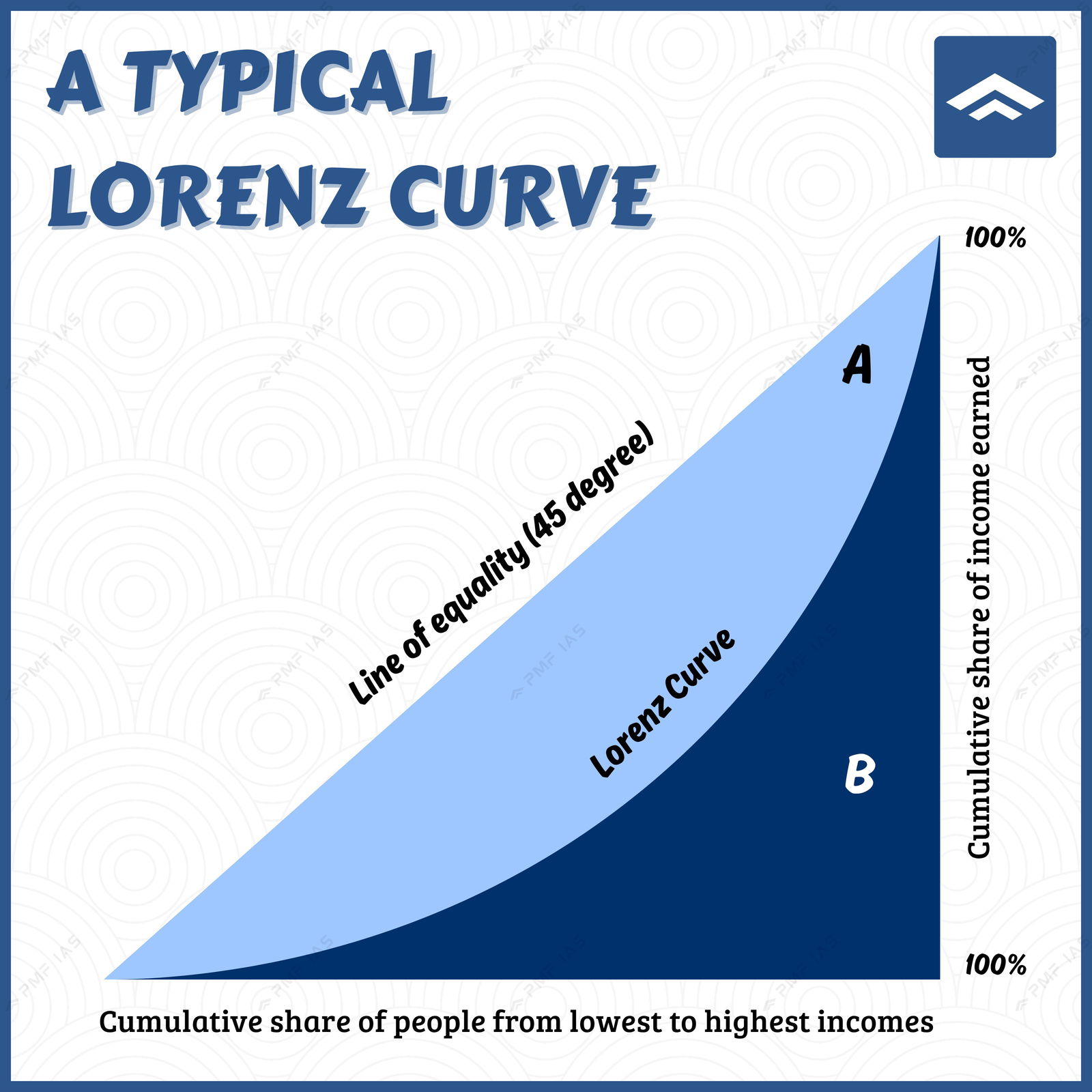
Lorenz Curve

  • The Gini index measures the area between the Lorenz curve and a hypothetical line of absolute equality, or the gap between the two, expressed as a percentage of the maximum area under the line of absolute equality.
  • The larger the gap, the more unequal the income distribution. This provides a clear number to show how income is fairly distributed.
About Lorenz Curve
  • A Lorenz curve plots the cumulative percentages of total income received against the cumulative number of recipients, starting with the poorest individual or household.
  • A diagonal line will show a perfectly equal distribution, while the Lorenz curve will show the actual distribution.

{GS2 – IR – Bilateral Relations} India-Argentina Relations

  • Context (IE): Indian PM visited Argentina, as part of five-nation tour of the ‘Global South’ outreach.

About Argentina

Argentina

  • Capital: Buenos Aires; located in southern South America.
    • Ushuaia, in Tierra del Fuego, is the world’s southernmost city.
  • Borders Chile (west), Bolivia, Paraguay, Brazil, Uruguay (north), and the Atlantic Ocean (east).
    • Argentina–Chile border is the 3rd longest international boundary worldwide.
  • Climate varies from temperate in the north to arid in the southeast and subantarctic in the southwest.
  • Geographically Diverse: Andes Mountain (west), Pampas plains (central) & Patagonia Plateau (south).
  • Major rivers like Rio de la Plata and Parana support agriculture and trade.
  • Holds 3rd largest global lithium reserves and ranks 4th in lithium production. Holds the world’s 2nd largest shale gas reserves and 4th largest shale oil reserves.

India-Argentina Relations

Historical background

  • It dates back to 1848 when an Argentine traveller, Lucio V Mansilla, visited India and described Kolkata as the ‘most beautiful city’ in the world in his travel journal.
  • In 1924, Rabindranath Tagore visited Argentina, which marked the beginning of cultural ties with music, art, yoga and philosophy. During his stay, he composed a poetry collection ‘Purabi’.
  • The last major diplomatic visit was 57 years ago by PM Indira Gandhi in 1968.
  • Last year (in 2024), both nations marked 75 years of diplomatic relations.

Key Areas of Cooperation

  • Political Relations: Elevated to Strategic partnership’ in 2019.
  • Trade: In 2024, India was Argentina’s 5th largest trading partner, with ~$5.2 billion in trade.
    • Major exports include petrochemicals, yarn and fabrics, and bulk drugs. Major imports include vegetable oils, minerals, and residual oils.
  • Energy: Argentina is part of the Lithium Triangle’ (along with Chile and Bolivia). KABIL of India is exploring 15,000 ha in Catamarca Province in the Andes region.
  • Defence: HAL has signed an agreement for Helicopter spare parts and maintenance, commitment to counter-terrorism.

{GS2 – IR – Diaspora} India Extends OCI Cards to 6th Generation Diaspora in Trinidad & Tobago

  • Context (HT): The Prime Minister recently announced that Overseas Citizenship of India (OCI) cards will now be available to 6th-generation persons of Indian origin in Trinidad and Tobago.
  • Prime Minister Narendra Modi was also conferred with ‘The Order of the Republic of Trinidad and Tobago’ – the country’s highest civilian honour during the visit.
  • This is the first Indian bilateral visit at the Prime Ministerial level to Trinidad and Tobago since 1999.

Indian Diaspora in Trinidad & Tobago

Overseas Citizen of India- OCI

  • People of Indian origin make up over 40% of the Caribbean nation’s population of 1.36 million, making it the largest concentration of Indian-origin individuals in the Caribbean.
  • Their ancestors, known as “girmitiyas”, were indentured labourers who began arriving from India in 1845, and their descendants have continued to maintain deep cultural and emotional ties with India.

Overseas Citizenship of India (OCI) Scheme

  • The OCI Scheme was introduced by amending the Citizenship Act, 1955, in 2005 and officially launched at the Pravasi Bharatiya Divas Convention in Hyderabad (2006).
  • It offers limited rights to Persons of Indian Origin (PIOs) who are now citizens of other countries.

{GS2 – IR – Groupings} Organisation for the Prohibition of Chemical Weapons

  • Context (PIB): The 23rd Regional Meeting of National Authorities of States Parties in Asia was organised by OPCW at New Delhi and hosted by the National Authority of the Chemical Weapons Convention.
  • United Nations Regional Centre for Peace and Disarmament in Asia and the Pacific (UNRCPD), along with 24 states parties attended the meet.

About Organisation for the Prohibition of Chemical Weapons (OPCW)

  • The organisation was established in 1997 as a nodal body for the effective implementation of Chemical Weapons Convention (CWC).| Headquarters: The Hague, Netherlands.
  • Functions:
    • Conduct inspections to verify that signatory states comply with the convention.
    • Conducts testing of sites and victims of suspected chemical weapons assaults.
    • Offers assistance to and safeguards States that are attacked or threatened with chemical weapons, while fostering cooperation in the peaceful utilisation of chemicals.
  • It was awarded Nobel Peace Prize in 2013 for its pivotal role in suppressing chemical weapons globally.

India & OPCW

  • India signed the CWC treaty in January 1993.
  • The Chemical Weapons Convention Act, 2000, was passed to implement the CWC.
  • It provided for the establishment of a National Authority for Chemical Weapons Convention (NACWC). It is the national authority for implementing the Convention in India.
    • Statutory body under the CWC Act, 2000. It is the Chief Liaison between the GoI and the OPCW.
    • It is an office in the Cabinet Secretariat of the GoI.
The Indian Chemical Council (ICC)
  • India’s oldest Chemical Industry Association works closely with the NACWC.
  • It is the premier national organisation under Ministry of Commerce & Industry, representing all sectors of India’s chemical industry, including organic and inorganic chemicals, plastics, and petrochemicals.
  • It was awarded the OPCW-The Hague Award 2024’, a first of its kind globally by OPCW, recognising its pivotal role in achieving the goals of the CWC.
  • UNRCPD assists countries in the region to achieve their peace, security, and disarmament goals
  • UNSC Resolution 1540 obliges all states to prevent non-State actors from accessing nuclear, chemical, or biological weapons and their delivery systems.

Chemical Weapons Convention (CWC)

  • It is a multilateral treaty banning chemical weapons and requiring their destruction.
  • It was open for signing from 1993 and became effective from 1997.
  • Members: 193 member states. Egypt, North Korea, and South Sudan have neither signed nor ratified the CWC.
  • Implementing Body: The OPCW implements CWC, which is headquartered in The Hague, with a mission to achieve a world free of chemical weapons.
  • It conducts audits of chemical facilities globally. It is more comprehensive than the 1925 Geneva Protocol.
  • It prohibits:
    • Development, production, acquisition, stockpiling, retention, transferring & use of chemical weapons.
    • Assisting other States to indulge in activities that the CWC prohibits.
    • Using riot-control devices as ‘warfare methods’.

{GS2 – Social Sector – Education} Five Years of NEP 2020

  • Context (TH): As India marks five years of NEP 2020, NIPUN Bharat is driving a quiet classroom transformation, advancing foundational literacy and numeracy as the country’s largest learning mission.

Key Features and Impact of NIPUN Bharat

  • Direct funding for quality improvement: Unlike traditional state education budgets dominated by salaries and infrastructure (80%), NIPUN earmarks resources for actual classroom quality improvements.
  • State-led customisation: States like Uttar Pradesh, Haryana, and Assam have developed teacher guides, workbooks, and lesson plans aligned with Foundational Literacy and Numeracy (FLN) goals.
  • District-level decentralisation: In 2023-24, Uttar Pradesh conducted 4 lakh+ spot assessments; Odisha’s Cluster Resource Coordinators made 57,000 classroom visits for teacher mentoring.
  • Learning Gains: Madhya Pradesh recorded a 10% point rise in oral reading fluency (2023-24). ASER 2024 reported the strongest FLN gains in 20 years, with Grade 3 proficiency up by 7% points between 2022 and 2024.

Challenges Ahead

  • Uneven Implementation: Progressive states have taken early leads, while others lag, threatening to widen regional disparities in educational quality.
  • Institutional Capacity: Many public institutions lack the human and financial resources required for structural transformation.
  • Need for Political Will: Sustained reform requires bipartisan support, consistent funding, and depoliticised discourse around language, curriculum, and school governance.
  • Teacher Workload and Training Gaps: Despite training modules, many teachers face excessive administrative burden and limited time for professional development.

Way Forward

  • Extend the Mission Timeline: Extend NIPUN Bharat beyond 2027 to build continuity and deepen impact. With nearly 100% fund utilisation, there is clear state-level ownership and demand.
  • Expand the Coverage: Cover the entire foundational stage, from Balvatika (age 5) to Grade 5. A year-long Balvatika in schools will help prepare children for formal education, while continued support till Grade 5 will reinforce learning gains.
  • Strengthen District FLN Units: Institutionalise district-level FLN cells for monitoring, mentoring, and data-based reviews. These units are the critical link between state design and classroom execution.
  • Institutionalise Annual FLN Diagnostics: Conduct regular system-level assessments like the Foundational Learning Study (2022) to identify learning gaps and inform targeted interventions.
  • Build Ownership: Engage local leaders, panchayats, and parents in “NIPUN Gram Sabhas”, milestone celebrations, and at-home learning support.

{GS2 – Social Sector – Health} 3 by 35 Initiative by WHO

  • Context (BS): The WHO launched the 3 by 35 Initiative to increase the prices of tobacco, alcohol, and sugary drinks by 50% by 2035 through health taxes to reduce non-communicable diseases (NCDs).
  • Tobacco, alcohol, and sugary drinks account for ~25% of global NCD-related deaths.
  • It aims to prevent 50 million early deaths and raise $1 trillion in new revenue by 2035.
  • The initiative advances SDG 3.4 by reducing avoidable deaths from NCDs by one-third.

About Health Tax

  • A health tax is an excise duty on products posing high public health risks, such as tobacco and alcohol.
    • These act as price-based disincentives that reduce demand for harmful lifestyle products.
  • WHO’s Global Action Plan for NCDs (2013–2030) declared health taxes as a “best buy” fiscal tool.

Rationale for Health Taxation

  • Consumption Fall: Health taxes lead to measurable declines in the use of tobacco, alcohol.
  • Revenue Stream: They ensure stable public financing, especially in low-income countries.
  • Pro-Poor Impact: Low-income groups benefit through fewer illnesses and reduced healthcare costs.
  • System Savings: Fewer NCDs reduce the burden on hospitals and public subsidies.
  • Product Change: Health taxes drive product reformulation to reduce tax liability.

Challenges for Health Taxes

  • Equity Risk: Health taxes may disproportionately impact low-income consumers.
  • Smuggling Threat: Weak enforcement can lead to an increase in black-market trade of taxed products.
  • Industry Pushback: Industries oppose taxes through lobbying and legal action.
  • Job Disruption: Job losses may occur in informal sectors without safety nets.
  • Capacity Gaps: Weak tax systems, poor tracking, and fragmented regulations hinder enforcement.

India’s Health Tax Landscape

  • India’s health tax system combines GST and excise duties across products, but lacks uniformity, public health focus, and effective enforcement.
  • Aerated Drinks: Carbonated drinks face ~40% GST, with a weak deterrent effect.
  • HFSS Foods: No specific tax exists for high-fat, salt, and sugar (HFSS) processed foods.
  • Cigarettes: Cigarettes face around 60% total tax via GST, NCCD, and state-level duties. Bidis and smokeless tobaccos are under-taxed despite high use by low-income groups.
  • Alcohol: State excise duties vary; alcohol is excluded from GST.
  • The National Calamity Contingent Duty is an additional excise on products like cigarettes to fund disaster and health-related spending.

Key Issues in India’s Health Taxes

  • Revenue Focus: Current taxes prioritise revenue over health goals.
  • Tobacco Disparity: Tax gaps between cigarettes and bidis weaken equity and effectiveness.
  • Informal Evasion: Informal markets bypass tax nets due to a lack of monitoring and registration.
  • Manufacturer Exemptions: Small firms often receive tax relief, which can dilute the health objective.
  • No Earmarking: Not earmarking revenue for disease prevention or treatment reduces impact.

{GS2 – Vulnerable Sections – Elderly} National Biobank

  • Context (PIB): India’s first National Biobank and Longitudinal Population Study was inaugurated at CSIR-Institute of Genomics and Integrative Biology (IGIB), New Delhi.
  • It forms the core data platform of the Phenome India project.
  • It is a central repository of high-quality genomic, clinical, and lifestyle data reflecting India’s vast ethnic and geographic diversity.
  • Objectives:
    • To monitor people’s health over time, enabling personalised treatment.
    • To support the development of AI-based tools and CRISPR-powered therapeutic solutions.
    • To strengthen studies on rare diseases, cancer, and cardiovascular conditions.
  • The Phenome India project, a long-term health study by the Ministry of Science and Technology, tracks 10,000 people across India to study how genes, lifestyle, and environment affect health.
  • A Longitudinal Population Study tracks the health and lifestyle data of the same group of people over many years to observe how diseases develop, progress, and respond to treatment.
  • CSIR–IGIB is a premier institute under CSIR specialising in genomics, molecular medicine, and bioinformatics, with key contributions to healthcare research and diagnostic innovation.

{GS3 – Envi – Conservation} Green Climate Fund

  • Context (BL): The Green Climate Fund (GCF) has approved $200 million for the India Green Finance Facility (IGFF), marking the Asian Development Bank’s (ADB) first partnership with GCF in India.
  • It promotes climate investments in developing clean energy technologies through concessional funding.
  • Focus Areas: It covers solar parks, battery storage, electric mobility, and resilient agriculture.
  • IGFF: It is a climate finance program launched jointly by ADB and GCF to support the country’s transition to low-carbon, climate-resilient infrastructure.

Green Climate Fund (GCF)

  • GCF is the world’s largest dedicated climate fund and an operating entity under the UNFCCC financial mechanism. It was set up in 2010 and is headquartered in Incheon, Republic of Korea.
  • It helps countries implement their Nationally Determined Contributions (NDCs) under Paris Agreement.
  • Governance: It operates under the GCF Board and reports to the Conference of the Parties (COP),

Asian Development Bank (ADB)

  • ADB was established in 1966 as a regional development bank to promote prosperity, inclusiveness, resilience, and sustainability in Asia and the Pacific.
  • India is a founding member of ADB and its fourth-largest shareholder.

{GS3 – IE – Trade} Invisibles Surpassing Visibles in India’s Export

  • Context (IE): Since 2019-20, India’s invisible exports have consistently surpassed visible exports (except in 2021-22), with invisibles being about 30.5% higher than visibles in 2024-25.
  • Visible trade refers to tangible goods such as petroleum, machinery, and textiles, while invisible trade includes intangible flows like services, remittances, and income transfers.
  • FY 2024–25: India’s exports were ~$441 billion, with a 1.7% global market share. Petroleum (18%), gems & jewellery, and chemicals were the leading sectors in visible exports.
    • China’s exports are ~$3.4 trillion with a 5.5% CAGR since 2020-21, while India’s are $441.8 billion at 8.3%, reflecting higher growth from a smaller base.
  • 2003–2014 Growth: Goods exports increased from ~$66 billion to ~$318 billion at a ~17% CAGR, driven by globalization and commodity demand.
    • Post-COVID, exports grew at 8.3% CAGR due to global demand rebound and PLI schemes.

India's trade status

Credits: IE

Trend in Invisible Trade

  • FY 2024–25: India’s invisible receipts hit ~$576 billion, ~4.6% of global invisible trade. Software services (44%), private transfers, and financial services were top contributors.
    • China’s services exports are ~$400 billion, with a 6.8% CAGR since 2020-21, while India’s invisibles hit ~$576 billion with an 11% CAGR, showing stronger growth and a higher final value.
  • 2003–2014 Expansion: Invisibles rose from $53 billion to $233 billion, a 15.9% CAGR, driven by outsourcing and labour migration.
    • Post-COVID, Invisibles reached $576 billion with an 11% CAGR, driven by digitisation, remote services, and diaspora inflows.

Reasons for Invisible Exports Surpassing Visibles

  • Digital Growth: India’s IT and BPO sectors provide scalable, quality digital services at competitive costs.
  • Remittance Base: Skilled and semi-skilled migration to Gulf, US, and UK sustains private transfer inflows.
  • Trade Immunity: Invisibles are immune to freight shocks, tariffs, and supply chain disruptions.

Reasons Why Visible Exports Lag Behind

  • Low-Tech: Merchandise exports primarily originate from low-resource sectors that add little value.
  • Infrastructure Gaps: Goods exports suffer from high logistics costs, port delays, and compliance issues.
  • Geopolitical Risk: Visible exports are susceptible to fluctuations in oil prices and trade restrictions.

{GS3 – Infra – Energy} Natural Gas Pipeline Tariff Regulations, 2025

  • Context (IE): The Petroleum and Natural Gas Regulatory Board (PNGRB) has approved the Second Amendment to the Natural Gas Pipeline Tariff Regulations, 2025.
  • Anchored in the vision of ‘One Nation, One Grid, One Tariff,’ this regulatory reform aligns with PNGRB’s strategy to simplify the gas market, promote cleaner fuels, and foster an inclusive, gas-based economy.”

Key Reforms

  • Streamlined Tariff Zones: The PNGRB has reduced the number of Unified Tariff Zones from three to two, simplifying the natural gas transportation system nationwide.
  • CNG & PNG (Domestic) Boost: The benefit of the Unified Zonal Tariff of Zone 1 has been extended nationwide to Compressed Natural Gas (CNG) and Piped Natural Gas (PNG) Domestic segments.
  • Efficient Fuel Procurement Mandate: It has mandated pipeline operators to procure at least 75% of their annual system-use gas through long-term contracts (minimum three-year tenure).
    • This will lower procurement risks, reduce transaction costs, and ultimately result in more predictable and aƯordable tariffs for consumers and investors alike.
  • Pipeline Development Reserve: To fund future expansion, PNGRB has introduced a dedicated Pipeline Development Reserve, utilising earnings from pipeline entities that exceed 75% utilisation benchmarks.
    • 50% of these net-of-tax earnings will be reinvested in infrastructure development, while the remaining 50% will be passed on to consumers through tariff adjustments, creating a performance-linked, self-sustaining model for growth.

Petroleum and Natural Gas Regulatory Board (PNGRB)

  • The PNGRB was constituted under the ‘Petroleum and Natural Gas Regulatory Board Act, 2006’.
  • Headquarters: New Delhi, India.
  • Role: Its core mandate is to ensure a fair, competitive, and transparent market for natural gas and petroleum products.
  • Appeals against PNGRB decisions are heard by the Appellate Tribunal for Electricity, established under the Electricity Act, 2003.

Functions

  • It authorises the construction & operation of natural gas pipelines and city gas distribution networks.
  • It regulates tariffs for the transportation of petroleum and natural gas through pipelines.
  • PNGRB facilitates open access to pipeline infrastructure on a non-discriminatory basis.
  • It promotes competition and market development in the natural gas and petroleum sector.
  • It protects consumer interests by ensuring fair trade practices.
  • PNGRB monitors and enforces technical and safety standards for gas infrastructure.
  • PNGRB resolves disputes between entities operating in the petroleum and natural gas sector.

{Prelims – In News} HAM Radio

  • Context (IE): Indian astronaut Shubhanshu Shukla communicated with students using HAM radio from the International Space Station (ISS), marking a space-to-Earth amateur radio contact.

About HAM Radio

  • HAM radio is a licensed, non-commercial service enabling real-time two-way radio communication.
  • It requires a transceiver, frequency-matched antenna, and regulated power for stable transmission.
  • It supports voice, Morse code, text, images, and data transfer across assigned radio frequencies.
  • Call Sign: Operators must announce a unique call sign every 10 minutes and at the end of each session to avoid interference.
  • Frequency Allocation: Bands are assigned across the radio spectrum by national authorities under guidelines from the International Telecommunication Union (ITU).
    • HAM radio operates from 1.8 MHz to 3000 MHz, covering Medium to Ultra High Frequency bands.
    • The signals range from local to intercontinental and space-based communication.
  • It enables low-cost, infrastructure-free communication during network failures or disasters.
  • Power Regulation: Transmission power is limited by authorities to prevent interference and maintain spectrum discipline.

HAM Radio in India

  • Legal Basis: It is governed by the Indian Wireless Telegraphs (Amateur Service) Rules, 1978, under the Indian Telegraph Act.
  • Licensing Authority: Amateur radio licenses are issued by the Wireless Planning and Coordination (WPC) Wing under the Ministry of Communications.

HAM Radio in Space

  • In 1983, astronaut Owen Garriott made the first HAM radio contact from the shuttle STS-9.
  • Amateur Radio on the ISS (ARISS) is a joint effort by space agencies allowing enthusiasts to communicate directly with astronauts.
  • The ISS uses VHF and UHF waves for HAM radio, which travel in straight lines and can’t bend around Earth’s curvature, making line-of-sight essential.

Never Miss an Update!

Leave a Reply

Your email address will not be published. Required fields are marked *