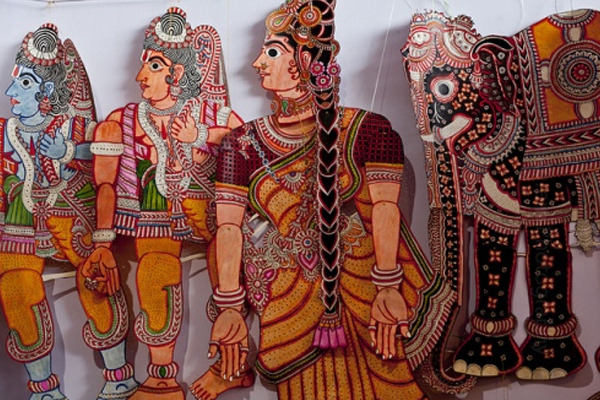
- Context (TH): Several traditional folk art forms of Andhra Pradesh are on the verge of extinction.

(Tholu Bommalata, Tappeta Gullu, Puli Veshalu, Harikatha, Jamukula Pata)
Credit: AP, auchitya, TH, TH, Resorcio
Key Folk Arts at Risk
- Tholu Bommalata: Ancient shadow puppetry art, dating back to the 3rd century CE. Uses translucent leather puppets, backlit by oil lamps to narrate epics like the Ramayana and Mahabharata.
- Traditionally performed overnight by itinerant artists, accompanied by music and narration.
- Jamukula Pata (Bonela Pata): A folk performance prevalent in northern districts like Vizianagaram and Srikakulam. Featuring a trio of artists—a lead singer and two chorus members—it has been a vital medium for storytelling and oral knowledge among marginalized communities.
- Tappeta Gullu: A devotional dance performed by shepherd communities to invoke rain and appease local deities such as Gangamma.
- Dancers wear ankle bells and play drums strapped to their chests while performing rhythmic movements to folk devotional songs.
- Puli Veshalu: A vibrant tiger dance linked to the Dasara festival in Vizianagaram, symbolizing valour and devotion. Performers paint their bodies and perform coordinated dances.
- Harikatha: A composite narrative art combining music, dance, storytelling, and spiritual discourse. This tradition has deep roots in Vizianagaram and was popularized by legends like Ajjada Adibhatla Narayana Dasu (1864–1945).
- Chekka Bhajana: A rhythmic devotional folk dance involving wooden clappers (chekkalu). Performed in groups with synchronized chanting and movements, it is integral to festivals and religious processions.
- Gangireddu Aata: A lively street performance featuring decorated bulls trained to “dance” to the sound of the nadaswaram (wind instrument), often performed during Sankranti and village fairs.
- Dasarulu: A folk theatre form that dramatizes mythological stories from the Ramayana and Mahabharata, commonly enacted during Dasara festivals.
- Samu Garadi: A martial dance with acrobatic and combat-style movements, celebrated in tribal and rural areas to showcase valour and honour local deities.
- Karrasamu: A stylized stick-fighting dance symbolizing the triumph of good over evil, performed with choreographed duels accompanied by traditional music.
- Yakshaganam: Andhra’s version of the Yakshagana dance-drama, performed in Telugu with elaborate costumes and narratives from epics and puranas.
Reasons for Decline
- Lack of patronage from both society and government.
- Minimal performance opportunities—only 3–4 events annually.
- Declining interest among youth due to changing cultural preferences.
- Inadequate financial support and welfare schemes for veteran artists.
Central Government Initiatives
- Kala Sanskriti Vikas Yojana: Supports folk art festivals, artist welfare under Ministry of Culture.
- Guru-Shishya Parampara Scheme: Financial support to master artists to train disciples.
- Scholarship Scheme for Young Artists: Offers scholarships to youth aged 18–25 to train in traditional and folk art disciplines.
- Zonal Cultural Centres (ZCCs): Regional centres organise festivals, camps, training for traditional arts.
- National Mission on Cultural Mapping: Documents art forms across India for targeted support.
- Ek Bharat Shreshtha Bharat: Encourages state-to-state cultural exchanges and folk art promotion.
- Sangeet Natak Akademi Awards & Fellowships: Recognises outstanding artists and supports folk arts revival through grants.
- Scheme for Safeguarding Intangible Cultural Heritage: Supports documentation and preservation of disappearing folk practices.
|
{GS2 – Governance – Initiatives} e-Zero FIR
- Context (PIB | IE): e-Zero FIR is launched as a pilot initiative in Delhi by the Indian Cybercrime Coordination Centre (I4C) to streamline FIR registration for high-value cyber financial crimes.
What is the e-Zero FIR Initiative?
- A digital system launched by the Indian Cybercrime Coordination Centre (I4C) under the Ministry of Home Affairs (MHA), that automatically registers FIRs for cyber frauds above ₹10 lakh reported via 1930 helpline or NCRP.
- Aims to enable quick recovery of defrauded funds and strengthen trust in cybercrime redressal.
- Legally backed by Sections 173(1) and 1(ii) of the Bhartiya Nagarik Suraksha Sanhita (BNSS).
- Based on the Zero FIR concept, allowing complaints to be filed at any police station, irrespective of jurisdiction.
- Supports the goal of building a ‘Cyber Secure Bharat’ under the national cybersecurity framework.
- Integrates NCRP, Delhi Police’s e-FIR System, and NCRB’s CCTNS for real-time case processing and seamless data sharing.
- Zero FIR, introduced post-Nirbhaya (2012) as a victim-centric reform, enables complaint registration at any police station regardless of jurisdiction, ensuring swift legal action removing delays due to territorial boundaries.
|
How the System Operates
- Victims report financial cyber fraud (above ₹10 lakh) via 1930 helpline or NCRP.
- Complaint automatically triggers a Zero FIR at Delhi’s e-Crime Police Station.
- The FIR is then electronically routed to the appropriate territorial cybercrime police station, based on the victim’s location.
- Victims must visit concerned police station within 3 days to convert the Zero FIR into a regular FIR.
- The system ensures timely action and jurisdiction-free complaint registration.
{GS2 – MoCI – Initiatives} Government e-Marketplace (GeM)
- Context (PIB): GeM recently celebrated its 8th Incorporation Day, marking significant strides in inclusive economic growth and digital transformation in public procurement.
About GeM
- Launched in 2016 by the Ministry of Commerce and Industry as a 100% GoI-owned digital e-commerce portal for mandatory public procurement.
- Purpose and Vision: Aims to create a transparent, efficient, inclusive, and faceless procurement ecosystem, replacing the Directorate General of Supplies and Disposals (DGS&D).
- Coverage: Adopted by all 36 States and UTs, with over 1.64 lakh government buyers and 4.2 lakh active sellers. Uttar Pradesh leads in usage.
- Product and Service Offering: Hosts over 10,000 product categories and 330+ services, facilitating both simple and complex procurements including defence, healthcare, and aviation.
- Key Policy Mandates: Mandatory for all ministries since 2017; sellers must declare Country of Origin to promote Aatmanirbhar Bharat and Make in India.
- Advanced Functionalities: Features automated rule-based MSE provision enforcement, real-time fraud detection & GeMAI (India’s first Generative AI chatbot supporting 10 Indian languages via voice & text).
- Advantages (Reduced Costs and Ease of Use): 97% of transactions are charge-free; Fees reduced by 33-96% and capped; 60% cut in caution money for sellers with turnover below ₹1 crore; Dedicated storefronts and bid information transparency.
- Massive Scale & Savings: Facilitated ₹13.4 lakh crore+ in transactions with ~10% cost savings (World Bank, Economic Survey).
- Inclusive & Diverse Seller Base: Onboarded 10 lakh+ MSEs, 1.3 lakh artisans/weavers, 1.84 lakh women entrepreneurs, and 31,000 startups.
- Empowering Marginalized Groups: Boosts SC/ST MSMEs, showcases SHG products via SARAS Collection, and enhances visibility through Startup Runway and Womaniya storefronts.
- Exceeding Inclusion Targets: Achieved 38% procurement from MSEs (vs 25% target) and ~4% from women-led businesses (vs 3% target).
- Strategic Reach & Expansion: Enabled major procurements (Akash Missile ₹5,000 cr, Vaccines ₹5,085 cr), Integrated Financial Management System in key states, and is poised to become the world’s largest public procurement portal.
{GS2 – MoHI – Schemes} PM E-DRIVE Scheme *
- Context (PIB | IE | TH): Karnataka requested electric buses under the PM E-Drive initiative.
- PM Electric Drive Revolution in Innovative Vehicle Enhancement, launched in 2024, is a ₹10,900 crore Centrally Sponsored Scheme for 2024–2026 under Ministry of Heavy Industries (MoHI) to promote clean, sustainable urban transport.
- Key Objectives:
- Expedite EV adoption across 2W, 3W, 4W, e-buses, trucks & ambulances.
- Reduce upfront EV cost for users and support EV ecosystem growth.
- Nationwide public EV charging infrastructure & improve air quality by reducing transport emissions.
- Promote domestic manufacturing and technological advancement in EVs.
- Builds On FAME-I (2015), FAME-II (2019), Electric Mobility Promotion Scheme 2024 (EMPS-2024).
- Demand incentives worth ₹3,679 crore will be provided for consumers (buyers/end users) for purchasing e-2Ws, e-3Ws, e-buses, e-trucks and e-ambulances via Aadhaar-authenticated e-vouchers, capped at 15% of ex-factory price.
- Subsidy rates for e-2W and e-3W are set at ₹5,000/kWh in FY 2024–25 and ₹2,500/kWh in FY 2025–26, directly reimbursed to original equipment manufacturer (OEM).
- 14,028 electric buses will be deployed in 9 major cities by 2026 through State/ city transport undertakings (STUs) under Gross Cost Contract/OPEX model, with vehicles priced below ₹2 crore eligible.
- Charging infrastructure support of ₹2,000 crore will enable installation of public charging stations (EVPCS) across 9 high EV penetration cities and key highways, following MoP’s 2024 guidelines.
- Electric ambulance deployment (₹500 crore) will include electric, plug-in hybrid, and strong hybrid types, aligned with performance standards set with MoHFW and MoRTH.
- Incentives for e-trucks (₹500 crore) require valid scrapping certificates from MoRTH-authorised facilities to promote clean freight transport.
- Capital support will fund EV public charging stations, procurement of e-buses and upgradation of vehicle testing infrastructure to ensure quality and safety compliance.
- Gross Cost Contract (GCC) model: The government pays a fixed amount to the operator to run and maintain electric buses, regardless of fare revenue collected.
- OPEX model: Focuses on covering the operating expenses of running electric buses, ensuring service sustainability without relying solely on ticket sales.
|
Complementary Measures & Policy Synergy
- PLI Scheme Compatibility: Incentives under PM E-DRIVE are in addition to those under PLI-Auto and PLI-ACC (Advanced Chemistry Cell).
- PM-eBus Sewa & PSM: Linked Payment Security Mechanism ensures smoother procurement and operation of e-buses by Public Transport Authorities.
- Technology Platform for Electric Mobility (TPEM): Facilitates R&D and innovation in the EV ecosystem under the Ministry of Science & Technology.
- State Incentives Encouraged: Road tax exemptions, toll waivers, parking fee rebates, etc.
- GST Reduction: GST on EVs lowered from 12% to 5% to boost affordability.
{GS2 – Polity – Laws} Espionage: Jyoti Rani Case
- Context (IE | BS | LM): YouTuber Jyoti was arrested for allegedly leaking sensitive information to a Pakistan High Commission official.
- She faces charges under Sec. 3, 4 & 5 of the Official Secrets Act, 1923 & Sec. 52 of the Bharatiya Nyaya Sanhita (BNS), 2023.
Official Secrets Act, 1923
- Historical Background: Enacted in 1923 during British rule, based on the British Official Secrets Act 1911, to suppress dissent and control sensitive information.
- Objective: Protects the sovereignty, defence, intelligence infrastructure and national security of India by penalising espionage, unauthorised communication or possession of classified data.
- Applicability & Coverage: Applies to government officials, civilians and foreign nationals; covers codes, passwords, maps, sketches and any intelligence that could harm India or help its enemies.
- Wide Interpretation: Any action that may prejudice national safety or aid an enemy is considered an offence.
- Key Penal Provisions:
- Section 3 (Spying for the enemy): Targets unauthorised access to defence sites or data; punishment up to 14 years (defence-related), otherwise up to 3 years.
- Section 4 (Communication with foreign agents): Presumes guilt if in contact with suspected agents without valid reason; punishment up to 14 years (defence-related), otherwise up to 3 years.
- Section 5 (Wrongful communication): Penalises both intentional and negligent disclosure or handling of secrets; punishment up to 3 years or fine or both.
- Other Provisions:
- Section 6: Penalises wearing unauthorised uniforms.
- Section 9: Attempt or abetment is punishable as the main offence.
- Search and Seizure: Authorities may conduct raids and seize documents without public disclosure in national interest.
Section 152 of Bharatiya Nyaya Sanhita, 2023 (Secession and Subversion)
- Criminalises acts that threaten India’s sovereignty and integrity through speech, writing, media or financial means.
- Targets promotion or incitement of secession, rebellion or separatism via electronic or visible methods.
- Punishable by life imprisonment or up to 7 years of imprisonment and a fine.
- Focuses on protecting national unity and internal security from subversive activities.
- Exempts peaceful criticism of the government aimed at lawful reform from punishment.
{GS2 – Social Sector – Education} Mizoram Achieves Full Functional Literacy
- Context (PIB): Mizoram became the first state in India to be officially declared fully functionally literate under the ULLAS – Nav Bharat Saksharta Karyakram (NILP).
- It’s literacy rate has reached 98.2%, surpassing the 95% benchmark considered as full functional literacy.
About Functional Literacy
- Refers to the ability to apply reading, writing, and arithmetic skills in day-to-day life helping individuals participate fully in society and the economy. This includes:
- Reading signs, instructions, and official documents.
- Writing applications or filling forms.
- Performing simple calculations for money, time, and measurements.
- Engaging with digital tools, public services, and workplaces effectively.
- Basic literacy is about learning the skills like how to read, write, and do basic arithmetic , while functional literacy is about using them in real life.
|
About ULLAS – Nav Bharat Saksharta Karyakram (NILP)
- A centrally sponsored scheme launched by the Ministry of Education (2022–2027).
- Aims to educate adults aged 15 years and above who missed formal schooling.
- Based on the spirit of Kartavya Bodh (sense of duty) and Jan Jan Saakshar Bharat (Every Citizen Literate).
- Aligned with the National Education Policy (NEP) 2020.
- Five Key Components:
- Foundational Literacy and Numeracy: Reading, writing, and arithmetic.
- Critical Life Skills: Digital, financial, legal, environmental, and health literacy.
- Basic Education: Equivalence to Classes 3, 5, and 8.
- Vocational Skills: Job-oriented skill training.
- Continuing Education: Lifelong learning through libraries, reading clubs, etc.
Implementation and Impact
- Operates through the ULLAS Mobile App for registration, e-content, and assessments.
- Encourages volunteerism—students, teachers, and NGOs act as educators.
- Over 2.37 crore learners and 40.84 lakh volunteers have been registered.
- Around 1.77 crore neo-literates have appeared for the national Foundational Literacy and Numeracy Assessment Test (FLNAT).
- Ladakh became the first Union Territory to achieve full functional literacy in 2024.
Also Read > National Education Policy 2020.
{GS2 – Social Sector – Health – Diseases} JN.1 Covid Variant
- Context (ET): A new COVID-19 variant, JN.1, is causing a surge in cases across Southeast Asia.
Key Features of JN.1 Covid Variant
- Origin: Sub-lineage of Omicron BA.2.86 (‘Pirola’), first identified in August 2023 and classified as a Variant of Interest (VOI) by the WHO in December 2023.
- Mutations: It contains about 30 spike protein mutations, enhancing its ability to evade vaccine- or infection-induced immunity.
- Spread: Initially found in Europe and the US, now causing case surges in Asia (Singapore, Hong Kong, China, Thailand).
- Transmissibility: More contagious than its parent lineage (BA.2.86).
- Immune Escape: Higher resistance to neutralizing antibodies; vaccinated individuals can be infected.
- Unusual Seasonality: Spreading during summer months, unlike typical respiratory viruses.
- Symptoms: Similar to earlier Omicron subvariants – sore throat, fatigue, dry cough, mild breathlessness. Severe cases mostly occur in elderly or immunocompromised individuals.
- Public Health Concern: With waning immunity and declining vaccination coverage, there’s potential for localized outbreaks despite endemic status.
About Omicron
- Variant of Concern (VOC) by WHO. First reported in South Africa in 2021, later spread globally.
- Characterized by extensive spike protein mutations linked to higher transmissibility.
|
- Variants of Concern (VOC) are variants with increased transmissibility, severity, or immune escape, such as Omicron, Delta, Gamma, Beta, Alpha. Variants of Interest (VOI) are variants with genetic changes that may affect transmission, treatment, or diagnosis but lack strong global impact (yet), such as Mu, and Lambda.
|
Also Read > Coronavirus, Coronavirus Disease 2019 (COVID-19 or 2019-nCoV).
{GS3 – S&T – Defence} Kinetic and Non-kinetic Warfare
- Context (ITN): India used kinetic and non-kinetic means to destroy intruding Pakistan drones.
|
Kinetic Methods
|
Non-kinetic Methods
|
- Kinetic warfare involves using physical force or traditional weapons to destroy or neutralise the enemy. It includes lethal and destructive means.
- It is different from soft forces of warfare, which involve cyberwarfare, diplomacy, lawfare, sanctions, information warfare, and others.
- Hard kill: Results into hard kill i.e., physically destroying or neutralizing an incoming threat (such as a missile, aircraft, or drone).
|
- Non-kinetic warfare refers to methods that are different from traditional military force or physical destruction.
- It involves tactics like cyberattacks, electronic warfare, and information manipulation.
- It may also involve non-military actors, which can be instrumental in hitting critical infrastructure, including communication networks, power grids, and financial systems.
- Soft Kill: Non-kinetic results into soft kill i.e., disrupting or deceiving the threat without destroying it
|
{GS3 – S&T – Space} Chandrayaan-5 Mission
- Context (IE): ISRO and Japan Aerospace Exploration Agency (JAXA) jointly conducted the 3rd Technical Interface Meeting (TIM-3), towards the Chandrayaan-5.
Key Features
- Also known as LUPEX (Lunar Polar Exploration), it is a joint project between ISRO and JAXA.
- Objective: To study water and water-ice on the lunar and subsurface.
- Components: The Mission would send an uncrewed lunar lander and rover to explore the south pole region of the Moon no earlier than 2028.
- ISRO is developing Chandrayaan-5’s lander, whereas JAXA is building the 350-kg rover. Weighing 6.5 tonnes, it is proposed to lift off on a Japanese rocket, H3, sometime in 2027-28.
- Scientific Instruments: The seven scientific instruments for this Mission will be contributed by ISRO, JAXA, European Space Agency (ESA), and NASA.
- ESA is developing the mass spectrometer, and NASA is developing the neutron spectrometers; both are currently in the design phase.
- One of the seven instruments will be large and shall have four sensors; one being developed by ISRO and the other by JAXA.
ISRO’s Chandrayaan Mission
- Chandrayaan-1 Mission: Successfully launched in 2008, it took chemical, mineralogical, and photo-geologic mapping of the Moon.
- Chandrayaan-2 Mission (2019): It was 98% successful, but just two per cent of the Mission could not be achieved in the final stages.
- Chandrayaan-3: A follow-on mission to Chandrayaan-2 demonstrated the ISRO’s end-to-end capability to land and rove on the lunar surface safely. In August 2023, ISRO executed a successful ‘soft-landing‘ of Chandrayaan-3 on the South Pole of the Moon.
- India is only the 5th nation to achieve a successful soft-landing (joining the US, Russia, China and Japan) on the lunar surface and the 1st to do so on its South Pole.
- Chandrayaan-4 Mission: Forthcoming Mission. It is India’s 1st lunar sample return mission.
Read More> Chandrayaan Mission.
{GS3 – S&T – Space} GRAIL Mission
- Context (DDN | ET): GRAIL (Gravity Recovery and Interior Laboratory) mission has provided the most detailed gravity map of Moon, revealing insights into its asymmetric interior & surface differences.
- Launched in 2011 under NASA’s Discovery Program; included twin spacecraft named Ebb and Flow.
- Objective: Measure lunar gravity to understand the Moon’s internal structure & geological evolution.
Key Scientific Findings
- Lunar Asymmetry: The Moon’s nearside (facing Earth) is structurally different from its farside, showing clear contrasts in heat, geology and crustal features.
- Asymmetry in internal mantle correlates with surface topography & crustal thickness variations.
- Tidal Deformation: Earth’s gravity causes more flexing on the nearside, indicating differences in mantle composition and structure.
- Thermal Variance: Nearside mantle is estimated to be 100-200°C hotter than the farside, likely due to radioactive decay of thorium and titanium.
- Intense ancient vulcanism on nearside led to heat-producing elements accumulating in that region.
- Geological Features: Nearside is dominated by mare, vast, flat plains formed from cooled volcanic basalt, whereas farside is rugged terrain with fewer mare and more highlands.
- Mare Basalts Evidence: 3-4 billion-year-old volcanic rocks suggest persistent geological activity linked to mantle composition.
Significance and Scientific Potential
- Comparative Planetology: Gravity-mapping techniques from GRAIL can be applied to moons like Enceladus (Saturn) and Ganymede (Jupiter) to study subsurface structures and habitability.
Impact on Future Lunar Exploration
- Lunar Navigation Framework: Gravity map contributes to building precise Positioning, Navigation and Timing (PNT) systems for safer lunar missions.
- Lunar Reference Frame: Supports development of a consistent time and location system essential for future robotic and human lunar operations.
{Prelims – Awards} Banu Mushtaq Wins International Booker 2025
- Context (TH | TH): Banu Mushtaq’s Heart Lamp, translated by Deepa Bhasthi, became the first Kannada work to win International Booker Prize, marking a historic milestone for Indian regional literature.
About the International Booker Prize
- In 2019, the Man Booker International Prize was renamed the International Booker Prize.
- The International Booker Prize is awarded annually for a single fiction book translated into English and published in the UK or Ireland.
- It was originally a biennial prize, began in 2005 as the Man Booker International Prize.
- After 2015, it expanded to allow living writers of any nationality to enter and was made annual.
- Novels and collections of short stories are both eligible.
- Recognizes both author and translator; prize money of £50,000 split equally.
How is the Booker Prize different?
- The Booker Prize was first awarded in 1969. The inaugural Booker Prize was awarded to P.H. Newby for his novel “Something to Answer For”.
- Founders: Tom Maschler and Graham C Greene.
- Awarded for fiction written in English (not translated) and published in the UK and Ireland.
- Until 2014, only novels written by Commonwealth, Irish, and South African citizens were eligible to receive the prize. Later, it was expanded to all nationalities.
- The winner of the Booker Prize 2023 is Prophet Song by Paul Lynch.
- Important winners: 1st Indian origin winner – VS Naipaul, 1st Indian citizen winner – Arundhati Roy.
{Prelims – PIN World – SA} Argentina’s Perito Moreno Glacier
- Context (IE): Argentina’s iconic Perito Moreno Glacier, once unusually stable, has now begun retreating rapidly since 2020 due to climate change.
Perito Moreno Glacier
- Located in Los Glaciares National Park, Santa Cruz Province, near El Calafate, Argentina, it covers ~250 sq km, stretches over 30 km, and rises 60 m above lake level.
- Formed around 18,000 years ago during the last Ice Age; nicknamed the ‘White Giant’.
- Declared a UNESCO World Heritage Site in 1981 for its glacial and ecological importance.
- Known for dramatic ice calving events since 1917, a key global tourist draws.
- Ice calving is the natural process where large chunks of ice break off from the edge of a glacier and fall into the water body, often creating dramatic waves and sounds. It is a keyway glaciers lose mass and reshape their structure over time.
|
About Argentina
- Capital: Buenos Aires; located in southern South America.
- Ushuaia, in Tierra del Fuego, is the world’s southernmost city.
- Borders Chile (west), Bolivia, Paraguay, Brazil, Uruguay (north), and the Atlantic Ocean (east).
- Argentina–Chile border is the 3rd longest international boundary worldwide.
- Climate varies from temperate in the north to arid in the southeast and subantarctic in the southwest.
- Geographically Diverse: Andes Mountain (west), Pampas plains (central) & Patagonia Plateau (south).
- Holds 3rd largest global lithium reserves and ranks 4th in lithium production.
- Major rivers like Rio de la Plata and Parana support agriculture and trade.

{Species-Insects-LC} Euthalia malaccana
- Context (TH): Euthalia malaccana, a butterfly previously known only from Southeast Asia, has been recorded for the first time in Basar, Leparada district of Arunachal Pradesh.

Credit: TH
About Euthalia malaccana
- Common name: Fruhstorfer’s Baron.
- Family: Nymphalidae (Brush-footed butterflies).
- Genus: Euthalia (commonly called barons or dukes with large, broad-winged butterflies).
- Distribution: Found in the Indo-Australian region, primarily in Southeast Asia, with earlier records from northern Thailand, the Malay Peninsula, and the Sunda Islands.
- Habitat: Prefers tropical and sub-tropical forested regions at mid-elevations.
- Conservation Status: IUCN Status: Least Concern, CITES: Not listed
- Identification Features:
- Males: Forewings with a prominent blue apical spot.
- Females: Display larger apical spots.
- Hindwings: Characterised by reduced red spots.
- These features distinguish it from related species like Euthalia lubentina.