Current Affairs – May 20, 2025
★ Up to 80% OFF on GS Foundation, Test Series, Crash Course, Current Affairs ★
{GS1 – A&C – Sites} Rajon ki Baoli
- Context (PIB): Rajon ki Baoli, a 16th century stepwell, has been successfully restored under ASI, World Monuments Fund India, and TCS Foundation.
- Built in 1506 CE during the reign of Sikandar Lodi by Daulat Khan Lodi.
- “Rajon ki Baoli” means “Stepwell of the Masons,” named after the raj mistris (masons), not royal patrons.
- Situated in Mehrauli Archaeological Park, Delhi, around 400m south of Adham Khan’s Tomb.
- Architectural and Structural Features
- Design: Four-tiered subterranean structure with only the top tier visible above ground.
- Architecture Style: Indo-Islamic architecture is marked by stone carvings, arched colonnades, and floral-stucco medallions.
- Additional Structures: Includes a mosque, a tomb, and a chhatri (pavilion) within the complex.
- Functional Aspects: Served as a traditional water reservoir, resting spot for travellers, and a naturally cool summer retreat due to its underground design.Restoration and Conservation
About the Lodi Dynasty
- Founder: Bahlul Lodi (1451-1489), the first Afghan ruler of Delhi.
- Buhlul Lodi, who succeeded the Sayyid Dynasty, was the first Afghan ruler, while his predecessors were all Turks. He died in 1489 and was succeeded by his son, Sikandar Lodi.
- Territory: Dominated areas like Punjab, Jaunpur, and the Upper Ganga Valley.
- Lodis were tribal Afghans. They considered the king to be ‘first among equals’ than a supreme ruler.
Key Rulers
Sikandar Lodi (1489–1517)
- He defeated Bengal rulers and Rajput Chiefs and extended his empire from the Punjab to Bihar.
- He founded Agra and shifted his capital from Delhi to Agra. He laid roads and provided irrigation facilities. He also funded public buildings like the Moth Ki Masjid and the royal tombs of the Lodi Gardens.
- However, he was a bigot. He destroyed many Hindu temples and imposed jizya. He broke the sacred images of the Jwalamukhi Temple at Nagar Kot and ordered the temples of Mathura to be destroyed.
- He was a patron of learning and scholarship. He wrote Persian poetry under the pen name Gulrukhi.
Ibrahim Lodi (1517–1526)
- Ibrahim Lodi, who succeeded Sikandar Lodi, was known for his arrogance. He openly insulted his nobles in court and harshly punished those who opposed him.
- One such noble, Daulat Khan Lodi, the governor of Punjab, felt deeply humiliated and invited Babur to invade India. Responding to the invitation, Babur marched against Delhi, defeated and killed Ibrahim Lodi in the First Battle of Panipat (1526) and established the Mughal Empire.
- Due to financial constraints, the Lodis funded tombs and mosques rather than grand structures.
- A key architectural innovation of this period was the double dome, which featured a hollow inner dome beneath the outer one.
{GS1 – Geo – PG – Climatology} Twister *
- Context (HT): A massive EF3 twister struck the Clayton area of St. Louis, USA.
About Twister
- Commonly known as a tornado, it is a rapidly rotating column of air that extends from a cumulonimbus cloud (usually in a thunderstorm) to the ground.
- Forms a funnel-shaped cloud and is often visible due to condensation, dust, and debris.
- With wind speeds exceeding 480 km/h, these are among earth’s most destructive weather phenomena.
-
Types of (Twisters) Tornadoes:
- Supercell Tornadoes: Most intense; develop from rotating thunderstorms.
- Landspouts: Form from surface-level convergence; weaker.
- Waterspouts: Tornadoes over water bodies; common in tropical regions.
- Non-supercell Tornadoes: Associated with squall lines or sea breezes.
- Intensity Measurement (Enhanced Fujita Scale): Classifies by estimated wind speeds and damage:
- EF0: Light damage, winds 105–137 km/h
- EF1 to EF2: Moderate to considerable damage, winds 138–217 km/h
- EF3: Severe damage, winds 218–266 km/h
- EF4 to EF5: Devastating to incredible damage, winds 267 km/h and above.
|
Formation of Twister (Tornado)
- Requires a precise combination of thermodynamic instability and atmospheric dynamics:
- Warm, moist air rises from low levels (oceans or plains).
- Cool, dry air from higher altitudes (mountains or polar) overlays it, causing atmospheric instability.
- Wind shear (change in wind speed/direction with height) creates horizontal spinning air. Strong thunderstorm updrafts tilt this horizontal spin vertically, forming a rotating storm core called a mesocyclone.
- The rear-flank downdraft (descending cool air) tightens the rotation, focusing it towards the ground.
- When the rotating column extends from the cloud base to the surface, a tornado forms.
|

Lifecycle of a Tornado
- Development: Rotation begins within the storm (mesocyclone stage).
- Maturity: Funnel cloud touches the ground; tornado reaches peak strength and damage potential.
- Dissipation: Updrafts weaken, rotation slows, and the tornado fades.
Geographic Distribution
- United States: The highest tornado frequency is mainly in “Tornado Alley” (Texas, Oklahoma, Kansas, Nebraska) due to the clash of warm, moist Gulf air with cool, dry Rocky Mountain air.
- Other tornado-prone regions: Bangladesh (site of the deadliest tornado in 1989 with 1,300+ deaths), Canada, Argentina, and Australia.
- India: Rare but have caused fatalities and damage in Bihar (2021) and West Bengal (2020).
- Indo-Gangetic Plains & parts of Northeast India are more vulnerable due to local atmospheric factors.
Also Read > Tornado.
{GS1 – MIH – Personalities} Sukhdev Thapar
- Context (FP): Sukhdev Thapar was a young revolutionary leader in India’s freedom struggle.

Credit: FP
About Sukhdev Thapar
- Born on 15 May 1907 in Naughara village, Ludhiana district, Punjab.
- Revolutionary Association: Member of the Hindustan Socialist Republican Association (HSRA).
- Actively organised revolutionary cells in Punjab and North India.
- Youth Mobilisation: Co-founded the Naujawan Bharat Sabha in 1926 (Lahore) to mobilise youth for the freedom struggle and combat communalism.
- Taught at National College, Lahore, inspiring students with stories of India’s freedom and heritage.
- Revolutionary Activities: Participated in the 1929 Prison Hunger Strike protesting the inhuman treatment of political prisoners in British jails.
- Played a key role in the Lahore Conspiracy Case (1928): Planned, along with Bhagat Singh and Rajguru, to assassinate James A. Scott, the police officer responsible for the brutal lathi charge on Lala Lajpat Rai during the Simon Commission protests, which led to Rai’s death.
- Due to mistaken identity, J.P. Saunders, Deputy Superintendent of Police, was killed instead.
- Execution: Arrested and tried for the murder of Saunders.
- Executed on 23 March 1931 in Lahore Central Jail along with Bhagat Singh and Rajguru.
- This day is observed annually as Shaheed Diwas (Martyrs’ Day).
- Legacy: Remembered for his fearless patriotism, sacrifice, and role in shaping India’s revolutionary movement. He died at the age of 24, leaving behind a legacy of courage and idealism.
Also Read > Shaheed Diwas.
{GS2 – MEITY – Schemes} Electronics Component Manufacturing Scheme *
- Context (PIB): Cabinet approves Electronics Component Manufacturing Scheme for making India Atmanirbhar in electronics supply chain.
Key Features
- Objective: To develop a robust component ecosystem by attracting large investments (global/domestic) in electronics component manufacturing ecosystem, increasing Domestic Value Addition by developing capacity and capabilities, and integrating Indian companies with Global Value Chains.
- Outlay: 22,919 crores.
- Tenure of the Scheme: Six years with a one-year gestation period.
- Provides Differentiated Incentives to Indian manufacturers tailored to overcome specific disabilities for various categories of components and sub-assemblies, enabling them to acquire technological capabilities and achieve economies of scale.
-
Target Segments:
- Sub-assemblies
- Bare components
- Selected bare components
- Supply chain ecosystem and Capital equipment.
- Types of Incentive: Payout of a part of the incentive is linked with employment targets achievement.
- Turnover linked incentive: Financial Year (FY) 2024-25 shall be treated as the base year for the computation of turnover linked incentive.
- Capex incentive: For disbursement of capex incentive, meeting the investment threshold and commencement of commercial production shall be mandatory criteria.
- Out of total capex incentive rate (25%), 5% of the capex shall be disbursed only on meeting cumulative incremental employment threshold.
- Hybrid incentive: i.e. combination of both (a) and (b).
- Implementation: The scheme shall be implemented by Ministry Of Electronics And Information Technology through a nodal agency, which shall act as a Project Management Agency (PMA).
- Eligibility: Greenfield and brownfield investments for the target segment.
Expected Outcome
- Investment: The scheme envisages to attract investment of Rs.59,350 crore.
- Production: Rs.4,56,500 crore.
- Employment: It envisages to generate additional direct employment of 91,600 persons and many indirect jobs as well during its tenure.
{GS2 – Polity – IC – President} Presidential Reference Under Article 143
- Context (TH | IE): President has invoked Art. 143 to seek SC’s advisory opinion on constitutional questions about the role & discretion of Governors & President in granting assent to State Bills.
Evolution and Constitutional Basis
- Evolved from Section 213 of the Government of India Act, 1935, which empowered the Governor-General to seek legal opinions from the Federal Court.
- Article 143(1): Enables the President to refer any question of law or fact of public importance to the Supreme Court, which may answer or decline to answer.
- Article 143(2): Covers disputes related to pre-Constitution treaties or agreements; the Court must give its opinion.
- Article 145(3): Mandates a Constitution Bench of at least five judges for hearing a Presidential Reference, after which the SC returns the reference to the President with the majority opinion.
- Nature of Opinion: Advisory only, not binding or precedent-setting, but carries persuasive value, usually followed by the executive and courts.
- President acts on the advice of the Union Council of Ministers while making a reference.
- Used Cautiously: Invoked only about 15 times since 1950, indicating its exceptional character.
Scope and Limitations of Advisory Opinions
- No Overruling of Final Judgments: A Presidential Reference cannot nullify or override a judgment that has attained finality.
- Legal Clarifications Allowed: The Court may use the advisory jurisdiction to clarify or refine the law laid down in a final judgment, without invalidating it.
Significance of the Provision with Notable Past References
- Legal Clarity for Executive: Offers constitutional guidance to the President on complex matters without litigation (eg- Delhi Laws Act Case, 1951 clarified delegated legislation).
- Strengthens Constitutional Governance: Clarifies grey areas in law to ensure orderly government functioning (eg- Berubari Case, 1960 ruled that ceding Indian territory needs constitutional amendment).
- Respects Judicial Limits: The Supreme Court may refuse vague or political questions, reinforcing the principle of separation of powers (eg- Special Courts Bill Reference, 1978 established that vague/political questions can be declined).
- Enables Judicial Transparency: Decisions on even non-binding references, bring public & legal scrutiny to complex issues. (eg- 1998 Third Judges Case laid down collegium system for judicial appointments).
- Facilitates Executive Decision-Making: Constitutional tool for legal advice without adversarial litigation.
- Clarifies Institutional Powers: Prevents institutional overreach and fosters cooperation among constitutional organs.
- Preserves Constitutional Morality: Promotes dialogue & interpretation within a democratic framework.
-
Other Notable References
- 1958 Kerala Education Bill: Balanced Fundamental Rights with DPSPs; interpreted Art. 30.
- 1993 Ram Janmabhoomi Case/ 1994 Ismail Faruqui Case: Court declined to answer the reference, affirming its discretion to refuse advisory opinions when questions lack legal or practical necessity and owing to political sensitivity.
- Natural Resources Allocation Case (2012): SC upheld the 2G verdict but clarified that auctions aren’t the only valid method for allocating natural resources if justified.
Current 2025 Reference over Assent Timelines
Strategic Implications Before the Supreme Court
- Judicial Overreach vs Restraint: SC must balance between clarifying the law and risking overstepping its mandate by revisiting a settled verdict.
- Precedent on Advisory Jurisdiction: Entertaining the reference could dilute the sanctity of Article 143 and encourage future misuse for political ends.
- Legislative Autonomy at Stake: Any softening of the ruling may weaken constitutional checks on Governors and disrupt state legislative processes.
- Threat to Doctrinal Consistency: Reopening settled norms through advisory routes risks creating instability in established constitutional jurisprudence.
Global Practices in Advisory Jurisdiction
- Canada: Permits advisory opinions by the Supreme Court on constitutional matters referred by federal or provincial governments; the 1998 Quebec Secession Reference is a key example.
- United States: Prohibits advisory jurisdiction due to a rigid separation of powers; the judiciary cannot offer opinions to the executive, as affirmed in Muskrat v. United States (1911).
Also refer, Presidential reference.
{GS3 – Envi – Species} Live Baiting in Tiger Reserves
- Context (IE): Tigress Kankati killed two people in Ranthambore National Park, Rajasthan.
Understanding Live Baiting
- Involves offering live animals (buffalo calves, goats) to predators like tigers to feed or attract them.
- Originating as a colonial hunting method, it was later used in tiger reserves post-Independence to guarantee tiger sightings for tourists.
- The practice was banned for tourism in 1982, but continues to feed injured or elderly tigers and to trap conflict animals like leopards.
|
Policy and Legal Status |
||
|
Context |
Status |
Remarks |
| Tiger tourism | Banned | Prohibited since 1982. |
| Capturing conflict animals | Permitted | Still used with goats or dogs to trap leopards, tigers. |
| Feeding injured/old tigers | Allowed but discouraged | Not explicitly banned but “not advisable” as per National Tiger Conservation Authority (NTCA) Standard Operating Procedure (SOP).
NTCA emphasises minimum human interference and discourages artificial feeding to preserve natural tiger behaviour. |
Consequences of Live Baiting (case study of Ranthambhore Tiger Reserve)
- Habituation: Tigers become fearless of humans, increasing attacks on people and livestock. (E.g., Kankati’s attacks)
- Dependency: Tigers lose hunting skills and survival instincts. (E.g., Simba, a tiger cub, died from injuries after a failed hunt; a rival killed T36, a male tiger, due to weak territorial abilities.)
- Conservation Threat: Artificial feeding disrupts predator-prey dynamics, weakens the gene pool, and threatens population sustainability.
- Beyond feeding, tourist and public pressure lead to excessive medical treatment and habitat modifications like creating water holes and trucking prey.
- Such actions disrupt ecological balance and encourage the survival of weaker tigers, increasing intra-species competition and human conflict.
Ethical Concerns
- Violates “survival of the fittest,” a key ecological principle.
- Misguided compassion interferes with natural processes and long-term conservation.
- Experts advocate habitat protection and minimal human interference as the best conservation strategy.
Also Read > NTCA, Declining Number of Tigers.
{GS3 – IS – Initiatives} Multi Agency Centre (MAC)
- Context (PIB): Union Home Minister inaugurated the new Multi Agency Centre (MAC) in New Delhi.
- The new MAC network has integrated the country, ensuring last-mile connectivity down to the level of district SPs in the remotest areas with a fast, standalone, and secure network.
What is Multi Agency Centre (MAC)?
- The MAC is a crucial intelligence-sharing platform in India, established to facilitate the exchange of real-time information and coordination among various intelligence and security agencies.
- Established by: Intelligence Bureau (IB) in 2001 following the Kargil war and the subsequent overhaul of the Indian national security apparatus suggested by the Kargil Review Committee report.
- It is nodal body for sharing intelligence inputs, MAC coordinates with representatives from numerous agencies, different ministries, both central and state.
- The state offices have been designated as subsidiary MACs (SMACs).
Significance
- It provide a seamless and integrated platform for synergising the efforts of all the agencies in addressing the complex and interconnected national security challenges.
- It strengthens the country’s efforts to tackle serious threats like terrorism, extremism, organised crime and cyber attacks.
{GS3 – S&T – BioTech} 1st Personalised Gene-Editing Therapy *
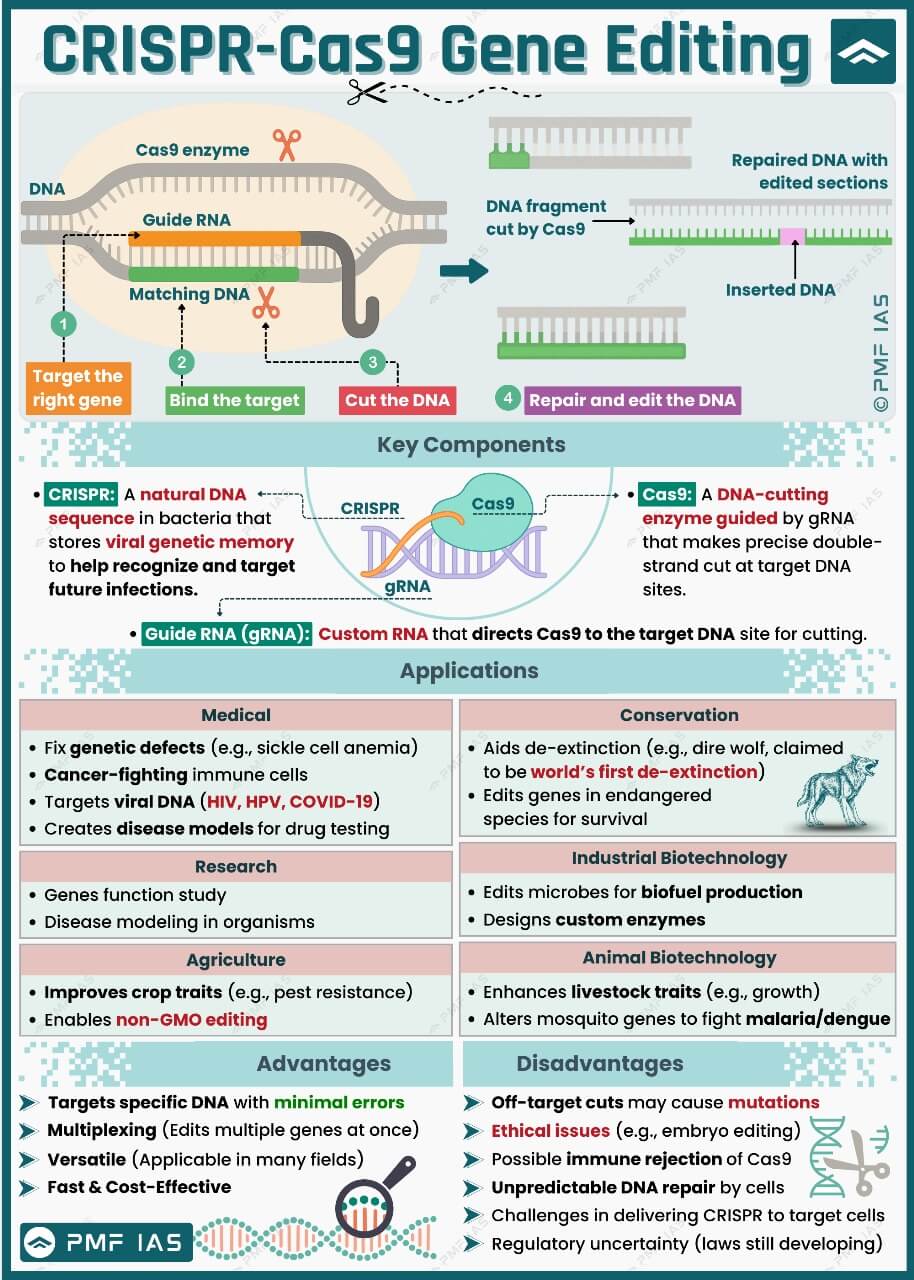
- Context (IE): US doctors and researchers have successfully tested a gene-editing therapy to treat an infant diagnosed with a carbamoyl phosphate synthetase 1 (CPS-1) deficiency.
- Researchers developed a bespoke CRISPR-based therapy explicitly tailored for that infant.
- Unlike previous CRISPR treatments that require editing stem cells outside the body, this therapy was delivered directly into infants’ livers using lipid nanoparticles carrying RNA and a guide sequence targeting the mutation.
About CPS-1 Deficiency
- It is a rare genetic metabolic disorder that affects the urea cycle, the body’s primary mechanism for removing excess nitrogen (ammonia) produced during protein metabolism.
- Urea Cycle: Normally, our body converts excess ammonia to urea and removes it from the body through urination. CPS-1 enzyme, located in the mitochondria of liver cells, catalyses the 1st step of the urea cycle.
- CPS-1 Deficiency leads to the inability to convert ammonia into urea, resulting in hyperammonemia (toxic ammonia buildup in the blood).
What is Gene Editing?
- Gene editing is a cutting-edge technique that allows scientists to make precise, targeted changes to the DNA of living organisms, including plants, bacteria, and animals.
- It enables adding, removing, or altering specific genetic material at particular locations in the genome.
- Tools: The most popular tool is CRISPR-Cas9, a system borrowed from bacteria that acts like molecular scissors to cut DNA at a specific spot.
- Other gene editing methods include TALENs and Zinc Finger Nucleases (ZFNs).

DNA Modification in Two Distinct Ways
|
Somatic Gene Editing |
Germline Gene Editing |
|
|
Applications
- Medical Treatments: Correcting genetic mutations to cure or manage diseases such as cystic fibrosis, sickle cell anaemia, muscular dystrophy, and certain cancers.
- Personalised Medicine: Designing therapies tailored to an individual’s genetic makeup for more effective results.
- Agriculture: Developing crops with improved yield, pest resistance, and climate resilience.
- Prevention of Genetic Disorders: Particularly via germline editing to stop hereditary diseases pre-birth.
Concerns
- Safety Risks: Off-target mutations may cause unintended genetic changes, leading to harmful effects.
- Ethical Issues: Especially with germline editing, altering human heredity raises moral questions about consent, identity, and “designer babies”.
- Long-Term Impact: Unknown consequences on future generations and ecological balance.
- Access and Equity: Potential for widening social inequality if gene editing is only available to affluent populations.
Way Forward
- Strengthen Research and Development: Invest in improving the precision, efficiency, and safety of gene editing technologies like CRISPR, base editing, and prime editing.
- Establish Robust Regulatory Frameworks: Create clear, globally harmonised regulations that ensure ethical use, safety, and equitable access to gene editing therapies.
- Prioritise Ethical Considerations: Implement strict oversight to prevent unethical applications, such as ‘designer babies’ or genetic enhancements beyond therapeutic purposes.
- Focus on Accessibility and Equity: Ensure that breakthroughs in gene editing benefit all sections of society, especially marginalised and low-income groups.
{Prelims – PIN World – Oceania} New Caledonia
- Context (TH): Efforts by France to forge a new political agreement in New Caledonia have failed.

About New Caledonia
- French overseas territory in the Pacific “Ring of Fire”, the arc of seismic faults around the southwestern Pacific Ocean, about 1,500 km east of Australia.
- Includes the main island, Grande Terre (capital Noumea), the Loyalty Islands (Ouvea, Lifou, Tiga, Mare), the Belep archipelago, the Isle of Pines, and several smaller islands.
- The population is just over 270,000 (2019 census).
- Approximately 39% are indigenous Kanaks (indigenous Melanesian people); the rest are Caledonians of mixed origins, including Europeans, Polynesians, Vietnamese, Indonesians, and Algerians.
- Under French law, it has a special autonomous (“sui generis”) status.
- Residents are French citizens who participate in French elections. Still, New Caledonia is not part of the EU or the Schengen Area despite being an overseas country and territory (OCT) associated with the EU.
History of the Island
- Originally inhabited by Kanaks, later annexed by France in 1853.
- After World War II, Kanaks were granted French citizenship.
- French migration in the 1960s reduced the Kanak majority, intensifying calls for independence.
- Political tensions led to the Matignon Agreements (1988) and Nouméa Accord (1998), establishing transitional governance and allowing up to three independence referendums.
- Referendums in 2018 and 2020 favoured remaining with France. The 2021 referendum, boycotted by many Kanaks over COVID-19 concerns, also favoured France, causing anger among pro-independence groups.
Significance
- It holds about 10–25% of the world’s nickel reserves, vital for global industries.
- It has one of the highest average incomes in the Pacific region.
- Its coral reefs and lagoons have been a UNESCO World Heritage Site since 2008.
- Crucial for France’s Indo-Pacific policy, helping to counterbalance China’s influence in the South Pacific.
- France aims to strengthen regional ties with India and Australia using New Caledonia as part of a broader Indo-Pacific alliance.
{Species – Reptiles – CR} Red-Crowned Roofed Turtle *
- Context (PIB | DD): Return of the Red-Crowned Roofed Turtle to the Ganga after 30 years under Namami Gange Mission, through reintroduction at Haiderpur Wetland with institutional efforts from Turtle Survival Alliance India (TSAFI), the Indian wing of global Turtle Survival Alliance, under IUCN.
s
Source: IUCN
- The Red-Crowned Roofed Turtle (Batagur kachuga), also called the Bengal Roof Turtle, belongs to the Geoemydidae family and is one of 24 turtle species endemic to India.
- Appearance: They have a reddish-orange head with a black crown, a greenish-brown carapace with yellow patterns, a yellow inner plastron with black markings, broad head, strong jaws and webbed feet.
- Shell Features: Juveniles have a keeled carapace and laterally angled plastron, giving them a sharp-edged appearance.
- Sexual Dimorphism: Females can grow up to 56 cm and weigh 25 kg; males are smaller with bright red, yellow, white and blue facial streaks.
- Behaviour: Has an omnivorous diet, lays 11-30 eggs during March-April.
- Geographical Range: Historically found across large river systems of India, Nepal and Bangladesh, especially the Ganga, Chambal and Brahmaputra rivers. The National Chambal Sanctuary holds the only known viable population in India today.
- Conservation Status: IUCN: CR | WPA: Schedule I | CITES: Appendix II.
- Major Threats: Pollution, damming, and water extraction, along with nesting site destruction due to sand mining and agriculture; suffers high mortality from fishing nets, poaching and illegal trade for exotic pets.
★ Up to 80% OFF on GS Foundation, Test Series, Crash Course, Current Affairs ★