NEW Preorder Ancient and Medieval Indian History ⚡️ Shipping from Aug 15th ★                      ★ NEW Prelims Cracker 2027 ⚡️ New Subjects from Sep 1st 📞 Call Now: 9211591415 ★                      ★ NEW GS Foundation 2027 ⚡️ Just Started ⬇️ Download Brochure 📞 Call Now: 9211591415 ★                      ★ PMF IAS Impact 🎯 53 Direct Hits in Prelims 2025 and 🎯 46 Direct Hits in Prelims 2026 ★

High Seas Treaty

  • Morocco became the 60th country to ratify the High Seas Treaty —triggering the treaty’s entry into force in January 2026.

About High Seas Treaty

  • High Seas Treaty (Biodiversity Beyond National Jurisdiction (BBNJ Treaty)) is referred to as the ‘Paris Agreement for the Ocean’. It was formally called the Agreement on Conservation and Sustainable Use of Marine Biological Diversity of Areas Beyond National Jurisdiction.
  • Adopted in 2023, it is designed to head off a brewing biodiversity crisis in the high seas.
  • It became the third agreement approved under the United Nations Convention on the Law of the Sea (UNCLOS) after the 1994 and 1995 treaties, which established the International Seabed Authority and the Fish Stocks Agreement.
  • It is the first legally-binding international agreement safeguarding marine life in the High Seas, an area of open ocean which plays a critical role in ensuring a healthy planet.
    • India signed the agreement in September 2024.
  • Objective: To address critical issues such as the increasing sea surface temperatures, overexploitation of marine biodiversity, overfishing, coastal pollution, and unsustainable practices beyond national jurisdiction.
  • The treaty will help achieve SDG Goal 14: Life Below Water > “Conserve and sustainably use the oceans, seas, and marine resources for sustainable development”.
  • The treaty will play an important role in achieving the global target to protect 30 per cent of the world’s coastal and marine areas by 2030.

What are High Seas?

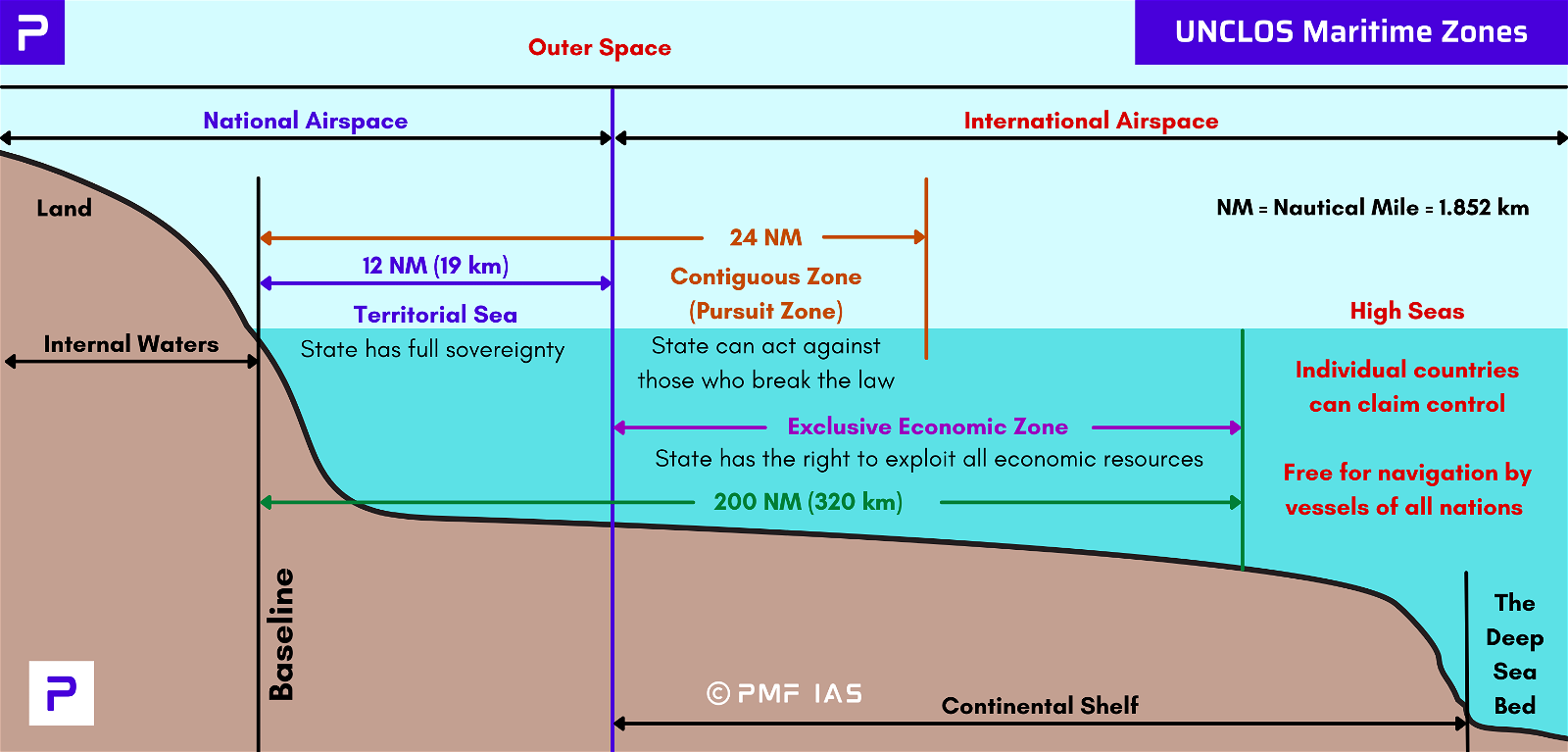
  • High Seas (open seas/international waters) refer to ocean areas beyond any national jurisdiction. They exist beyond the Exclusive Economic Zones (EEZ).
  • High or open seas cover almost 2/3rd of the world’s oceans.
  • These waters are considered the common heritage of humankind, and all nations have the freedom to navigate, fish, conduct scientific research, and engage in other lawful activities in these areas.
  • Ocean ecosystems produce half the oxygen we breathe, represent 95% of the planet’s biosphere and soak up carbon dioxide as the world’s largest carbon sink. Though high seas cover the majority of ocean area, only 1% of them are legally protected.

High seas

Timeline Description automatically generated

Achievement of ‘30×30’

  • ’30×30′ is a worldwide initiative for governments to designate 30% of Earth’s land and ocean area as protected areas by 2030.
  • It was launched by the High Ambition Coalition for Nature and People in 2020, which now has more than 100 countries, including India, the US, and the UK.
  • 30 by 30 was agreed at the COP15 meeting of the Convention on Biological Diversity and became a target of the Kunming-Montreal Global Biodiversity Framework.

Key Principles of High Seas Treaty

  1. Polluter pays principle, whereby responsibility is on polluters to manage and bear the costs of their pollution.
  2. Fair and equitable benefit-sharing from marine genetic resources and digital sequence information.
  3. Precautionary principle, by which states should not let the lack of scientific certainty hold them back from responding to threats of serious, irreversible damage to the high seas.
  4. An ecosystem and integrated approach to ocean management, together with the building of the resilience, maintenance and restoration of ecosystem integrity.
  5. Use of knowledge from indigenous peoples and local communities and the protection of their rights.

Pillars of High Seas Treaty

WhatsApp Image at

Key Features

  • Conserving Marine Biodiversity: Protecting marine ecosystems beyond national jurisdictions.
  • Equitable Sharing of Benefits: Mandating fair distribution of profits from marine genetic resources through a global fund.
  • Environmental Impact Assessments (EIAs): Requiring assessments to regulate harmful activities in international waters.
  • Marine Protected Areas (MPAs): Creation of protected zones in high seas to safeguard biodiversity.
  • Capacity-Building & Technology Transfers: Equitable partnerships in maritime science & governance.
  • Third UNCLOS Implementing Agreement: Complements treaties on deep-sea mining and fisheries.

Institutional Arrangement

  • Conference of Parties (COP): It will consist of the Parties to the Treaty and is the main decision-making body (except for certain matters on environmental impact assessments).
  • Clear House Mechanism: For fair sharing of scientific information and monetary benefits, the treaty mandates installing a clear house mechanism. Through the mechanism, information on marine protected areas, marine genetic resources, and area-based management tools will be open to access for all parties.
  • Scientific and Technical Body (STB): It will provide scientific and technical advice to the COP.
  • Subject-Matter Committees: Access and Benefit-Sharing Committee, the Capacity-Building and Transfer of Marine Technology Committee, the Finance Committee, and the Implementation and Compliance Committee.

Issues with High Seas Treaty

  • Some of the world’s biggest players — the U.S., China, Russia and Japan — are yet to ratify the treaty.
  • Lack of Strategic Clarity: The treaty lacks a detailed roadmap for achieving its ambitious goals.
  • Territorial Disputes: Overlapping maritime claims, e.g. in South China Sea, hinder consensus on MPAs.
  • Livelihood Concerns: Coastal communities dependent on marine resources fear economic restrictions from MPAs.
  • Weak Accountability Mechanisms: Wealthier nations may under-report profits from marine genetic resource exploitation.
  • Fragmented Regulations: Conflicts with existing treaties, like the Convention on Biological Diversity, create enforcement challenges.
  • Neglect of EEZ Impacts: The treaty overlooks harmful activities within EEZs, such as oil and gas exploration, reducing its environmental effectiveness.

Way Forward

  • Integrating High Seas & Coastal Regulations: Develop cohesive frameworks linking high-seas governance with coastal policies.
  • Incentives for Compliance: Encourage coastal states, especially in the Global South, to align domestic laws with international norms.
  • Foster Collective agreement among nations for shared responsibility in ocean governance.
  • Global Cooperation: Wealthier nations must provide technical and financial assistance to ensure equitable benefits.
  • Transparent Accountability Mechanisms: Introduce robust checks to prevent underreporting by wealthier nations.
  • Strengthening EIAs: Comprehensive reviews for planned activities, including oil & gas exploration.

United Nations Convention on Law of the Sea (UNCLOS)

  • UNCLOS (Law of the Sea Treaty) is an international agreement that came into force in 1994.
  • It establishes the legal framework for marine and maritime activities.
  • UNCLOS establishes general obligations for safeguarding the marine environment and protecting the freedom of scientific research on the high seas.
  • It can hold states liable for damage caused by the violation of their international obligations through its three institutions:
    1. International Tribunal for the Law of the Sea,
    2. International Seabed Authority (ISA), and
    3. Commission on the Limits of the Continental Shelf.
  • The convention gives a clear definition of Internal Waters, Territorial Waters, Contiguous Zone, Exclusive Economic Zone and Continental Shelf.
  • It provides rights to landlocked states for access to and from the sea without taxation of traffic through transit states.
  • Members: It has 167 member states and the European Union. India is a member.

International Seabed Authority (ISA)

  • ISA is a Jamaica based autonomous intergovernmental body established under the 1982 UN Convention on the Law of the Sea (UNCLOS) and its 1994 Agreement on Implementation.
    • UNCLOS creates a legal regime for controlling resource exploitation in deep-seabed areas beyond national jurisdiction through the International Seabed Authority.
    • It holds authority over the ocean floors outside member states’ Exclusive Economic Zones.

United Nations Fish Stocks Agreement (UNFSA)

  • UNFSA is a multilateral treaty under the UNCLOS and was adopted in 1995.
  • It aims at ensuring sustainable use of straddling fish stocks and highly migratory fish stocks.
  • It provides an international legally binding framework for conserving and managing the world’s most commercially significant high-seas fish stocks.

Leave a Reply

Your email address will not be published. Required fields are marked *