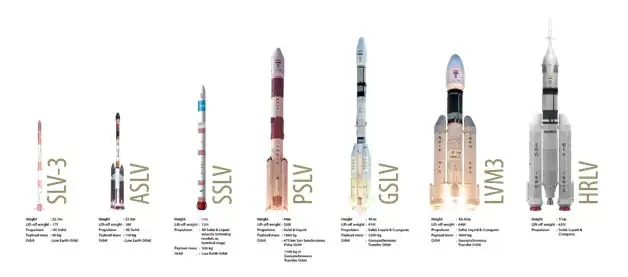
From SLV to GSLV and beyond, India’s journey in launch vehicle development marks a significant chapter in its scientific evolution. India’s satellite launch vehicles are frequently featured in UPSC and State PCS exams due to their role in showcasing technological self-reliance and national progress.
Polar Satellite Launch Vehicle (PSLV)
- PSLV is India’s 3rd generation launch vehicle and 1st Indian launch vehicle equipped with liquid stages.
- After its 1st successful launch in October 1994, PSLV emerged as a reliable and versatile workhorse launch vehicle of India.

Credit: ISRO
Stages of PSLV
- The PSLV has four stages, using solid and liquid propulsion systems alternately.
- 1st Stage and 3rd Stage: Solid-fuelled stages
- 2nd Stage and 4th Stage: Liquid-fuelled stages.
- The 2nd stage engine, Vikas, is a derivative of France’s Viking engine.
- The PS4 is the uppermost stage of PSLV, comprising two Earth-storable liquid engines.
Orbits in which PSLV Places Satellites
Notable Launches
- The PSLV has launched around 345 satellites for 34 countries and was also used in primary ISRO missions.
- Chandrayaan-1/PSLV-C11 (2008): India’s 1st mission to the Moon.
- Mars Orbiter Mission/PSLV-25 (2013): India became the 1st Asian nation to reach Mars orbit and the 1st in the world to do so in its maiden attempt.
- Astrosat/PSLV-C30 (2015): India’s 1st dedicated multi-wavelength space observatory.
- PSLV-C37 (2017): Set a world record by launching 104 satellites in a single mission.
- IRNSS (2013-18): PSLV launched all seven satellites of the Indian Regional Navigation Satellite System (IRNSS), later named NavIC.
- PSLV-C58 / XPoSat (2024): India’s 1st dedicated polarimetry mission to study cosmic X-rays.
Geosynchronous Satellite Launch Vehicle (GSLV)
- GSLV is a space launch vehicle designed, developed, and operated by the ISRO to launch satellites and other space objects into Geosynchronous Transfer Orbits (GTO).
- The GSLV is 49 meters tall, with a lift-off mass of 414.75 tonnes. It is larger than PSLV and is equipped with a cryogenic upper stage, allowing it to carry heavier payloads.

Credit: ISRO
Variants of GSLV
- GSLV Mk I: Early versions of GSLV, some utilizing imported cryogenic stages.
- GSLV Mk II: Developed to launch communication satellites in geo transfer orbit using cryogenic 3rd stage. It can carry 2250 kg payload to GTO and 6000 kg to Lower Earth Orbit (LEO).
- GSLV Mk III/LVM3: The latest and most powerful variant of GSLV, capable of heavier payloads and missions beyond Earth orbit.
Three-Stage Launch Vehicle
- 1st Stage: Uses the 138 tonne S139 solid rocket motor with four liquid engine strap-on motors. This stage generates maximum thrust of 4700 kilo Newton.
- 2nd Stage: Uses a liquid rocket engine which is known as Vikas engine. It generates maximum thrust of 800 kilo Newton.
- 3rd Stage: Uses a Cryogenic engine, which uses liquefied oxygen and hydrogen as fuel.
- In the initial launches, GSLV used the Russian cryogenic engine. In 1994, ISRO started a project called Cryogenic Upper Stage Project to develop India’s own cryogenic engine.
- The CE-7.5 is India’s 1st cryogenic engine, it can generate a maximum thrust of 75 kilo Newton. The 1st successful flight of the GSLV using the CE-7.5 was in 2004.
Key Launches
- INSAT Series: A fleet of Indian satellites used for communication, meteorology, and broadcasting services since the 1980s.
- GSAT Series: Indian communication and navigation satellites providing services like telecommunication, internet, and GPS-based navigation.
- Chandrayaan-2 (2019): India’s 2nd lunar mission launched to explore the Moon’s south pole, including an orbiter, lander, and rover.
- OneWeb Launches (2022–2023): ISRO’s GSLV Mk III launched over 35 satellites for UK-based OneWeb’s global broadband network.
Significance
- Launches Heavy Satellites: GSLV enables India to place large communication and weather satellites into GTO, essential for national telecommunication, weather forecasting, and broadcasting.
- Indigenous Cryogenic Technology: Mastery of cryogenic engine technology through GSLV marks a major scientific and engineering achievement, reducing dependence on foreign launch systems.
- Paves the Way for Human Spaceflight: LVM-3 is the launch vehicle chosen for Gaganyaan, India’s upcoming human spaceflight mission, showing its role in advancing India’s human space capabilities.
- Boosts India’s Space Economy: With GSLV’s capability to launch foreign satellites, especially through NewSpace India Limited (NSIL), it contributes to India’s presence in the global commercial launch market.
Launch Vehicle Mark III (GSLV MK III)
- It is a three-stage vehicle with a 110 ton core liquid propellant stage (L-110) and a strap-on stage with two solid propellant motors, each with 200 tons propellant (S-200).
- The upper stage will be cryogenic fueled with a propellant loading of 25 tons (C-25).
- The LVM-3 has a lift-off mass of 640 tonnes, and it can carry a payload of up to 4,000 kilograms/4 tonne class satellites of the GSAT series into geosynchronous transfer orbit (GTO) at 35,000 km and 8000 kg to Low Earth Orbit.
Small Satellite Launch Vehicle (SSLV)
- SSLV is a 3 stage Launch Vehicle developed by ISRO (Indian Space Research Organisation) for launching small satellites into Low Earth Orbit (LEO).
Key Features
- Size: SSLV is 2m in diameter and 34m in length with lift off weight of ~120 tonnes.
- Stages: SSLV is configured with three Solid Propulsion Stages and liquid propulsion based Velocity Trimming Module (VTM) as a terminal stage.
- The VTM is a liquid-propelled stage that is used to precisely adjust the satellite’s velocity just before it is injected into orbit.
- Payload Capability: SSLV is capable of launching objects ranging from 10 kilograms to 500 kilograms to a 500-kilometer planar orbit.
- Single Satellite: Up to 500kg in 500km planar orbit.
- Three Multiple satellites: Ranging from 10kg to 300kg into 500km Planar Orbit.

Credit: India Today
Key Launches of SSLV
- SSLV-D2 (Developmental Flight 2): Although the SSLV-D1 (2022) was a failure, the SSLV-D2 (2023) placed following satellites into their designated orbits.
- EOS-07: Earth observation satellite for technology demonstration.
- Janus-1: U.S. satellite by Antaris, for AI-based operations in space.
- AzaadiSAT-2: Upgraded version of the student satellite.
Significance
- Launch-on-Demand: It is designed to provide on-demand launch services, catering to the emerging small satellite launch market
- Cost Effectiveness: The SSLV is designed for low cost, both in terms of development and operation, offering a more affordable alternative for small satellite launches.
- SSLV enables India to compete with global small launchers like Rocket Lab’s Electron and Firefly’s Alpha, by offering low-cost and rapid-deployment services.
- Flexibility: The SSLV can accommodate multiple satellites in a single launch.
- Reduced Turnaround Time: The SSLV aims to provide faster turnaround times between launch preparations and actual launch.
- Minimal Infrastructure: The SSLV requires minimal launch infrastructure compared to larger launch vehicles.
AzaadiSAT
- AzaadiSAT is a student-built satellite developed by schoolgirls across India as part of a nationwide initiative.
- Aim: To promote Science, Technology, Engineering, and Mathematics (STEM) education among young girls, especially from rural and underrepresented regions.
- Project Coordinated by: Space Kidz India, an organization promoting space science among students.
- Launch: As part of India’s 75th year of independence (Azadi Ka Amrit Mahotsav) celebrations.
|


