Great Nicobar Project: Significance & Concerns Associated
- The Great Nicobar Project, with potential to become a strategic connectivity hub, is criticised for endangering indigenous rights, biodiversity, and legal safeguards.
About Great Nicobar Project
- The Great Nicobar Project, formally called the Holistic Development of Great Nicobar Island, was approved by the Narendra Modi Cabinet in 2021.
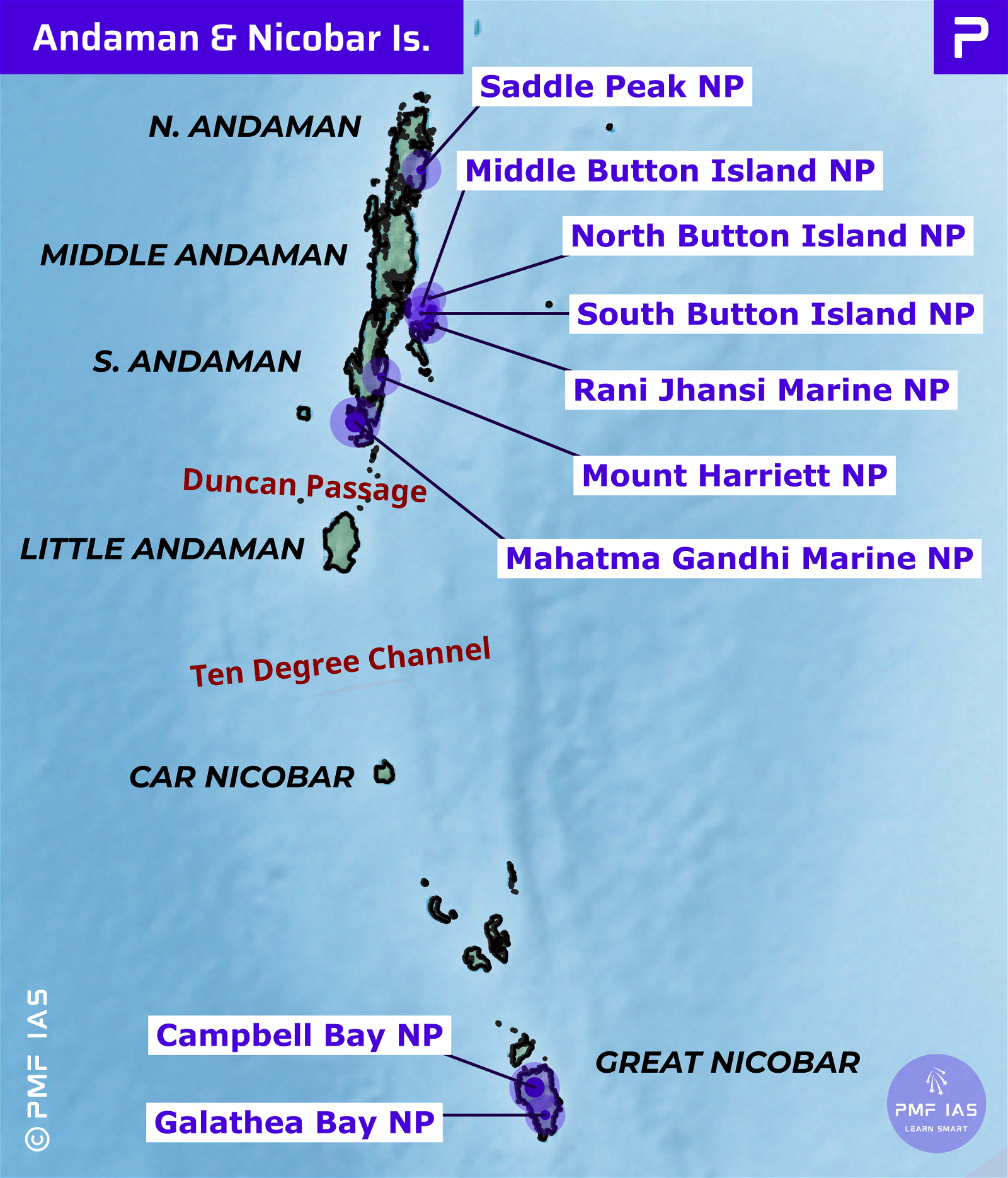
- It is a proposed ₹72,000-crore infrastructure project on Great Nicobar Island near the Malacca Strait.
- Core Components: Under the project, a greenfield city has been proposed which includes four components:
- International Container Transhipment Terminal (ICTT) at Galathea Bay. The port aims to rival Singapore’s transhipment throughput near the China-influenced Malacca Strait, a lane carrying roughly 25% of global trade.
- A greenfield airport with a 3,300-metre runway, capable of handling wide-body aircraft.
- 450 MVA hybrid gas-solar plant is proposed to ensure energy self-sufficiency.
- A township
- Expansion: Additions include a cruise terminal, a shipbreaking yard, & a coastal transport corridor.
- Extent: The project is proposed to span over 166 sq km, which is about 10% of Great Nicobar’s 910 sq km area, including 84 sq. km denotified Shompen & Nicobarese tribal reserves.
- Implementation: Conceived by NITI Aayog, executed by Andaman and Nicobar Islands Integrated Development Corporation Limited (ANIIDCO) through a phased 30-year plan.
- The project draws inspiration from global models like Singapore and Hong Kong, and aims to transform the island into a “growth pole” for the BIMSTEC region.

|
Strategic and Economic Importance
- International Container Transhipment Terminal (ICTT) could capture regional transhipment, reducing India’s logistics dependence.
- Greenfield dual-use airport enhances civilian access and defence deployment.
- The project strengthens India’s ability to monitor and project power across the eastern chokepoints, including the Sunda, Lombok, and Ombai-Wetar straits.
- It aligns with the Centre’s Sagarmala initiative, which promotes development in coastal economic zones.
- Supports Maritime India Vision 2030 and advances Act East regional connectivity.
- The port could generate Rs 30,000 crore in annual revenue by 2040, according to government estimates, while creating 50,000 jobs.
- It could serve as India’s frontline in the eastern Indo-Pacific against potential maritime threats.
- By integrating maritime, transport, and economic infrastructure, the project underpins India’s long-term strategic vision for the Andaman and Nicobar Islands as a hub for security, trade, and regional influence
Key Challenges
- Biodiversity Hotspot at Risk: Great Nicobar, part of UNESCO World Heritage Site candidate, hosts around 200 bird species, including the Nicobar megapode, and 85% forest cover. Deforestation threatens endemic flora and fauna, leading to irreversible biodiversity loss.
- Maritime Ecosystem Destruction: Galathea Bay, a Ramsar wetland, is India’s most important nesting site for the giant leatherback turtle. Dredging of seabeds could destroy coral reefs that support hundreds of fish species, disrupting the marine food chain.
- Natural Disaster Vulnerability: Mangroves in Galathea Bay act as natural tsunami barriers. Their destruction would increase coastal vulnerability. The island lies in a seismically active zone, and large-scale reclamation may worsen erosion and seismic risks.
- Regulatory Failure: Procedural opacity and Coastal Regulation Zone (CRZ) dilution erode environmental governance transparency.
- Legal Breaches: Bypassing the Forest Rights Act 2006 for project clearances denies tribals consent, eroding safeguards.
- Displacement: Denotified reserves threaten the survival & continuity of the Shompen-Nicobarese PVTGs.
Way Forward
- Tribal Safeguards: Mandate FRA consent via Gram Sabhas, ensuring legitimate project clearances.
- Transparent Review: Declassify High-Powered Committee report with environmental & tribal experts.
- EIA Reassessment: Conduct multi-seasonal biodiversity studies for accurate impact assessment.
- Exclusion: Remove CRZ-IA and biodiversity hotspots from project zones, ensuring ecological integrity.
- Seismic Standards: Enforce island-specific earthquake codes with cumulative disaster risk assessments.