Current Affairs – September 04, 2026
{GS2 – IR} Belgium PM’s Visit to India
- Context (PIB): Belgian Prime Minister Bart De Wever paid an official visit to India, marking the first visit by a Belgian PM in about two decades.
Key Outcomes of the Visit
- Trade: Bilateral trade was targeted to double in five years, an Investment Fast-Track Mechanism was launched, and SFPIM–NIIF collaboration was formalized for a dedicated investment corridor.
- Defense: A Letter of Intent on Defense Cooperation was signed, a Brussels Defense Attaché was appointed, and steps were initiated to explore a Counter-Terrorism Joint Working Group.
- Security: CBI and the Belgian Federal Police signed an agreement to combat transnational organized crime, investigate cross-border cyber threats, and track international fugitives.
- Clean Energy: Pacts on green hydrogen, offshore wind, and energy storage were renewed, reinforced by bilateral knowledge exchanges through Egmont Institute programs.
- Semiconductor: Encouraged engagement among Indian chipmakers, universities, ChipIn Centre, C-DAC, and Belgium’s imec; MeitY Startup Hub and Hub Brussels to continue deep-tech startup collaboration.
- Logistics: Port links between Antwerp and India were strengthened through APEC–JNPA port management training and joint dredging initiatives for offshore wind projects.
- Mobility: Facilitated entry for qualified Indian nurses, increased diplomatic visa-processing capacity, and invited premier Belgian universities to establish local campuses in India.
Overview of India–Belgium Bilateral Relations
- Belgium was among the first European countries to establish diplomatic relations with independent India in September 1947; ~9,000 Indian soldiers lost their lives in the Flanders Fields during World War I.
- Trade: Belgium was India’s 25th largest trading partner in FY 2025–26, with $13.01 billion in bilateral trade. The balance of trade favors India.
- Energy: Belgian firm John Cockerill is setting up an electrolyzer plant in Kakinada, Andhra Pradesh.
- Bilateral Platforms: Belgo-Indian Network for Astronomy and Astrophysics (BINA); India–Belgium–Luxembourg (BLEU) Joint Economic Commission.
- Convergence: Belgium’s support for India’s permanent UNSC seat; a shared focus on counterterrorism and a rules-based maritime order.
Read More> Belgium
{GS2 – Social Sector} Healthcare Affordability in India
- Context (TH): Parliamentary Standing Committee on Health and Family Welfare has flagged the rising out-of-pocket healthcare burden in its 176th Report on ‘Affordability and Accessibility of Healthcare Facilities in the Public and Private Sectors’.
State of Affordability and Accessibility of Healthcare in India
- Missing Middle: More than 40 crore Indians (over a quarter of the population) are too well-off for a full government subsidy yet not financially secure enough to cover private care costs.
- Private Dominance: The private sector delivers more than 60% of inpatient care and about 70% of outpatient care. Average out-of-pocket spending for a private hospital stay is about 7.6 times that in government facilities, and private outpatient care costs about five times as much.
- Out-of-Pocket Burden: Household out-of-pocket spending was 43.4% of total health expenditure in 2022–23. Medicines account for about 21% of India’s current health expenditure.
- Spending Deficit: Government health expenditure is 1.43% of GDP, compared with the 2.5% target under the National Health Policy, 2017.
- Delivery Gap: Primary care receives about 51% of health allocations, while secondary & tertiary care receive only 28% and 11%, respectively. Rural Community Health Centers face about 80% shortfall of specialist doctors.
- Bed Shortfall: India has about 1.3 hospital beds per 1,000 people against the WHO benchmark of 3.5, and public facilities provide only 0.79 beds per 1,000.
Factors Behind Rising Out-of-Pocket Burden
- Cover Blind Spot: Major health insurance schemes exclude outpatient consultations, diagnostics, and medicines, which together account for over 50% of India’s total out-of-pocket healthcare expenditure.
- Chronic Recurrence: An 11.4% adult diabetes prevalence and a 35.5% hypertension prevalence lock households into repeated spending on medications, consultations, and tests.
- Regulatory Void: Adoption of the Clinical Establishments Act, 2010, in only about 11 states and 6 UTs leaves most of the private market without a uniform national rate-cap regime.
- Pharmacy Markup: The dominance of private pharmacies over Jan Aushadhi results in outpatient medicine bills that are about six times higher (BMJ Open survey, 2022–23).
- Fiscal Squeeze: Health’s share of general government expenditure fell from 6.12% in 2021–22 to 4.89% in 2022–23, following the COVID spending peak.
Key Recommendations of the Standing Committee Report
- Public Spending: Raise government health expenditure to 2.5% of GDP on a time-bound roadmap to expand free public care and reduce household medical bills.
- Rate Caps: Mandate statutory ceilings on essential procedures, diagnostics, and implants, with a published Schedule of Charges, to rein in private-sector prices.
- Clinical Standards: Enforce nationwide adoption of the Clinical Establishments Act, 2010 to bring private facilities under uniform registration and minimum standards.
- OPD Cover: Extend Ayushman Bharat–PM-JAY to outpatient care, diagnostics, and medicines to stop day-to-day treatment from draining household income.
- Middle Insurance: Launch a voluntary, contributory insurance product for the missing middle to bridge the gap between fully subsidized coverage and costly private plans.
Read More> Healthcare Expenditure in India | Out-of-Pocket Expenditure in India
{GS3 – S&T} India’s Data Center Expansion and Climate Challenge **
- Context (TH): India’s data center capacity is projected to double by 2028, creating a severe conflict with its national net-zero climate commitments.
Landscape of India’s Data Center Ecosystem
- Operational Capacity: Nearly tripled since 2020 to reach 1.5 GW and is projected to expand fourfold to 6.5 GW by 2030, growing at a 20% compound annual growth rate.
- Geographical Concentration: Over 70% is clustered across five metropolitan hubs: Mumbai, Chennai, Bengaluru, Delhi NCR, and Hyderabad; emerging installations are exploring Rajasthan and Gujarat.
- Capital Influx: Domestic infrastructure firms are partnering with international hyperscalers to capture a projected $200 billion investment surge over the next decade.
- Workload Evolution: The sector is shifting from standard enterprise IT to high-density, compute-intensive Generative AI clusters requiring specialized server architectures.
Ecological and Climate Concerns
- Hydrological Stress: A standard 100 MW facility evaporates ~2 million litres daily, driving national data center water consumption toward an estimated 358 billion litres annually by 2030.
- Developing facilities in regions like Rajasthan—which already extracts over 147% of its groundwater recharge adds to the water stress.
- Grid Collisions: Continuous baseload power demands collide with record-breaking peak grid loads, while severe transmission bottlenecks leave over 20 GW of renewable energy stranded.
- Heat Islands: A 2026 Cambridge-led study estimated an average land-surface warming of about 2°C near AI data centers, with detectable effects extending several kilometers outward.
- E-Waste Generation: Rapid replacement cycles for high-performance AI computing hardware generate a large, poorly regulated stream of toxic e-waste with hazardous heavy metals.
Pathway for Sustainable Expansion
- Thermal Management: Transition away from evaporative cooling toward closed-loop liquid and direct-to-chip technologies to drastically reduce freshwater consumption.
- Green Power: Enforce strict regulations requiring data centers to source 100% of their operational energy from renewable power via green tariffs.
- Ecological Efficiency Metrics: Institutionalize strict building codes enforcing rigorous national benchmarks for Power Usage Effectiveness (PUE) and Water Usage Effectiveness (WUE).
- Geographical Decentralization: Incentivize new data center setups in Tier-2 and Tier-3 cities near renewable energy generation plants to ease pressure on metropolitan grids.
- Circular Economy Integration: Enforce strict Extended Producer Responsibility (EPR) guidelines for enterprise servers to ensure safe recycling and mineral recovery from discarded hardware.
Read More > AI Data Centres in India
{GS3 – S&T} India’s Nuclear Energy Technology Transition **
- Context (PIB): India’s nuclear energy technology is shifting from a state-dominated, uranium-constrained model to a thorium-led, private-participation model, targeting 100 GW by 2047.
India’s Three-Stage Nuclear Power Programme
- Engineered by Dr. Homi J. Bhabha in the 1950s, India’s Nuclear Power Programme bypasses uranium scarcity (~2% of global reserves) by leveraging massive thorium deposits (~25% globally).
|
Stage |
Technology |
Fuel |
Mechanism & Output |
Status |
| Stage I | Pressurized Heavy Water Reactors (PHWRs) |
Natural Uranium with Heavy Water |
Fission of rare U-235 generates power while U-238 captures neutrons. Produces commercial electricity & Plutonium-239. | Fully commercialized, with 24 operational reactors nationwide. |
| Stage II | Fast Breeder Reactors (FBRs) | Plutonium-239 and Depleted Uranium (MOX) | Operates with fast neutrons to drive fission while converting surrounding U-238 or thorium into fissile material. It breeds more fissile material than it consumes. | The 500 MWe Prototype Fast Breeder Reactor (PFBR) at Kalpakkam achieved first criticality. |
| Stage III | Thorium-Based Reactors | Thorium-232 paired with bred Uranium-233 | Uranium-233 undergoes fission, while thorium-232 captures neutrons and converts to uranium-233, enabling virtually limitless, clean energy. | Design phase, led by the Bhabha Atomic Research Centre (BARC). |
Key Bottlenecks and Challenges
- Capital Burden: Nuclear projects require high upfront investment and typically have 10–12-year project or construction periods, increasing financing and execution risks.
- Fuel Transition: Scaling from Stage II fast breeders to commercial Stage III thorium reactors remains complex and depends on adequate fissile inventories.
- Import Dependence: Low-grade domestic uranium reserves necessitate reliance on international imports of enriched fuel for safeguarded reactors.
- Public Anxiety: Localized protests about radiation safety, displacement, and radioactive waste management—like historical Kudankulam demonstrations—often delay projects.
Recent Policy Shifts and Interventions
- Nuclear Energy Mission (2025–2026): Targets about 22 GW by 2031-32 and 100 GW by 2047, with ₹20,000 crore allocated for Small Modular Reactors (SMR) R&D.
- Indigenous SMRs: India is developing factory-built SMRs, targeting at least five indigenous SMRs to be operational by 2033.
- SHANTI Act, 2025: Replaced old legacy laws, eliminating statutory supplier liability for accidents and aligning liability rules with international practice.
- Private Sector Integration: Modernized laws allow limited private participation and joint ventures with PSUs under Central Government licensing and safety regulation.
- Global Collaborations: India supplements indigenous PHWRs with imported high-capacity Light Water Reactors (LWR), notably the Russian-collaborated VVER units at Kudankulam.
|
Read More > Nuclear Energy | India’s Thorium Roadmap
{Prelims – Awards} Tenzing Norgay National Adventure Awards 2024
- Context (PIB): Ministry of Youth Affairs and Sports announced four recipients of the Tenzing Norgay National Adventure Awards 2024.
- Instituted in 1993, the award is the nation’s top honor for adventure sports and holds a status equivalent to the Arjuna Awards. It is named after Tenzing Norgay, one of the first two climbers to summit Mount Everest with Edmund Hillary in 1953.
- Categories: Land Adventure, Water Adventure, Air Adventure, and Lifetime Achievement.
-
2024 Awardees:
- Land Adventure: Baljeet Kaur won as the first Indian to scale five 8,000m peaks in a season; Skalzang Rigzin as the first Indian civilian to summit Everest without supplemental oxygen or Sherpa support.
- Water Adventure: Rimo Saha, for his record in para-swimming and open-water sea competitions.
- Lifetime Achievement: Shiv Prasad Chamoli, for lifelong contributions to winter games and adventure sports administration.
{Prelims – Envi} Purse Seine Fishing *
- Context (TH): SC directed the Tamil Nadu to frame rules to create a “specified channel”/official navigation corridor through its territorial waters, enabling fishing vessels to transit to the EEZ for purse seine fishing.
- Purse Seine Fishing is a fishing method in which a large net is used to encircle a school of fish and then draw the net closed from below.
- Exclusive Economic Zones (EEZ): Extends up to 200 nautical miles from the baseline, where India has sovereign rights for exploring, exploiting, conserving and managing marine resources.
- Territorial Waters: Extend up to 12 nautical miles from the coast and fall within the State’s regulatory sphere for fisheries.
|
{Prelims – Envi} Sharp-tailed Sandpiper (Calidris acuminata)
- Context (TOI): A rare sharp-tailed sandpiper was spotted near Najafgarh Jheel in Gurugram, Haryana.
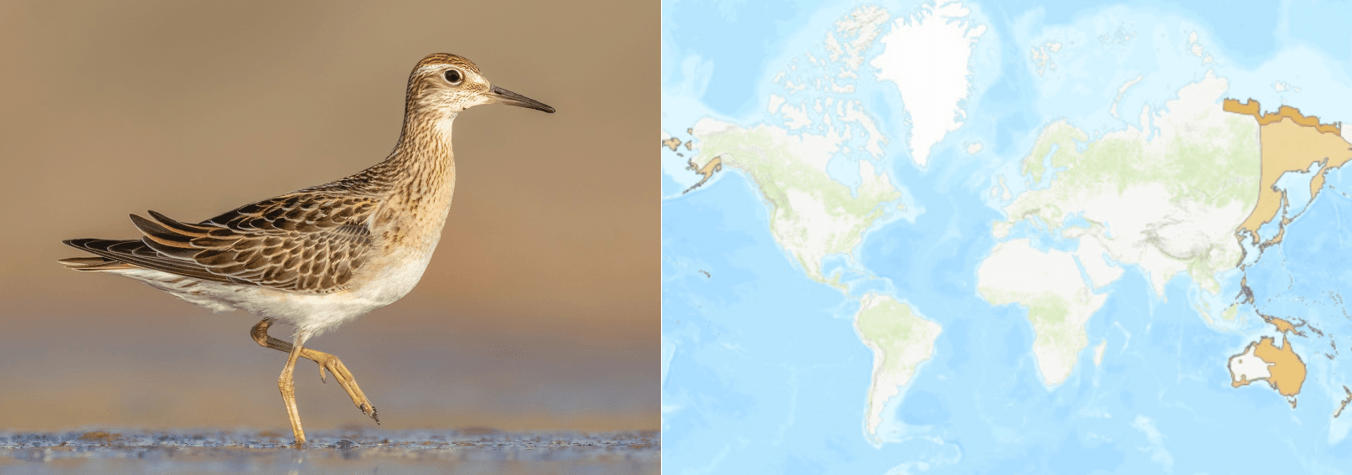
- It is a small-to-medium-sized migratory wader (shorebird) known for long-distance annual migrations between Arctic Siberia and Australasia.
- Habitat: Shallow freshwater wetlands, coastal estuaries, flooded pastures, and saltmarshes.
- Distribution: Breeds in the boggy tundra of northern Siberia during the short summer, wintering mainly in Australia, New Zealand, and Melanesia. It is a rare vagrant visitor to India and Western Europe.
- Ecological role: Biological indicator for the health of the East Asian-Australasian Flyway.
- IUCN: Vulnerable
{Prelims – PIN World} Kyrgyzstan
- Context (PIB): Prime Minister congratulated Kyrgyzstan’s President Zhaparov on the occasion of the Independence Day of the Kyrgyz Republic and for hosting the 26th SCO Summit.
- Kyrgyzstan is a landlocked country in Central Asia. Capital: Bishkek
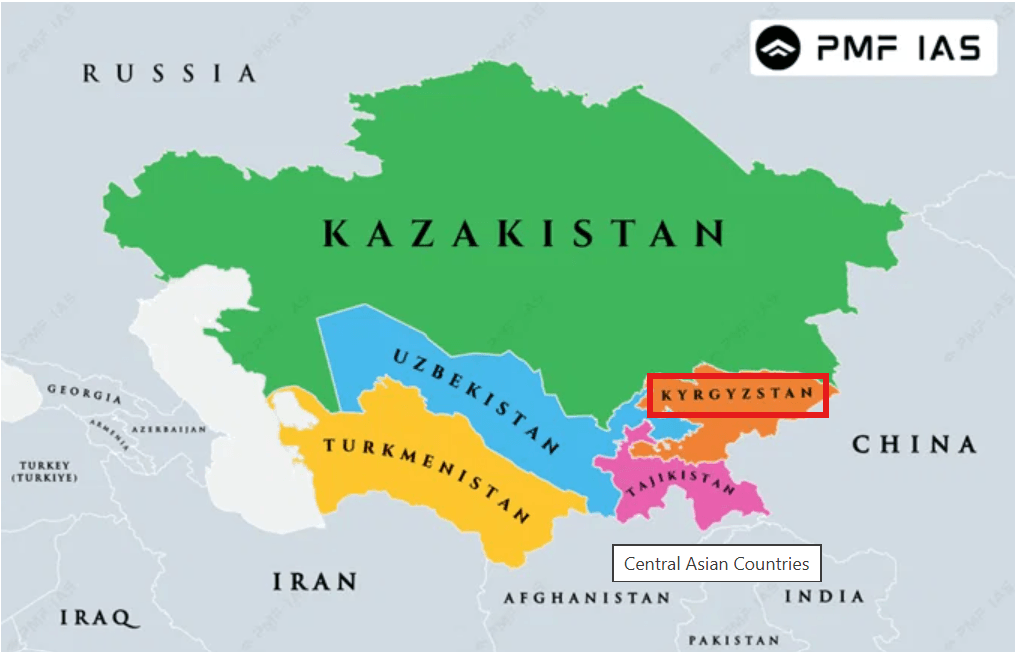
- Borders: Kazakhstan on the northwest and north, by China on the east and south, and by Tajikistan and Uzbekistan on the south and west.
- Independence: Formerly a constituent (union) republic of the U.S.S.R., Kyrgyzstan declared its independence on August 31, 1991.
- Major Mountain System: Tien Shan Mountains, and the Pamir-Alay (spans across Tajikistan, Kyrgyzstan, and Uzbekistan). Highest Peak: Jengish Chokusu (Victory Peak)
- Fergana Valley: It is one of the important agricultural and densely populated lowland areas of Central Asia.
{Prelims – IE} Sovereign Credit Rating Upgraded to ‘A-‘
- Context (PIB): Japan Credit Rating Agency (JCR) raised India’s Long-Term Foreign and Local Currency Issuer Ratings by one notch, from ‘BBB+’ to ‘A-‘, with a ‘Stable’ outlook.
- India’s country ceiling was raised to ‘A’, allowing Indian companies to potentially secure higher credit ratings and lower borrowing costs than the sovereign itself.
- Major Factors: Robust economic growth, banking-sector improvement, fiscal consolidation, expenditure quality, ongoing structural reforms, and foreign exchange buffers.
- Expected Impacts: Lower borrowing costs for government and corporations, higher foreign capital inflows (FPI/FDI), and stronger currency resilience against global shocks.
|
Read More> Sovereign Credit Rating Agencies (SCRAs)
{Prelims – Polity} Distinguished Jurists as Supreme Court Judges *
- Context (TH): Recently, the constitutional provision that allows a “distinguished jurist” to be appointed as a judge of the Supreme Court, was in the news as the provision has remained unused for over 76 years.
- Constitutional Provision: Article 124(3) provides three routes for eligibility for appointment as a Supreme Court judge:
- A person who has been a High Court judge for at least 5 years; or
- An advocate of a High Court for at least 10 years; or
- A person who, in the President’s opinion, is a “distinguished jurist.”
- No Clear Definition: The Constitution does not define the term “distinguished jurist” or prescribe objective eligibility criteria.
Distinguished Jurist Provision for High Courts
|
{Prelims – S&T} ‘RAKSHA’ Defence Diplomacy Document
- Context (PIB): Defence Minister unveiled ‘RAKSHA’, a strategic document outlining India’s 10-year roadmap for global defence partnerships.
- It marks a shift towards proactive global defence cooperation, aligning national security objectives with long-term partnerships, stability and mutual growth.
Key pillars of RAKSHA
- Strategic Partnerships: Deepening bilateral and multilateral security cooperation.
- Capacity Building: Enhancing joint military exercises, training programmes, and sharing best practices with friendly nations.
- Indigenous Exports: Promoting Make-in-India defence platforms to establish the nation as a reliable global defence manufacturing hub.
- Maritime security: Strengthening India’s role as a Net Security Provider and First Responder in Indian Ocean Region.
{Prelims – S&T} Earth Observation Satellite EOS-05
- Context (DDN): The Indian Space Research Organization (ISRO) launched EOS-05 (formerly GISAT-1A) aboard the GSLV-F17 rocket.
- EOS-05 is India’s first Earth observation imaging satellite to operate from Geosynchronous Orbit (GEO).
- It is designed to provide near real-time imaging of priority targets every 5 minutes and the whole Indian landmass every 30 minutes.
- Features multispectral and hyperspectral sensors, enabling high-resolution imaging across visible, near-infrared, short-wave infrared, and long-wave infrared spectral bands.
- Significance: Supports agricultural assessment, resource management, environmental monitoring for natural disasters, and continuous surveillance for national security.
|
{Prelims – Misc} One Liner
- Initiatives – BIO-NIVESH (DD): Union Minister launched BIO-NIVESH, a strategic platform aimed at strengthening engagement between biotechnology innovators and the investment community and catalysing the flow of private capital into promising biotechnology innovations for scale-up and commercialisation.
- Polity – Bar Council of India (AIR): Supreme Court held that the Bar Council of India (BCI) has no statutory power to regulate the conduct of law students, observing that it was for educational institutions to take action against students in accordance with their own regulatory norms.