Current Affairs MCQs – September 03, 2026
Consider the following statements regarding the Interlinking of Rivers (ILR) Programme in India:
- The National Perspective Plan for interlinking of rivers envisages 30 inter-basin water transfer links, comprising 14 links under the Himalayan component and 16 under the Peninsular component.
- The National Water Development Agency (NWDA) was established to prepare and facilitate the implementation of the National Perspective Plan for interlinking of rivers.
Which of the statements given above is/are correct?
- 1 only
- 2 only
- Both 1 and 2
- Neither 1 nor 2
Explanation
Statement 1 is correct
- The National Perspective Plan (NPP) for Interlinking of Rivers envisages 30 inter-basin water transfer links—14 under the Himalayan Rivers component and 16 under the Peninsular Rivers component.
Statement 2 is correct
- The National Water Development Agency (NWDA) was established to prepare and facilitate the implementation of the National Perspective Plan for interlinking of rivers. It undertakes studies and prepares proposals for transferring water from surplus to deficit river basins.
Answer: (c) Both 1 and 2; Difficulty Level: Medium
Which one of the following best describes Dhokra Shilpkala?
- A traditional textile art involving intricate hand embroidery and mirror work, primarily practised by tribal communities of western India.
- A traditional metal-casting art that uses the lost-wax technique, with artisans creating figurines and objects inspired by nature, mythology and everyday life.
- A traditional stone-carving art involving the construction of large sculptures of deities using locally available sandstone.
- A traditional pottery art in which clay vessels are decorated with geometric and floral motifs using natural dyes.
Explanation
Option (b) is correct
- The origins of Dhokra Shilpkala can be traced back to the tribal communities residing in the regions of Chhattisgarh, Jharkhand, West Bengal, and Odisha.
- The word “Dhokra” is believed to be derived from the Dhokra Damar tribes, who are the traditional metal smiths of Central India.
- It involves an intricate process of metal casting, using the lost-wax technique (cire perdue).
- Themes: Artisans draw inspiration from nature, mythology, and everyday life, incorporating motifs such as animals, birds, deities, and tribal symbols into their creations.
- Size: It encompasses a wide range of artistic expressions from miniature figurines and jewelry to larger-than-life sculptures and functional objects.
Answer: (b) A traditional metal-casting art that uses the lost-wax technique, with artisans creating figurines and objects inspired by nature, mythology and everyday life; Difficulty Level: Medium
Consider the following statements regarding Article 142 of the Constitution of India:
- Article 142 empowers the Supreme Court to pass any decree or order necessary for doing complete justice in any cause or matter pending before it.
- The power under Article 142 can be exercised even if the order passed by the Supreme Court is inconsistent with a Fundamental Right, provided it is necessary to do complete justice.
- The Supreme Court has held that Article 142 is a curative power that can supplement existing law but cannot ordinarily supplant substantive law.
- The Supreme Court can exercise its power under Article 142 to quash criminal proceedings in an appropriate case to do complete justice.
Which of the statements given above are correct?
- 1 and 2 only
- 1, 3 and 4 only
- 2, 3 and 4 only
- 1, 2, 3 and 4
Explanation
Statement 1 is correct
- Article 142 empowers the Supreme Court to pass a decree or make an order necessary for doing “complete justice” in any cause or matter pending before it.
Statement 2 is incorrect
- In Prem Chand Garg v. Excise Commissioner (1963), the Supreme Court held that Article 142 cannot be used to pass an order inconsistent with the Constitution, including Fundamental Rights.
Statement 3 is correct
- In Supreme Court Bar Association v. Union of India (1998), the Court described Article 142 as a curative power that can supplement, but cannot ordinarily supplant, substantive law.
Statement 4 is correct
- In Delhi Judicial Service Association v. State of Gujarat (1991), the Supreme Court recognised that Article 142, read with Articles 32 and 136, could be used to quash criminal proceedings in an appropriate case to achieve complete justice.
Answer: (b) 1, 3 and 4 only; Difficulty Level: Medium
The ‘Status of the World’s Soil Resources 2026’ report was released by which one of the following organisations?
- United Nations Environment Programme (UNEP)
- United Nations Convention to Combat Desertification (UNCCD)
- International Union for Conservation of Nature (IUCN)
- None of the above
Explanation
Option (d) is correct
- Food and Agriculture Organization (FAO) published the Status of the World’s Soil Resources 2026 report, prepared under the FAO’s Global Soil Partnership (GSP) and Intergovernmental Technical Panel on Soils, which assesses major soil threats based on evidence from 75 countries.
- Loss of Soil Biodiversity: It ranks 4th among seven major threats to soil function, after soil erosion, loss of soil organic carbon and nutrient mismanagement.
- Major Threat – Habitat Loss: Intensive irrigation, heavy machinery, fertilisers and pesticides can significantly alter soil habitats and reduce soil biodiversity.
- Global Implementation Gap: Sustainable soil-management practices are deteriorating in 58% of regional and sub-regional assessments, while improving in only around 10%.
Answer: (d) None of the above; Difficulty Level: Easy
Consider the following statements regarding the Pichavaram Mangrove Ecosystem:
- The Pichavaram Mangrove Forest is situated in a coastal estuary between the Vellar and Coleroon Rivers in Tamil Nadu.
- Pichavaram Mangrove Forest is designated Ramsar Site and is classified as a CRZ-II area under the Coastal Regulation Zone framework.
- The ecosystem is predominantly characterised by Sundari (Heritiera fomes) and Nypa fruticans, which are the dominant mangrove species found in the region.
How many of the statements given above are not correct?
- Only one
- Only two
- All three
- None
Explanation
Statement 1 is correct
- The Pichavaram Mangrove Forest is located in Cuddalore district of Tamil Nadu. It lies in a coastal estuarine region between the Vellar and Coleroon Rivers and includes the Killai backwaters, which are connected to the Bay of Bengal through a shallow littoral passage.
Statement 2 is incorrect
- Pichavaram is indeed a Ramsar Site, but it was designated in 2022. However, it is classified as CRZ-IA, which covers ecologically sensitive areas requiring the highest level of protection, and not CRZ-II.
Statement 3 is incorrect
- The dominant mangrove species in the Pichavaram ecosystem include Avicennia marina and Rhizophora. Sundari (Heritiera fomes) is particularly associated with the Sundarbans, while Nypa fruticans is not the dominant species of Pichavaram.
Answer: (b) Only two; Difficulty Level: Medium
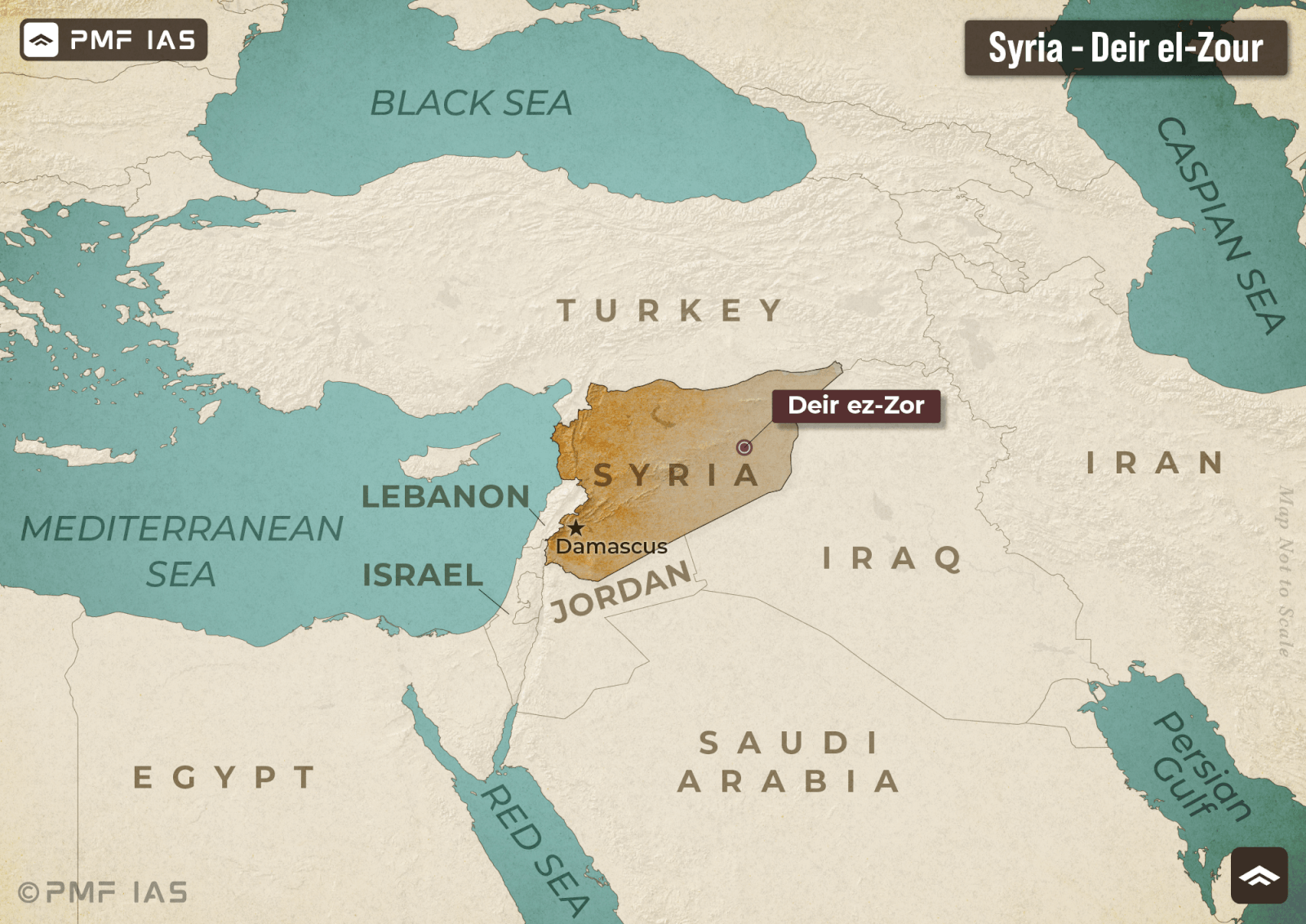
The location ‘Deir el-Zour’, which was recently in the news in the context of a UN report concerning the construction of a nuclear reactor, is located in which one of the following countries?
- Iran
- Syria
- Lebanon
- Iraq
Explanation
Option (b) is correct
- UN report confirmed that Syria was building a nuclear reactor in Deir el-Zour under former President Assad.
- Location: East coast of Mediterranean Sea in southwestern Asia. Capital: Damascus.
- Borders: Turkey (north), Iraq (east), Jordan (south), Lebanon (west) and Israel (southwest).
- Major Landforms: Syrian Coastal Mountains, Anti-Lebanon Mountains and the Syrian/Syro-Arabian Desert.
- The Golan Heights: A major territorial and geopolitical issue involving Syria and Israel.
- Syria is a member of the UN and the League of Arab States (Arab League).