NEW Prelims Cracker 2027 ⚡️ Starts July 1st 📞 Call Now: 9211591415 ★                      ★ NEW GS Foundation 2027 ⚡️ Just Started ⬇️ Download Brochure 📞 Call Now: 9211591415 ★                      ★ PMF IAS Impact 🎯 53 Direct Hits in Prelims 2025 and 🎯 46 Direct Hits in Prelims 2026 ★

UPSC CSE Prelims Previous Year Questions (PYQs) – 2024

Table of contents
Answer: (a) 1 only; Difficulty Level: Easy

With reference to the Indian Parliament, consider the following statements:

  1. A bill pending in the Lok Sabha lapses on its dissolution.
  2. A bill passed by the Lok Sabha and pending in the Rajya Sabha lapses on the dissolution of the Lok Sabha.
  3. A bill in regard to which the President of India notified his/her intention to summon the Houses to a Joint Sitting lapses on the dissolution of the Lok Sabha.
Which of the statements given above is/are correct?
  1. 1 only
  2. 1 and 2
  3. 2 and 3
  4. 3 only

Explanation

Only Statements 1 and 2 are correct
  • The position with respect to lapsing of bills is as follows:
    • A bill pending in the Lok Sabha lapses, regardless of whether it originated there or was transmitted from the Rajya Sabha.
    • A bill passed by the Lok Sabha but still pending in the Rajya Sabha also lapses.
    • A bill that has been passed by both Houses but is awaiting the President’s assent does not lapse.
    • A bill that has not been passed by both Houses due to disagreement does not lapse if the President has notified a joint sitting before the dissolution of the Lok Sabha.
    • A bill pending in the Rajya Sabha but not passed by the Lok Sabha does not lapse.
    • A bill passed by both Houses but returned by the president for reconsideration by the Houses does not lapse.
Answer: (b) 1 and 2; Difficulty Level: Easy

With reference to the Parliament of India, consider the following statements:

  1. Prorogation of a House by the President of India does not require the advice of the Council of Ministers.
  2. Prorogation of a House is generally done after the House is adjourned sine die but there is no bar to the President of India prorogating the House which is in session.
  3. Dissolution of the Lok Sabha is done by the President of India who, save in exceptional circumstances, does so on the advice of the Council of Ministers.
Which of the statements given above is/are correct?
  1. 1 only
  2. 1 and 2
  3. 2 and 3
  4. 3 only

Explanation

Statement 1 is incorrect
  • Prorogation means the end of a session (not of a Parliament). The President declares the prorogation of both Houses of Parliament. Adjournment is the suspension of proceedings/sitting for a while, which may be hours, days, or weeks. The Presiding Officer of the House can adjourn a sitting of the House of Parliament.
  • Under Article 85(2) of the Constitution, the President may prorogue the Houses or either House of Parliament from time to time. For prorogation of the House, the President requires the advice of the Council of Ministers. Termination of a session of the House by an Order by the President under the above constitutional provision is called ‘prorogation’.

Additional Information

  • On prorogation of (any) House of Parliament, the President can issue Ordinances (since it is impossible to enact laws when any of the House is not in session) under Article 123 of the IC. If an Ordinance is issued/notified before the order of prorogation, it would be void.
  • The Effect on Pending Business:
    • Bills: a bill pending in Parliament does not lapse by the prorogation of the House.
    • Business pending before Parliamentary Committees: Any business pending before a committee does not lapse by the prorogation of the House.
    • Motions and Resolutions: On the prorogation, all pending notices except those relating to the introduction of Bills lapse and fresh notices must be given for the next session.
Statement 2 is correct
  • The presiding officer (Speaker or Chairman) declares the House adjourned sine die, when the business of a session is completed. Within the next few days, the President issues a notification for prorogation of the session. However, the President can also prorogue the House while in session.
Statement 3 is correct
  • In terms of Article 83(2) of IC: The House of the People, unless sooner dissolved, shall continue for five years from the date appointed for its first meeting and no longer and the expiration of the said period of five years shall operate as a dissolution of the House:
    • Provided that the said period may, while a Proclamation of Emergency is in operation, be extended by Parliament by law for a period not exceeding one year at a time and not extending in any case beyond a period of six months after the Proclamation has ceased to operate.
  • The LS can also be dissolved earlier by the President on the advice of the Council of Ministers.
  • The LS can also be dissolved if the President feels that no viable government can be formed after the resignation or fall of a government.
Answer: (c) 2 and 3; Difficulty Level: Easy

Consider the following statements:

  1. Statement-I: The European Parliament approved The Net-Zero Industry Act recently.
  2. Statement-II: The European Union intends to achieve carbon neutrality by 2040 and therefore aims to develop all of its own clean technology by that time.
Which one of the following is correct in respect of the above statements?
  1. Both Statement-I and Statement-II are correct and Statement-II explains Statement-I
  2. Both Statement-I and Statement-II are correct, but Statement-II does not explain Statement-I
  3. Statement-I is correct, but Statement-II is incorrect
  4. Statement-I is incorrect, but Statement-II is correct

Explanation

Statement 1 is correct
  • The EU’s Net-Zero Industry Act (NZIA) entered into force on 29 June 2024. The Net-Zero Industry Act is an initiative stemming from the Green Deal Industrial Plan which aims to scale up the manufacturing of clean technologies in the EU. This means increasing the EU’s manufacturing capacity of technologies that support the clean energy transition and release extremely low, zero or negative greenhouse gas emissions when they operate.
Statement 2 is incorrect
  • The aim is that the Union’s overall strategic net-zero technologies manufacturing capacity approaches or reaches at least 40% of annual deployment needs by 2030. This will accelerate the progress towards the EU’s 2030 climate and energy targets and the transition to climate neutrality by 2050 (not 2040). The act also sets a target of reaching 50 million metric tons of annual storage capacity of carbon dioxide by 2030

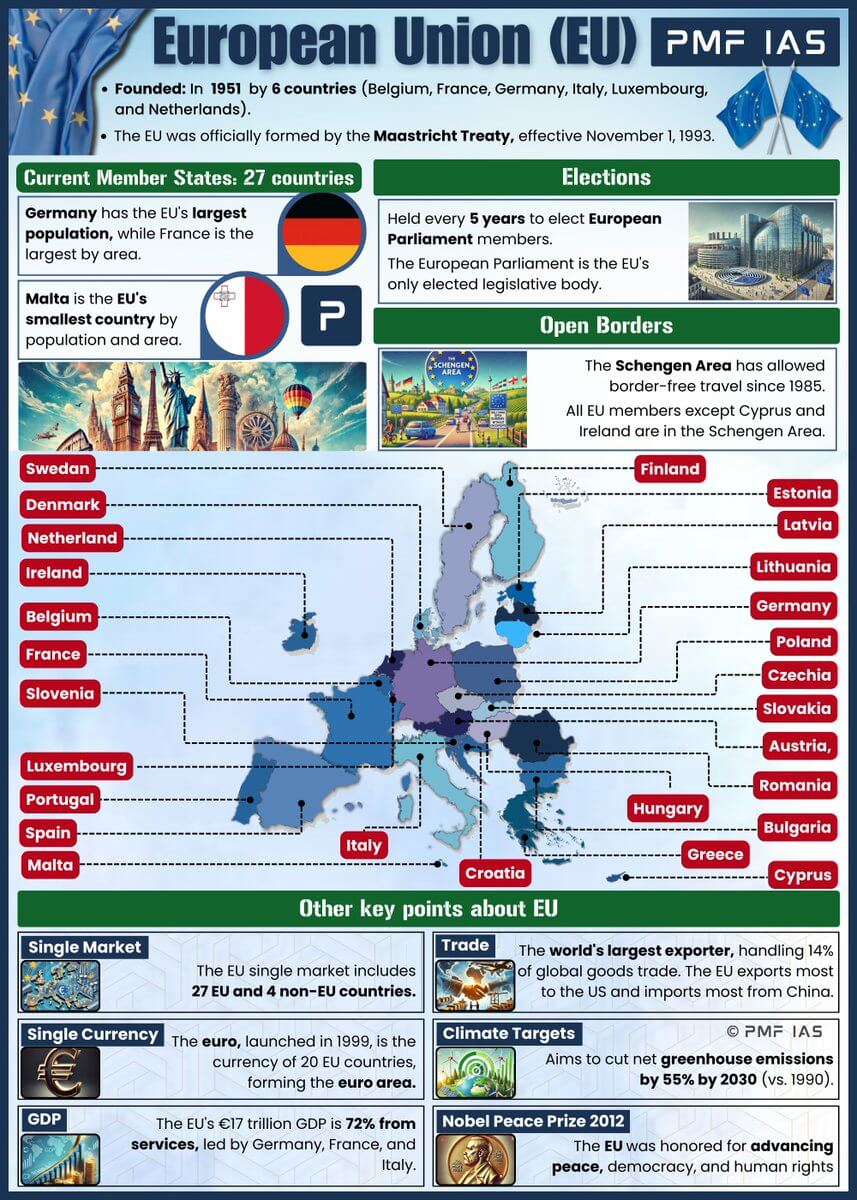
European Union (EU) facts, including founding year, member states, and key features. It features a color-coded map of 27 member countries, labeled with names, highlights Schengen Area

PMF Concept Hack

  • Statement II can be inferred as wrong because the target year 2040 appears too near and impractical for complete carbon neutrality. Also, the phrase “develop all of its own clean technology” is too absolute and unrealistic, making the statement suspicious. Hence, Statement I is correct and Statement II is incorrect → Answer: (c)
Answer: (c) Statement-I is correct, but Statement-II is incorrect; Difficulty Level: Easy

Consider the following statements:

  1. Statement-I: Recently, Venezuela has achieved a rapid recovery from its economic crisis and succeeded in preventing its people from fleeing/emigrating to other countries.
  2. Statement-II: Venezuela has the world’s largest oil reserves
Which one of the following is correct in respect of the above statements?
  1. Both Statement-I and Statement-II are correct and Statement-II explains Statement-I
  2. Both Statement-I and Statement-II are correct, but Statement-II does not explain Statement-I
  3. Statement-I is correct, but Statement-II is incorrect
  4. Statement-I is incorrect, but Statement-II is correct

Explanation

Statement 1 is incorrect
  • Venezuela has been facing one of the largest displacement crises in the world. Rampant violence, inflation, gang warfare, soaring crime rates, and shortages of food, medicine and essential services are forcing millions to flee. Nearly 8 million Venezuelans are displaced globally, with the majority — more than 6.5 million — currently residing in Latin America and the Caribbean. This is the largest forced displacement crisis ever in Latin America.
Statement 2 is correct
  • Venezuela has the largest reserves of oil in the world. Most of these reserves are located in the Orinoco belt.

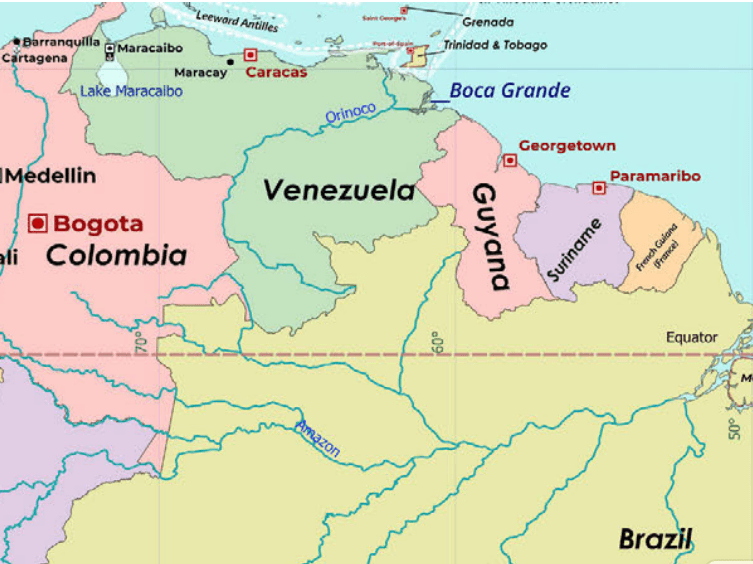
northern South America, highlighting countries Colombia, Venezuela, Guyana, and Brazil with major cities like Bogota, Caracas, and Georgetown labeled in red. Key geographical features include Lake Maracaibo, Orinoco and Amazon rivers, and the Equator line

PMF Concept Hack

  • Statement I can be inferred as incorrect using basic current-affairs awareness—Venezuela has faced a prolonged economic and migration crisis, and large-scale emigration has continued. So, claiming it has rapidly recovered and stopped migration is unlikely. Statement I is incorrect, Statement II is correct → Answer: (d)
Answer: (d) Statement-I is incorrect, but Statement-II is correct; Difficulty Level: Easy

With reference to the Digital India Land Records Modernisation Programme, consider the following statements:

  1. To implement the scheme, the Central Government provides 100% funding.
  2. Under the Scheme, Cadastral Maps are digitised.
  3. An initiative has been undertaken to transliterate the Records of Rights from local language to any of the languages recognized by the Constitution of India.
Which of the statements given above are correct?
  1. 1 and 2 only
  2. 2 and 3 only
  3. 1 and 3 only
  4. 1, 2 and 3

Explanation

Statement 1 is correct
Statement 2 is correct
  • Objectives:
    • To develop a modern, comprehensive, and transparent land record management system.
    • To develop an Integrated Land Information Management System (ILIMS) across India
  • Major components:
    • Computerization of land records.
    • Computerization of Registration.
    • Digitization of Cadastral Maps.
    • Linkage of RoR (Record of Rights) with cadastral maps.
    • Modern Record Room.
    • Integration of Registration with Land Records.
Statement 3 is correct
  • Some innovative initiatives under DILRMP:
    • Unique Land Parcel Identification Number (ULPIN) or Bhu-Aadhar: It is a 14-digit identification number accorded to a land parcel based on the longitude and latitude coordinates of the land parcel.
    • National Generic Document Registration System (NGDRS) or E-Registration: In order to have a uniform process for registration for deeds/documents, “One Nation One Registration Software namely National Generic Document Registration System (NGDRS)”is being implemented in States/UTs.
    • Transliteration of Land Records in all languages of Schedule VIII in all States/UTs: In order to address the problem of linguistic barriers in land governance, the Government with the technical support of Centre for Development of Advanced Computing (C-DAC) Pune, has undertaken an initiative to transliterate the Records of Rights available in local language to any of the 22, Schedule VIII languages of the Constitution.
    • BHOOMI SAMMAN: Awards are given to top-performing states/UTs, and districts based on their progress in digitizing and integrating land records.

Additional Information: NAKSHA Initiative

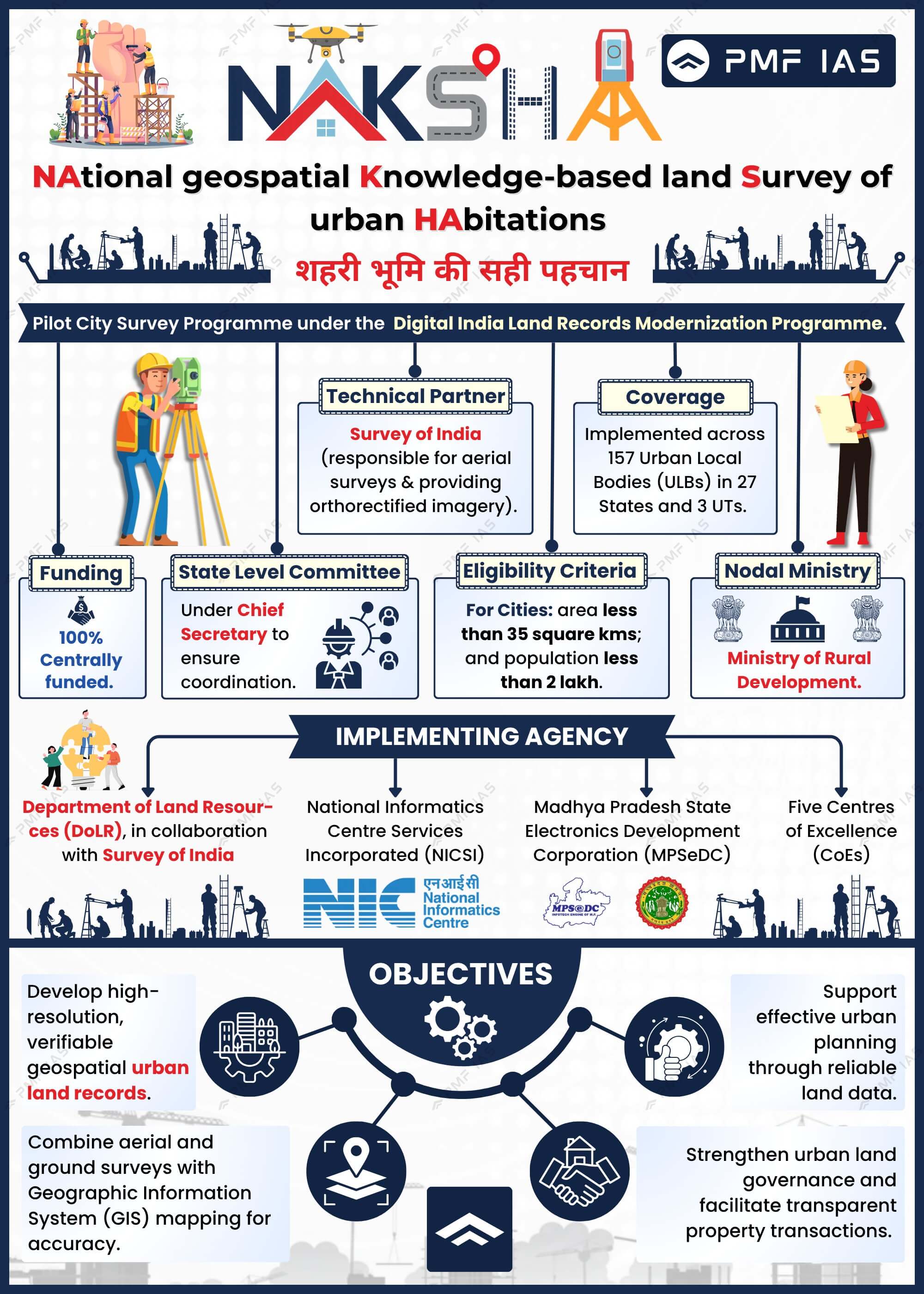
  • NAKSHA is a city survey initiative launched as a pilot under existing Digital India Land Records Modernization Programme (DILRMP).

Naksha, a National Geospatial Knowledge-based Land Survey of Urban Habitations under the Digital India Land Records Modernization Programme, highlighting pilot city surveys, funding, state-level committees, eligibility criteria, and nodal ministry involvement.

Answer: (d) 1, 2 and 3; Difficulty Level: Medium

With reference to the ‘Pradhan Mantri Surakshit Matritva Abhiyan’, consider the following statements

  1. This scheme guarantees a minimum package of antenatal care services to women in their second and third trimesters of pregnancy and six months post-delivery health care service in any government health facility
  2. Under this scheme, private sector health care providers of certain specialities can volunteer to provide services at nearby government health facilities.
Which of the statements given above is/are correct?
  1. 1 only
  2. 2 only
  3. Both 1 and 2
  4. Neither 1 nor 2

Explanation

Statement 1 is incorrect
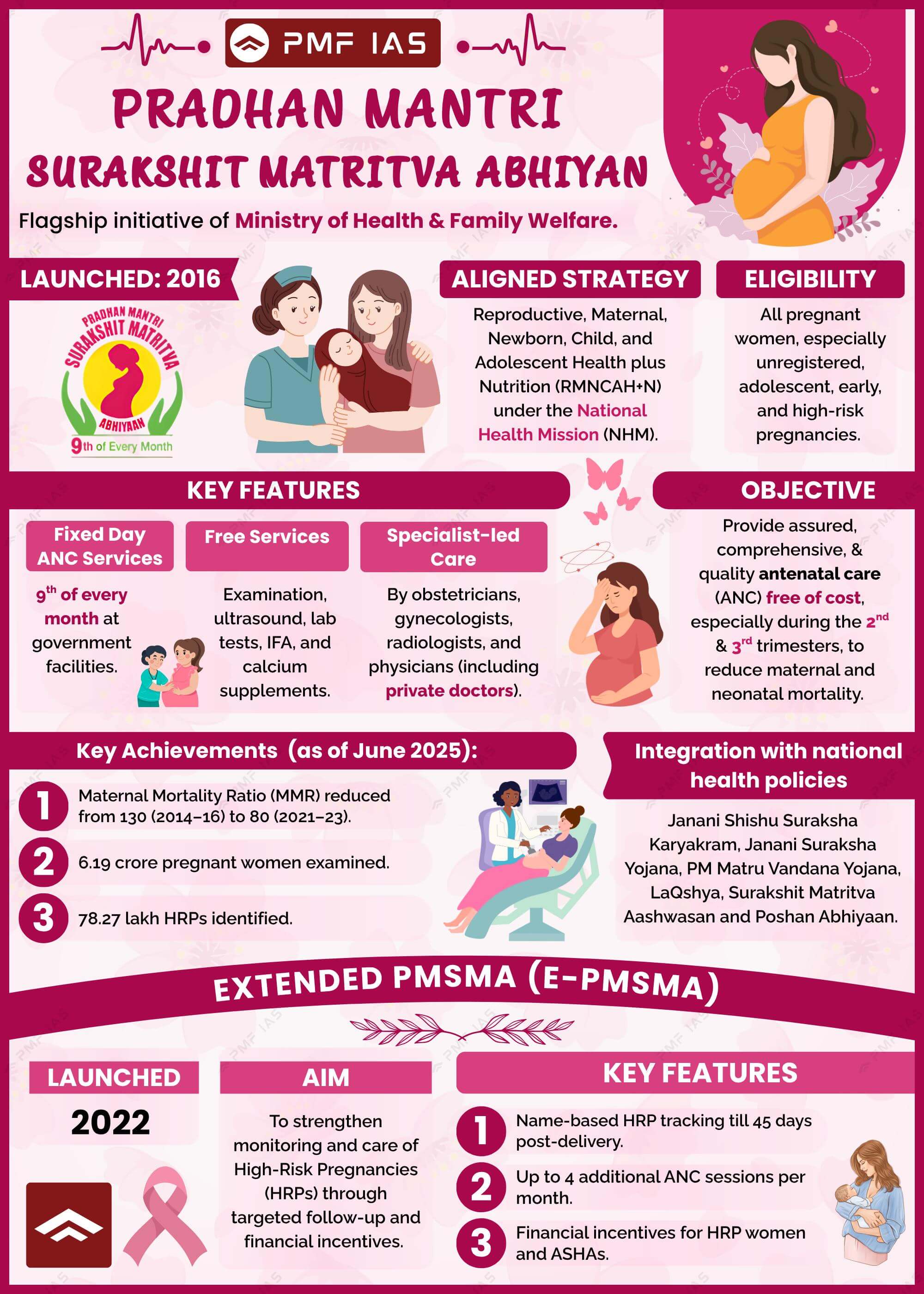
  • The Pradhan Mantri Surakshit Matritva Abhiyan has been launched by the Ministry of Health & Family Welfare (MoHFW). The program aims to provide assured, comprehensive and quality antenatal care, free of cost, universally to all pregnant women on the 9th of every month. PMSMA guarantees a minimum package of antenatal care services to women in the 2nd/3rd trimesters of pregnancy at designated government health facilities. It does not explicitly mention or guarantee six months of post-delivery health care services.

Pradhan Mantri Surakshit Matritva Abhiyan, a health initiative launched in 2016 by Ministry of Health & Family Welfare

Statement 2 is correct
  • The programme follows a systematic approach for engagement with the private sector, which includes motivating private practitioners to volunteer for the campaign, developing strategies for generating awareness, and appealing to the private sector to participate in the Abhiyan at government health facilities.
Answer: (b) 2 only; Difficulty Level: Medium

With reference to the Pradhan Mantri Shram Yogi Maan-dhan (PM-SYM) Yojana, consider the following statements:

  1. The entry age group for enrolment in the scheme is 21 to 40 years.
  2. Age specific contribution shall be made by the beneficiary.
  3. Each subscriber under the scheme shall receive a minimum pension of 3,000 per month after attaining the age of 60 years.
  4. Family pension is applicable to the spouse and unmarried daughters.
Which of the statements given above is/are correct?
  1. 1, 3 and 4
  2. 2 and 3 only
  3. 2 only
  4. 1, 2 and 4

Explanation

Statement 1 is incorrect
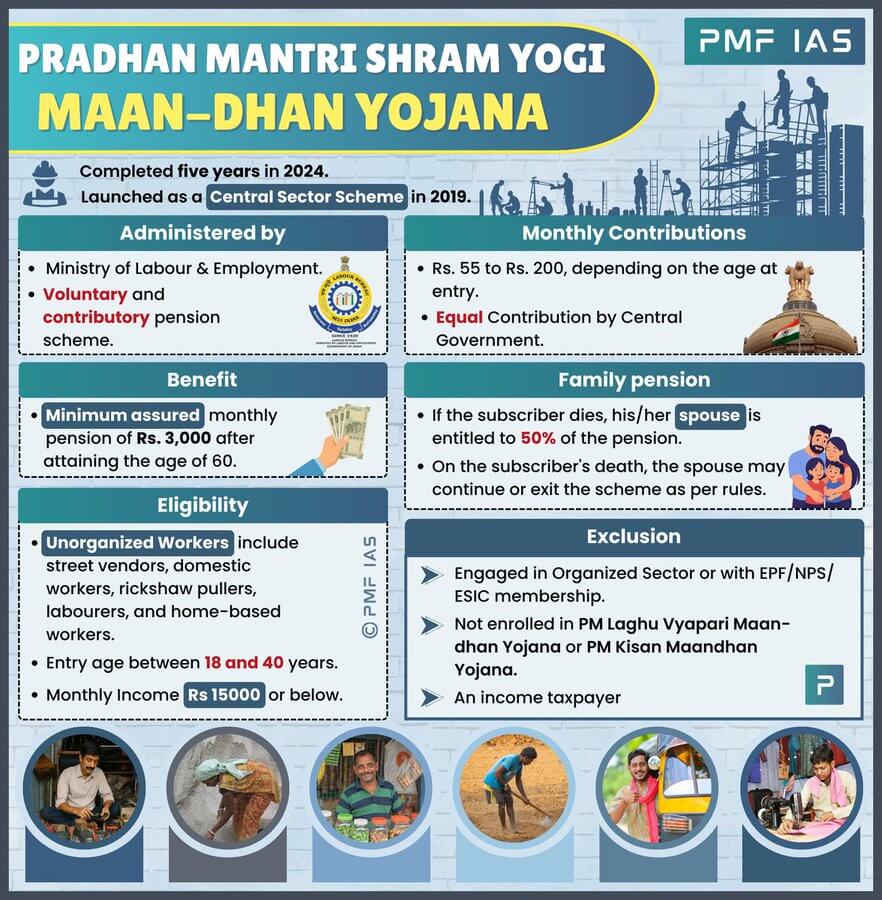
  • The scheme allows enrolment from 18 to 40 years of age, not 21 to 40, enabling individuals to join earlier and contribute for a longer period.
Statement 2 is correct
Statement 3 is correct
  • Subscribers are entitled to a minimum monthly pension of ₹3,000 after attaining 60 years, ensuring social security for workers in the unorganised sector.
Statement 4 is incorrect
  • Family pension is restricted to the spouse, who receives 50% of the pension after the subscriber’s death; unmarried daughters are not eligible.

Pradhan Mantri Shram Yogi Maan-Dhan Yojana, a voluntary pension scheme for unorganized workers launched in 2019 and completing five years in 2024.

Answer: (b) 2 and 3 only; Difficulty Level: Medium

Consider the following statements:

  1. Statement-I: The atmosphere is heated more by incoming solar radiation than by terrestrial radiation.
  2. Statement II: Carbon dioxide and other greenhouse gases in the atmosphere are good absorbers of long-wave radiation.
Which one of the following is correct in respect of the above statements?
  1. Both Statement-I and Statement-II are correct and Statement-II explains Statement-I
  2. Both Statement-I and Statement-II are correct, but Statement-II does not explain Statement-I
  3. Statement-I is correct, but Statement-II is incorrect
  4. Statement-I is incorrect, but Statement-II is correct

Explanation

Statement 1 is incorrect
  • Atmosphere is mostly transparent to the incoming shortwave radiation but actively absorbs the outgoing terrestrial (longwave) radiation.
Statement 2 is correct
  • Greenhouse gases in the atmosphere, such as water vapour and carbon dioxide, absorb a large portion of the Earth’s outgoing longwave infrared radiation, thereby warming the lower atmosphere. Therefore, as a mountain climber ascends in altitude, temperatures decrease—even though they are technically getting closer to the sun.
Answer: (d) Statement-I is incorrect, but Statement-II is correct; Difficulty Level: Easy

Consider the following statements:

  1. Statement-I: The thickness of the troposphere at the equator is much greater as compared to the poles.
  2. Statement-II: At the equator, heat is transported to great heights by strong convectional currents.
Which one of the following is correct in respect of the above statements?
  1. Both Statement-I and Statement-II are correct and Statement-II explains Statement-I
  2. Both Statement-I and Statement-II are correct, but Statement-II does not explain Statement-I
  3. Statement-I is correct, but Statement-II is incorrect
  4. Statement-I is incorrect, but Statement-II is correct

Explanation

Statement 1 is correct
  • The troposphere is thicker at the equator (16-18 km) than at the poles (about 8 km). The tropopause marks the upper boundary of the troposphere, separating it from the stratosphere.
Statement 2 is correct and is the correct explanation for statement 1
  • At the equator, intense solar heating causes strong convectional currents, which carry heat and air upward to higher altitudes. Less intense solar radiation at the poles results in weaker convection and a thinner troposphere. These strong convectional currents at the equator are the primary reason for the greater thickness of the troposphere there; hence, Statement-II explains Statement-I.
Answer: (a) Both Statement-I and Statement-II are correct, and Statement-II explains Statement-I; Difficulty Level: Easy

Consider the following:

  1. Pyroclastic debris
  2. Ash and dust
  3. Nitrogen compounds
  4. Sulphur compounds
How many of the above are products of volcanic eruptions?
  1. Only one
  2. Only two
  3. Only three
  4. All four

Explanation

Option (d) is correct
  • Volcanic eruptions discharge various materials, including gases, vapours, lavas, fragmental materials, dust and ashes. Vapours and gases account for 60 to 90 per cent of emissions. Volcanic gases consist of carbon dioxide, nitrogen oxides, sulfur dioxide, hydrogen, and carbon monoxide, along with compounds like sulfurated hydrogen, hydrochloric acid, and volatile chlorides of iron, potassium, and other metals. Various categories of pyroclastic material are ejected during an eruption, including tephra (ash), volcanic dust, lapilli, and volcanic bombs.

PMF Concept Hack

  • Use a broad understanding of volcanic eruptions here. Since none of the statements is extreme and all appear scientifically possible in a broader sense, eliminating any option becomes risky.
Answer: (d) All four; Difficulty Level: Easy

Which of the following is/are correct inference/inferences from isothermal maps in the month of January?

  1. The isotherms deviate to the north over the ocean and to the south over the continent.
  2. The presence of cold ocean currents, Gulf Stream and North Atlantic Drift makes the North Atlantic Ocean colder, and the isotherms bend towards the north.
Select the answer using the code given below:
  1. 1 only
  2. 2 only
  3. Both 1 and 2
  4. Neither 1 nor 2

Explanation

Statement 1 is correct
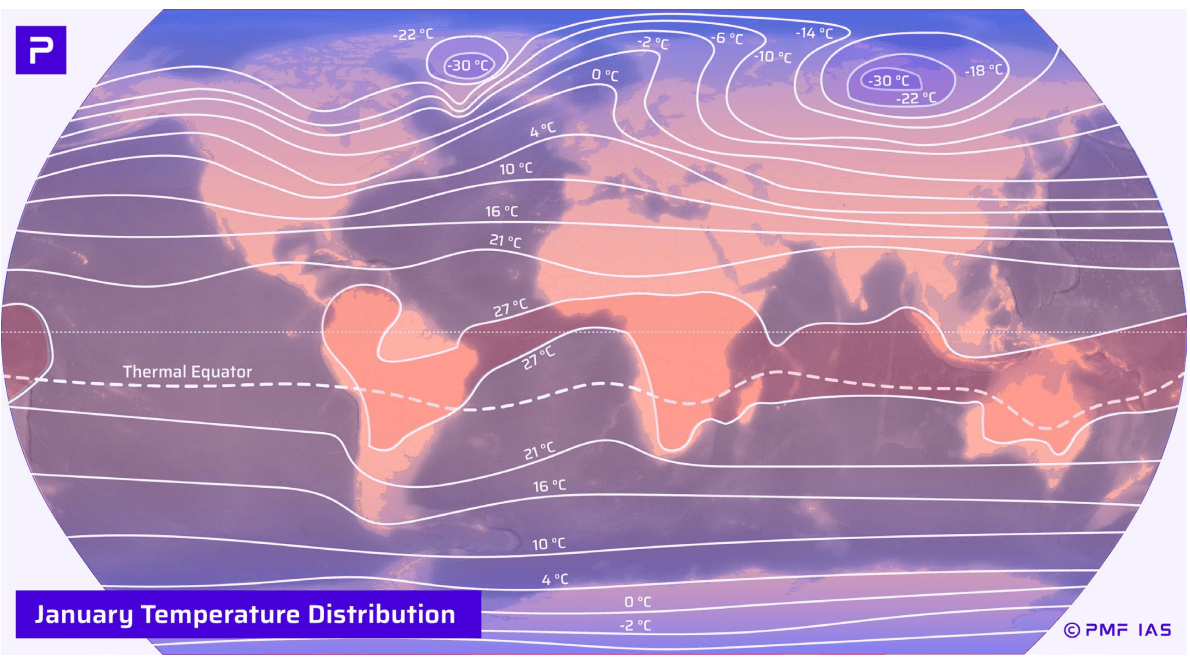
  • Isotherms are imaginary lines on maps that connect locations with equal temperatures (at sea level). Isothermal maps display these isotherms, providing a visual representation of temperature distribution across a region. They are useful in meteorology, climatology, and geography for studying temperature patterns, climate zones, and spatial temperature variations. Isothermal maps help in understanding climate classifications, temperature trends, and seasonal variations in different parts of the world. In January (winter in the Northern Hemisphere), continents will be colder than the surrounding oceans. Due to the temperature difference between land and water, isotherms will tend to bend northward over oceans (warmer) and southward over continents (colder) in January.

A global temperature distribution map for January showing isotherms with temperature values ranging from -30°C to 27°C across continents and oceans. The map highlights thermal equator position and temperature gradients

Statement 2 is incorrect
  • In January, closer-spaced isotherms in the Northern Hemisphere indicate a steep temperature gradient, with eastern coasts having steeper gradients than western coasts. Gulf Stream and North Atlantic Drift are warm currents that cause the isotherms to bend northward over the North Atlantic Ocean, not southward.
Answer: (a) 1 only; Difficulty Level: Medium

Which of the following countries are well known as the two largest cocoa producers in the world?

  1. Algeria and Morocco
  2. Botswana and Namibia
  3. Côte d’Ivoire and Ghana
  4. Madagascar and Mozambique

Explanation

Option (c) is correct
  • Cocoa is an important plantation crop grown for chocolate around the world. Côte d’Ivoire and Ghana are by far the two largest cocoa-growing countries, accounting for around 50 % of global cocoa production, followed by Ecuador with 9 %. In Asia, Indonesia is the largest producer country.

Additional Information

  • Cocoa Crop – Key Information:
    • It is a small (4–8 m tall) perennial tree crop that primarily comes from three tropical regions—Southeast Asia, Latin America, and West Africa.
    • It does not like too much sunlight and grows in the shade of other important crops such as plantain, cassava and rubber.
    • In India, it is mainly cultivated in Andhra Pradesh, Karnataka, Kerala and Tamil Nadu mainly as intercrop with Arecanut and Coconut.
    • Cocoa can be grown up to 300 m above mean sea level. It requires a minimum of 90-100 mm rainfall per month with an annual rainfall of 1500-2000 mm.
    • The plants need an equitable climate with well-distributed rainfall. If dry periods are prolonged, irrigation scheduling is necessary. The temperature range of 15°-39°C, with an optimum of 25°C, is considered ideal.
Answer: (c) Côte d’Ivoire and Ghana; Difficulty Level: Hard

With reference to the Himalayan rivers joining the Ganga downstream of Prayagraj from West to East, which one of the following sequences is correct?

  1. Ghaghara – Gomati – Gandak – Kosi
  2. Gomati – Ghaghara – Gandak – Kosi
  3. Ghaghara – Gomati – Kosi – Gandak
  4. Gomati – Ghaghara – Kosi – Gandak

Explanation

Option (b) is correct
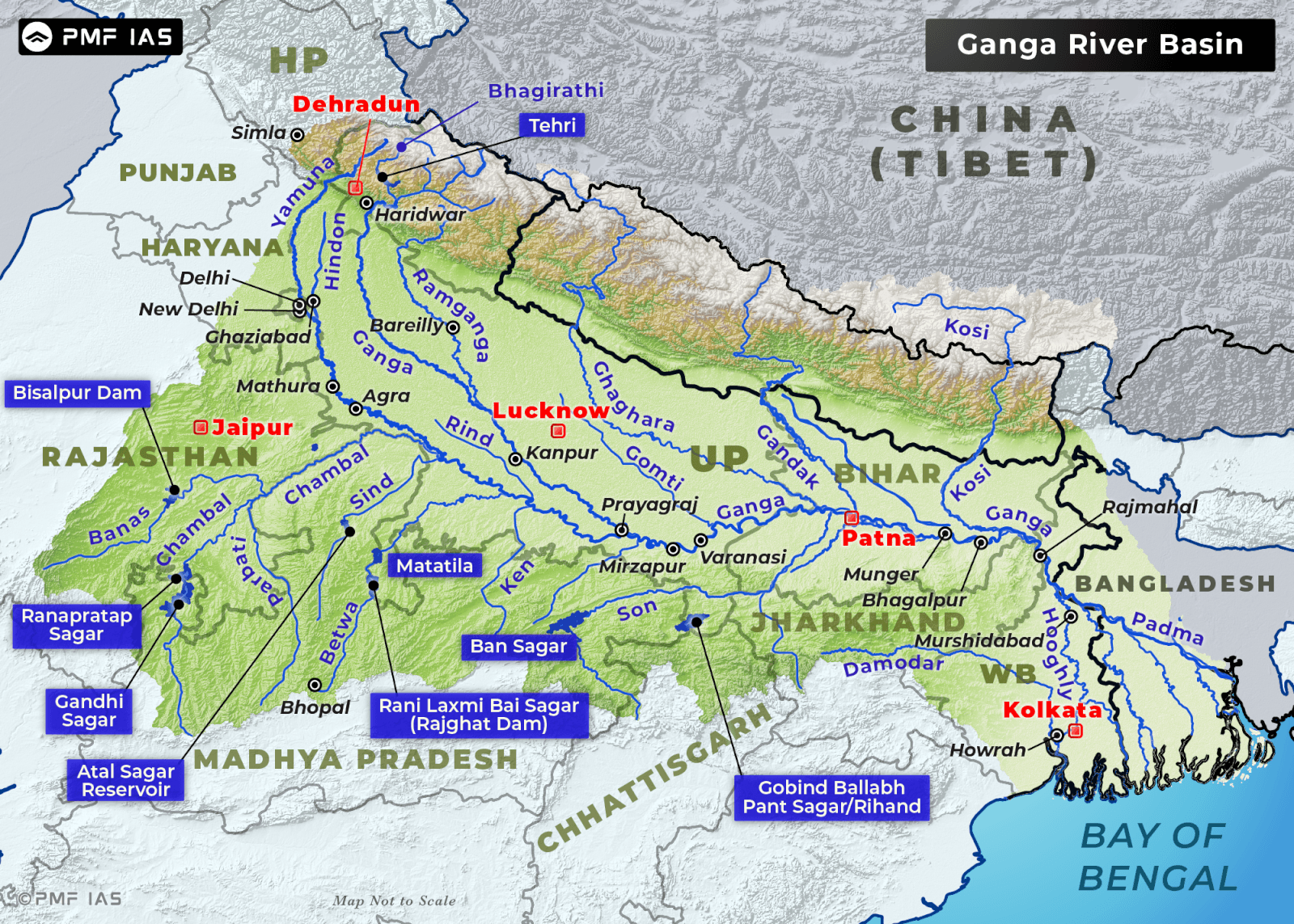
  • Gomati River joins the Ganga at Ghazipur district, Uttar Pradesh
  • Ghaghara River joins Ganga near Chapra, Bihar.
  • Gandak River joins Ganga at near Patna, Bihar
  • Kosi River joins the Ganga at Katihar, Bihar.

Map of Ganga River Basin highlighting major rivers, tributaries, and dams across northern India and neighboring countries. Key cities like Dehradun, Lucknow, Patna, and Kolkata

Additional Information

  • Gomati River:
    • The river originates from Gomat Taal (also called Fulhaar Jheel) near Madhotanda in Pilibhit district, Uttar Pradesh.
    • It flows entirely within the state of Uttar Pradesh.
    • Its tributaries are Sukheta, Choha, Andhra Choha, Kathina, Sarayan, Sai River (Major tributary), which joins near Jaunpur, Peeli River and Kalyani River.
    • Major cities and towns along its course include: Lucknow (capital city of Uttar Pradesh), Jaunpur and Sultanpur.
  • Ghaghara River:
    • The Ghaghara (known as Karnali in Nepal) originates in the glaciers of Mapchachungo.
    • Sharda River (Kali or Kali Ganga) joins it before it finally meets the Ganga at Chhapra.
    • Tributaries: Sharda (Kali), Seti River, etc
  • Gandak River:
    • Gandak comprises two streams, namely Kaligandak and Trishulganga. They rise in the Nepal Himalayas between the Dhaulagiri and Mount Everest.
    • Gandak drains the central part of Nepal and joins the Ganga at Sonpur near Patna.
    • It was declared as National Waterway (NW)-37 from Bhaisalotan Barrage to its confluence with the Ganga River vide National Waterways Act, 2016.
    • Valmiki National Park (Bihar) and Chitwan National Park (Nepal) are located on the banks of this river.
    • Tributaries: Kali Gandak, Mayangadi, Bari, Panchand, etc.
  • Kosi River:
    • Kosi is a transboundary river that flows through Nepal, Tibet (China), and India.
    • It is formed by the confluence of three streams — Sun Kosi, Arun Kosi, and Tamur Kosi, all originating in the Himalayan region of Nepal and Tibet.
    • Kosi, the Sorrow of Bihar, tends to change its course generally in the westward direction and cause devastating floods.
    • It is also called Sapt Kosi because of its seven tributaries.
    • The tributaries Trijuunga, Kamala Balan, Bagmati, etc
Answer: (b) Gomati – Ghaghara – Gandak -Kosi; Difficulty Level: Hard

Consider the following statements:

  1. Statement-I: Rainfall is one of the reasons for weathering of rocks.
  2. Statement-II: Rain water contains carbon dioxide in solution.
  3. Statement-III : Rain water contains atmospheric oxygen.
Which one of the following is correct in respect of the above statements?
  1. Both Statement-II and Statement-III are correct and both of them explain Statement-I
  2. Both Statement-II and Statement-III are correct, but only one of them explains Statement-I
  3. Only one of the Statements II and III is correct and that explains Statement-I
  4. Neither Statement-II nor Statement-III is correct

Explanation

Both Statement-II and Statement-III are correct and both of them explain Statement-I
  • Rainfall plays a significant role in the weathering of rocks through physical, chemical, and biological processes. As rainwater falls, it absorbs carbon dioxide from the atmosphere, forming carbonic acid, which contributes to the chemical weathering of rocks. Rainwater also contains dissolved gases such as carbon dioxide, nitrogen, and sulphur oxides, which lower its pH to around 5.5 or less, enhancing its corrosive effects. Additionally, dissolved oxygen in rainwater supports oxidation reactions, further promoting chemical weathering of certain rock minerals.
Answer: (a) Both Statement-II and Statement-III are correct and both of them explain Statement-I; Difficulty Level: Easy

Consider the following countries:

  1. Finland
  2. Germany
  3. Norway
  4. Russia
How many of the above countries have a border with the North Sea?
  1. Only one
  2. Only two
  3. Only three
  4. All four

Explanation

Option (b) is correct
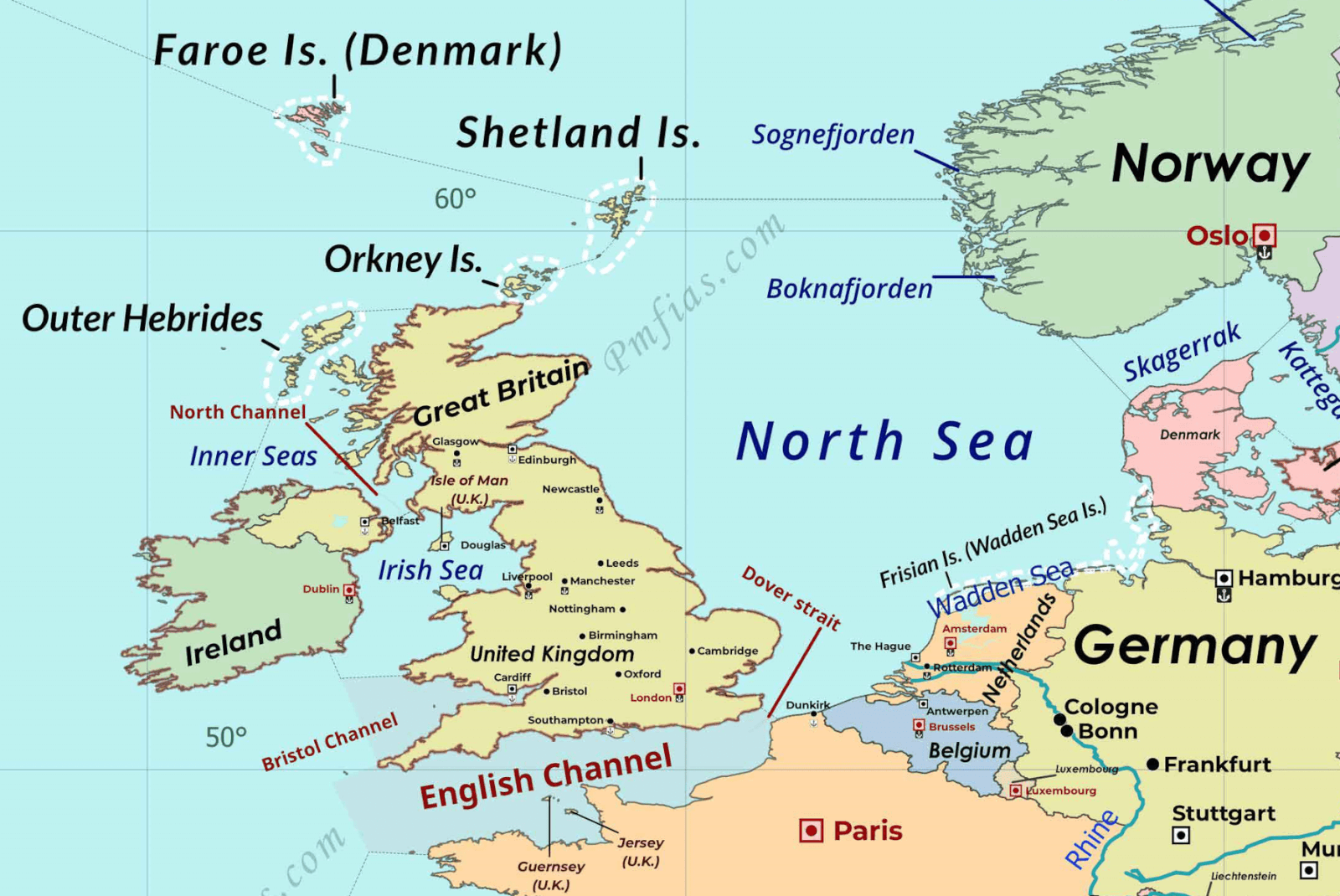
  • The North Sea was in the news due to the UK’s plans for new fossil fuel offshore drilling in the North Sea. It is a marginal sea of the Atlantic Ocean, that lies between England and Scotland on its west, the Netherlands, Belgium, and France on its south, and Norway, Denmark, and Germany on its east.

Map showing Northwestern Europe, including Great Britain, Ireland, Norway, Germany, and surrounding seas such as North Sea, Irish Sea, and English Channel, with key cities like London, Paris, and Oslo marked in red. Important islands like Faroe, Shetland, Orkney, and Outer Hebrides are labeled, along with major waterways including Dover Strait and Wadden Sea, highlighting regional geography and maritime boundaries.

Answer: (b) Only two; Difficulty Level: Easy

Consider the following information:

Waterfall Region River
  1. Dhuandhar
Malwa Narmada
  1. Hundru
Chota Nagpur Subarnarekha
  1. Gersoppa
Western Ghats Netravati
In how many of the above rows is the given information correctly matched?
  1. Only one
  2. Only two
  3. All three
  4. None

Explanation

Pair 1 is incorrect
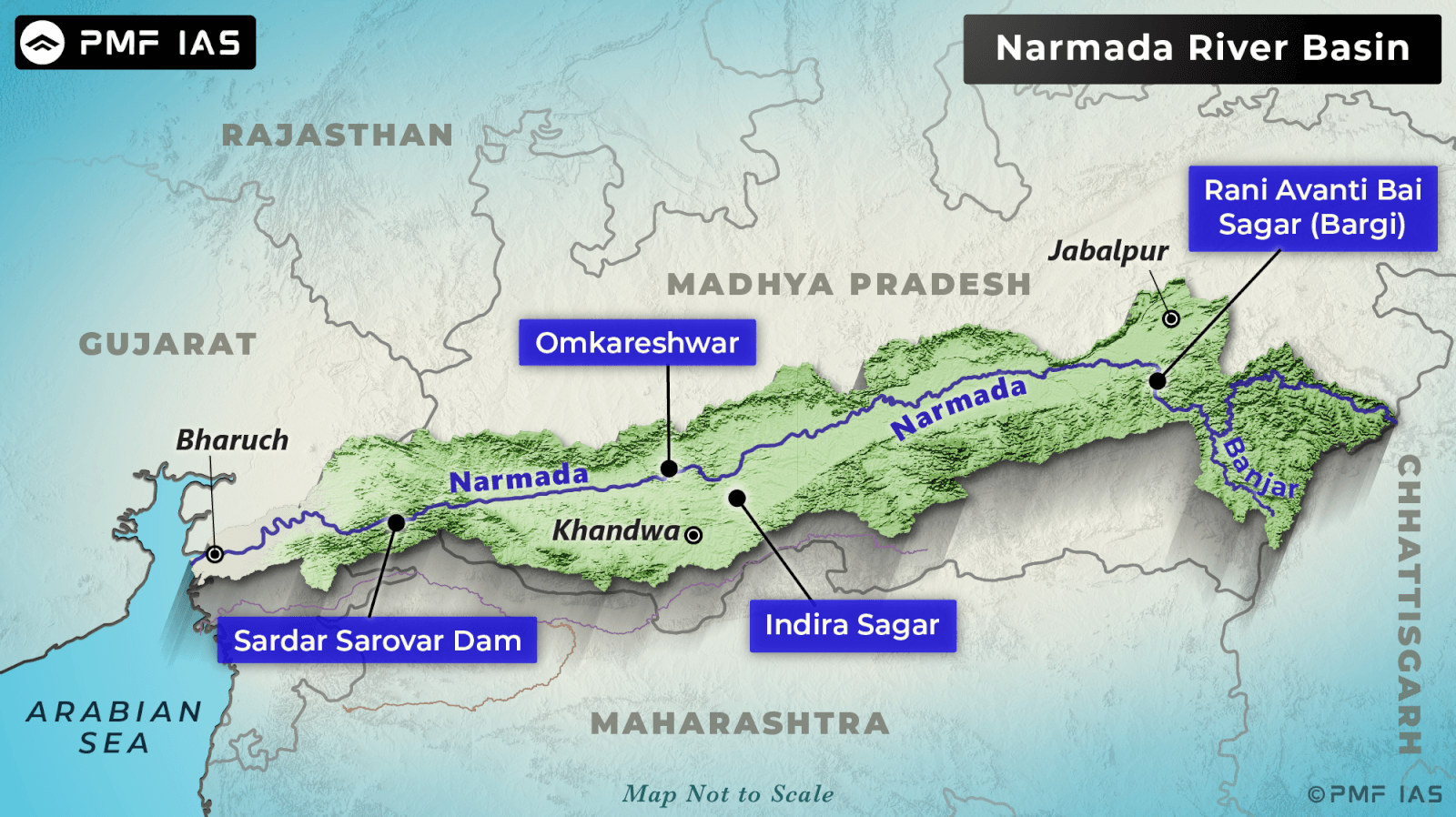
  • Dhuandhar Waterfall is located on the Narmada River at Bhedaghat village in Madhya Pradesh, approximately 25 km west of Jabalpur city. Jabalpur is not part of the Malwa region, it is associated with the Mahakoshal region of Madhya Pradesh.

Additional Information: Narmada River System

  • The Narmada basin extends over MP, Gujarat, Maharashtra, and Chhattisgarh, which is nearly 3% of the country’s total geographical area.
  • The basin is bounded by Vindhyas on the north, by the Maikala range on the east, by Satpuras on the south, and by the Arabian Sea on the west.
  • Narmada, with a length of 1,312 km, is the largest west-flowing river in peninsular India. It flows through the states of Madhya Pradesh and Gujarat.
  • It is the fifth-largest river in the country and the largest one in Gujarat.
  • It originates from the Amarkantak plateau of MP. It flows westwards in a rift valley between the Satpura in the south and the Vindhyan range in the north.
  • It drains into the Arabian Sea through the Gulf of Khambhat.
  • Left bank tributaries: Burhner, Banjar, Sher, Shakkar, Dudhi, Tawa, Ganjal, Kundi, Goi, and Karjan.
  • Right bank tributaries: Hiran, Tendoni, Barna, Kolar, Man, Uri, Hatni, and Orsang.

Map of Narmada River Basin spanning Madhya Pradesh, Maharashtra, and Gujarat, highlighting key dams and locations along the river. Features labeled points including Sardar Sarovar Dam, Omkareshwar, Indira Sagar, and Rani Avanti Bai Sagar (Bargi), with the river path marked in blue and basin area shaded in green.

Pair 2 is correct
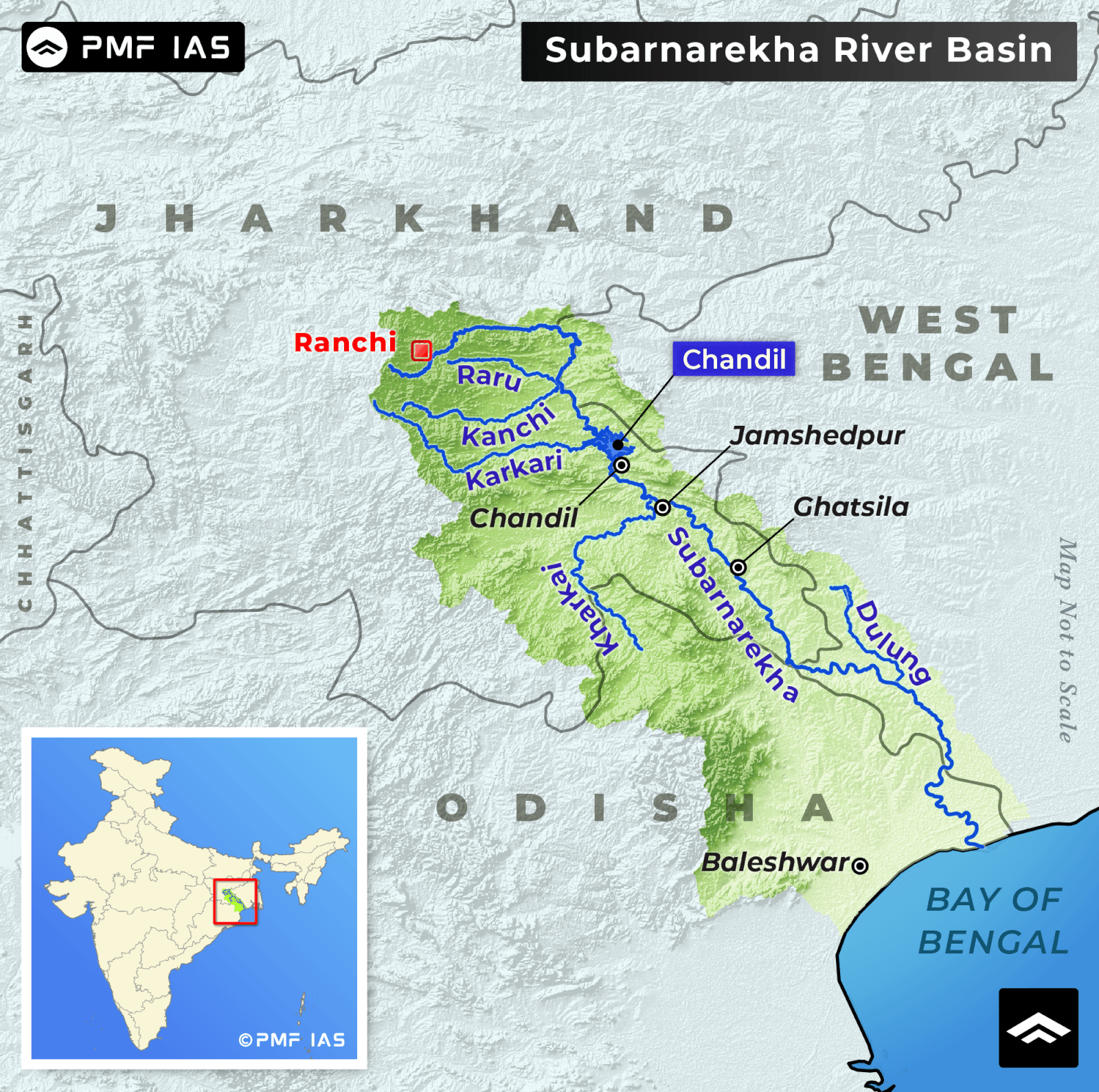
  • Hundru Falls is located within the Chota Nagpur Plateau in Ranchi, Jharkhand, India. It’s a major waterfall on the Subarnarekha River, falling from a height of approximately 320 feet.

Subernarekha River System

  • Subernarekha basin extends over Jharkhand, Odisha, and West Bengal.
  • Situated in the north-east corner of Peninsular India, the basin is bounded by the Chota Nagpur plateau on the north and west, ridges separating it from Baitarani basin on the south, Bay of Bengal on the south-east and Kasai Valley on the east.
  • The River rises in the Ranchi district of Jharkhand and flows into the Bay of Bengal.
  • Right bank tributaries: Kanchi, Karkari, and Kharkai.
  • Left bank tributaries: Dulang

Map showing Subarnarekha River Basin across Jharkhand, West Bengal, and Odisha, highlighting major tributaries like Raru, Kanchi, Karkari, and Kharkai in blue with key cities such as Ranchi, Jamshedpur, and Baleshwaro marked. Inset map locates basin within India, with color-coded elevation shading and labels for Chandil dam and Bay of Bengal coastline

Pair 3 is incorrect
  • Jog Falls is one of the highest waterfalls in India and is formed by the Sharavathi River. Jog Falls is located in the Shimoga district of Karnataka. Also known as Gerusoppe Falls, Gersoppa Falls, and Jogada Gundi. With a drop of 253 meters (830 feet), it is the second-highest plunge waterfall in India.

Sharavati River

  • Location: Western Karnataka; the 128 km long river flows westward into the Arabian Sea at Honavar.
  • Significance: Major hydroelectric source for Karnataka, contributing 40% of the state’s hydropower.
  • Major Tributaries: Haridravathi, Hilkunji, Mavinahole, Yennehole, Hurlihole, Nandihole, and Nagodihole.

Netravati River

  • Origin: Bangrabalige Valley, Yelaneeru Ghat in Kudremukh (Chikkamagaluru, Karnataka).
  • Joins the Kumaradhara River at Uppinangadi, which flows to the Arabian Sea
  • Provides water to Bantwal and Mangalore.
Answer: (a) Only one; Difficulty Level: Medium

Consider the following information:

Region Name of the mountain range Type of mountain
  1. Central Asia
Vosges Fold mountain
  1. Europe
Alps Block mountain
  1. North America
Appalachians Fold mountain
  1. South America
Andes Fold mountain
In how many of the above rows is the given information correctly matched?
  1. Only one
  2. Only two
  3. Only three
  4. All four

Explanation

Row 1 is incorrect
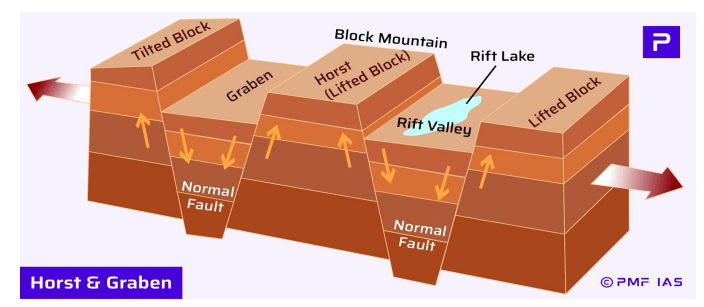
  • Block mountains are created because of faulting on a large scale (when large areas or blocks of earth are broken and displaced vertically or horizontally). The uplifted blocks are termed horsts, and the lowered blocks are called graben. The Great African Rift Valley (valley floor is a graben), the Rhine Valley (graben) and the Vosges mountain (in France) (horst) in Europe are examples.

Diagram illustrating horst and graben geological structures formed by normal faults. It shows tilted and lifted blocks separated by grabens and rift valleys, with arrows indicating fault movement and a labeled rift lake within the valley

Row 3 is correct
  • Fold mountains are formed when sedimentary rock strata in geosynclines are subjected to compressive forces. They are the loftiest mountains, and they are generally concentrated along continental margins.
    • Geosyncline: a large-scale depression in the Earth’s crust containing very thick deposits. E.g. Tethys geosyncline
  • Classification of Fold Mountains:
    • On the Basis of Period of Origin
      • Very Old Fold Mountains: Very old fold mountains are more than 500 million years old. They have rounded features and are of low elevation (due to denudation). E.g. Appalachians in North America and the Ural Mountains in Russia.
      • Old Fold Mountains: The fold mountain systems belonging to the Caledonian and Hercynian mountain-building periods (earlier than 66 million years ago) that occurred before the Tertiary Period falls in this category. Old fold mountains are also called thickening relict fold mountains because of their lightly rounded features and medium elevation. Top layers are worn out due to erosional activity. Example: Aravalli Range (India’s oldest fold mountain system. The range rose in the post-Precambrian event called the Aravalli-Delhi orogeny).
Row 2 is incorrect, and Row 4 is correct
  • Alpine or Young Fold Mountains: Alpine fold mountains, belonging to the Tertiary period (66 million years ago to present), can be grouped under the new fold mountains category, as they originated during this period. Examples include the Rockies, the Andes, the Alps, and the Himalayas. They are characterised by rugged relief, imposing height and highly conical peaks
Answer: (b) Only two; Difficulty Level: Easy

The organisms “Cicada, Froghopper and Pond skater” are:

  1. Birds
  2. Fish
  3. Insects
  4. Reptiles

Explanation

Option (c) is correct
  • All three of these organisms belong to the class Insecta. Cicadas belong to the order Hemiptera and the superfamily Cicadoidea. They are known as true bugs, featuring mouthparts designed for piercing and sucking, along with two pairs of wings. Cicadas don’t bite or sting, nor do they carry any diseases. The bugs are beneficial to the environment, acting as natural tree gardeners.
  • Froghopper also known as spittlebugs; small, jumping insects.
  • Pond skaters, also known as water striders, are insects that can move across the surface of water by utilising surface tension.
Answer: (c) Insects; Difficulty Level: Medium

Consider the following statements:

  1. Statement-I: Many chewing gums found in the market are considered a source of environmental pollution.
  2. Statement-II: Many chewing gums contain plastic as gum base.
Which one of the following is correct in respect of the above statements?
  1. Both Statement-I and Statement-II are correct and Statement-II explains Statement-I
  2. Both Statement-I and Statement-II are correct, but Statement-II does not explain Statement-I
  3. Statement-I is correct, but Statement-II is incorrect
  4. Statement-I is incorrect, but Statement-II is correct

Explanation

Option (a) is correct
  • Modern chewing gum is made using non-biodegradable hydrophobic polymers, along with artificial sweeteners and flavours. After use, most people dispose of gum carelessly, creating ‘gum pollution’, a form of environmental litter. Globally, over 105 tonnes of plastic-like waste are generated each year from discarded chewing gum. Since gum base makes up 20–30% of chewing gum and is neither edible nor digestible, it acts like plastic, releasing flavours and sweeteners as it is chewed.

PMF Concept Hack

  • No statement here is absolute, which itself makes them more acceptable. Discarded chewing gum contributes to environmental pollution, and many chewing gums use synthetic, plastic-like polymers as the gum base. The important connection is that the presence of plastic makes chewing gum non-biodegradable and polluting.
Answer: (a) Both Statement-I and Statement-II are correct, and Statement-II explains Statement-I; Difficulty Level: Easy

Consider the following pairs:

Country Animals found in its natural habitat
  1. Brazil
Indri
  1. Indonesia
Elk
  1. Madagascar
Bonobo
How many of the pairs given above are correctly matched?
  1. Only one
  2. Only two
  3. All three
  4. None

Explanation

Pair 1 incorrect
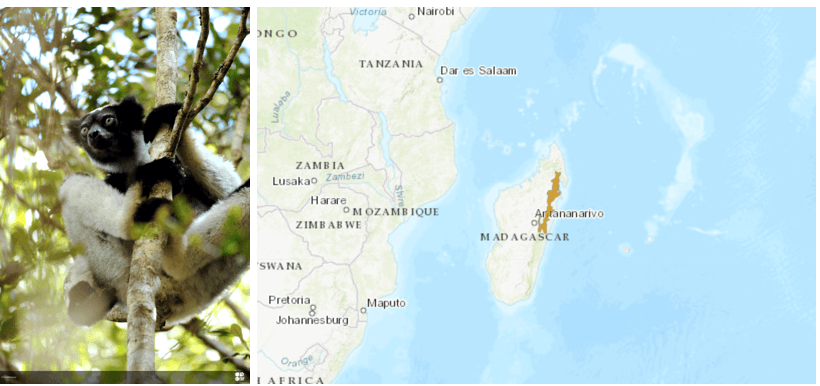
  • The indri (Indri indri), also called the babakoto, is one of the largest living lemurs. It is a diurnal tree-dweller and, like all lemurs, it is native to Madagascar. It is monogamous, lives in small family groups, moves through the canopy, and is herbivorous, feeding mainly on leaves but also on seeds, fruits, and flowers.
  • Unique Trait: Besides humans, it is the only mammal found that can use rhythm.
  • IUCN: CR

Photograph of a black-and-white ruffed lemur clinging to a tree branch in a forested area, showing its distinctive fur pattern and alert expression. Map highlighting Madagascar in orange, emphasizing the lemur's native habitat off the southeastern coast of Africa

Source: IUCN

Pair 2 incorrect
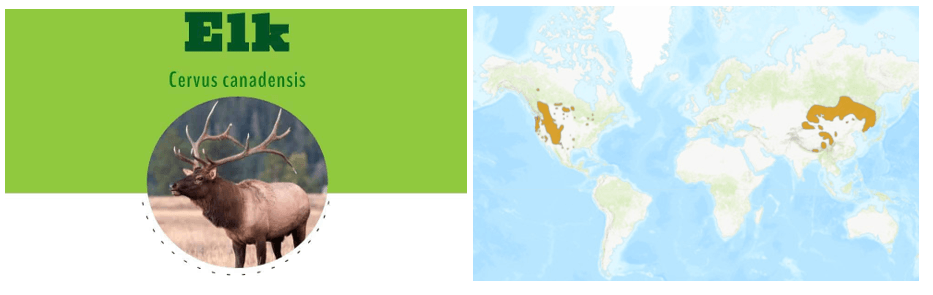
  • The elk, or wapiti, is one of the largest land-dwelling animals in North America, Central Asia, and East Asia, where it lives in mountain meadows, forests, and forest edges.
  • IUCN: LC

A two-part infographic featuring a photograph of an elk (Cervus canadensis) on the left and a world map on the right. The map highlights elk distribution in brown, showing populations primarily in western North America and parts of eastern Asia.

Source: IUCN

Pair 3 is incorrect
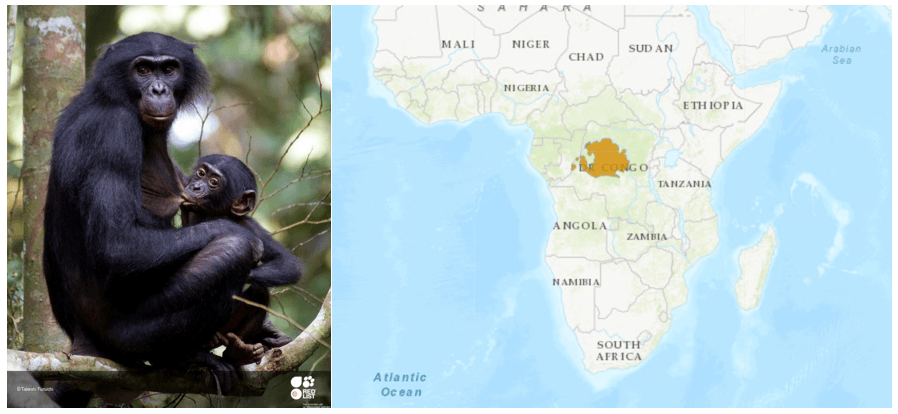
  • Wild bonobos can only be found in forests south of the Congo River in the Democratic Republic of Congo (DRC). Bonobos and chimpanzees look similar, and both share 98.7% of their DNA with humans—making these two ape species our closest living relatives. They are usually a bit smaller, leaner, and darker than chimpanzees. Their society is also different—bonobo groups tend to be more peaceful and are led by females.
  • IUCN: EN

Wild bonobos

Source: IUCN

Answer: (d) None; Difficulty Level: Hard

Consider the following statements regarding World Toilet Organisation:

  1. It is one of the agencies of the United Nations.
  2. World Toilet Summit, World Toilet Day and World Toilet College are the initiatives of this organization, to inspire action to tackle the global sanitation crisis.
  3. The main focus of its function is to grant funds to the least developed countries and developing countries to achieve the end of open defecation.
Which of the statements given above is/are correct?
  1. 2 only
  2. 3 only
  3. 1 and 2
  4. 2 and 3

Explanation

Statement 1 is incorrect
  • Founded on 19 November 2001, World Toilet Organization (WTO) is a global non-profit (not a UN Agency and it was granted consultative status with the United Nations Economic and Social Council in 2013) committed to improving toilet and sanitation conditions worldwide.
Statement 2 is correct
  • WTO established World Toilet Day and the World Toilet Summit in 2001; this was followed by the World Toilet College in 2005. Through its various initiatives, WTO continues to provide an international platform for toilet associations, governments, academic institutions, foundations, UN agencies and corporate stakeholders to exchange knowledge and leverage media and corporate support in an effort to promote clean sanitation and public health policies.
Statement 3 is incorrect
  • WTO empowers individuals through education, training and building local marketplace opportunities to advocate for clean and safe sanitation facilities in their communities rather than directly granting funds.
Answer: (a) 2 only; Difficulty Level: Hard

Consider the following statements:

  1. Lions do not have a particular breeding season.
  2. Unlike most other big cats, cheetahs do not roar.
  3. Unlike male lions, male leopards do not proclaim their territory by scent marking.
Which of the statements given above are correct?
  1. 1 and 2 only
  2. 2 and 3 only
  3. 1 and 3 only
  4. 1, 2 and 3

Explanation

Statement 1 is correct
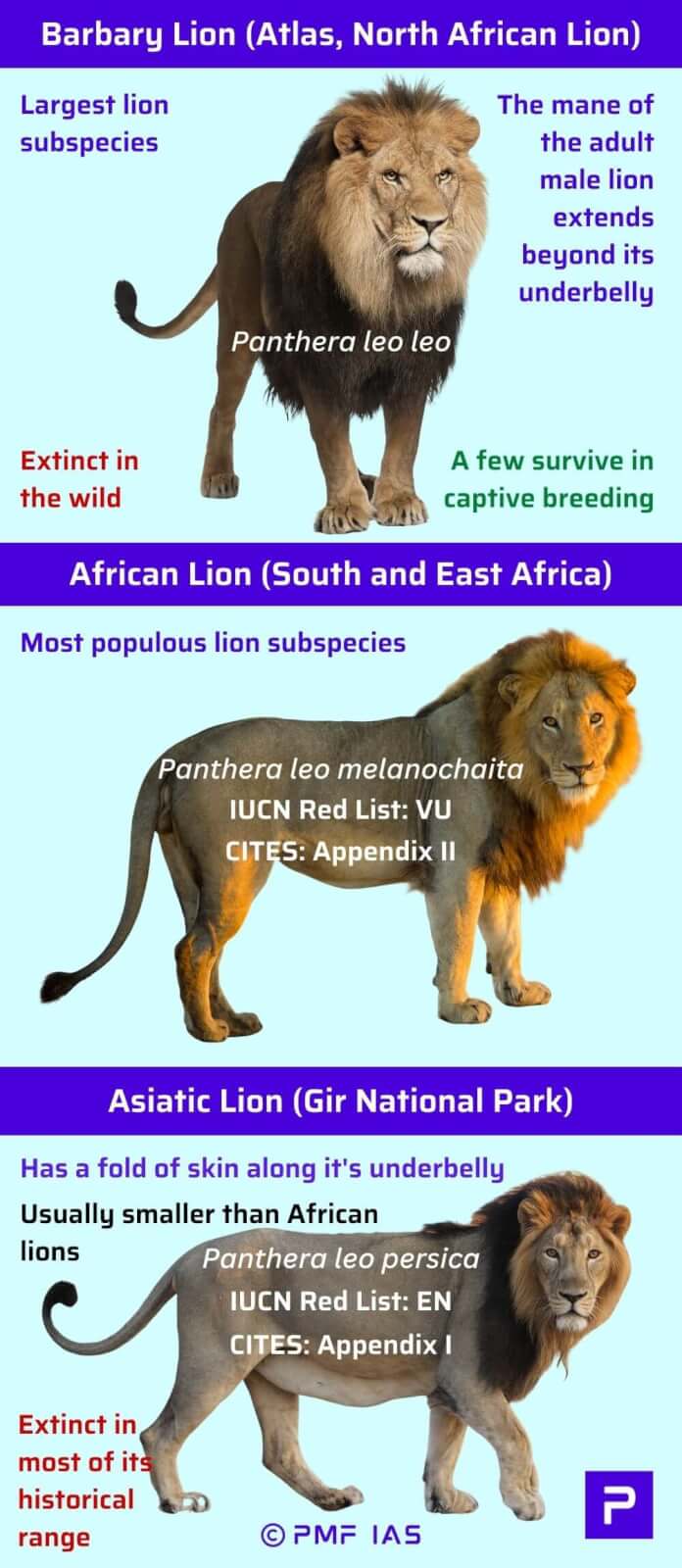
  • Lions do not have a fixed breeding season and can reproduce at any time of the year.

Diagram comparing three lion subspecies: Barbary Lion, African Lion, and Asiatic Lion, highlighting conservation status, physical traits, and population details.

Statement 2 is correct
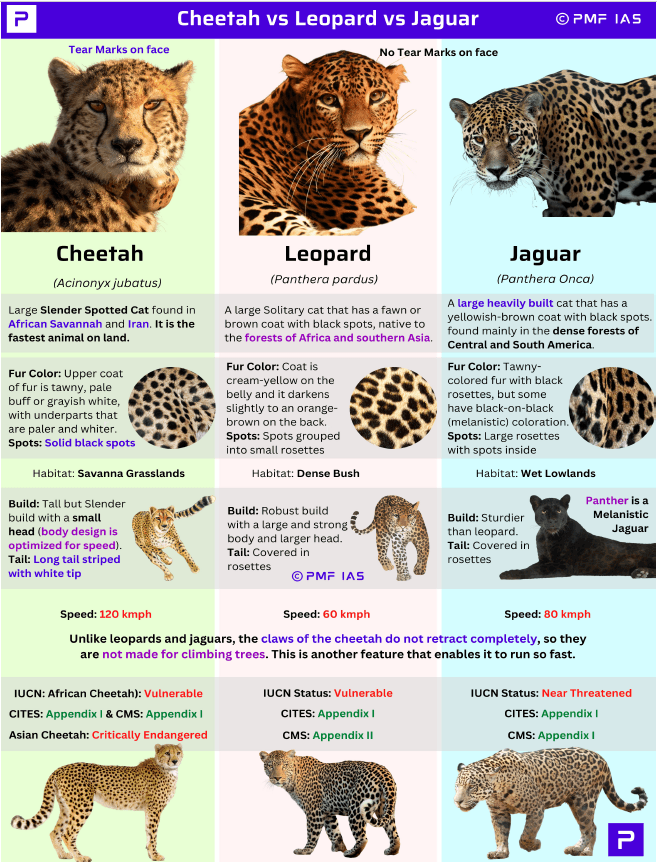
  • Unlike other “big cats” (a classification that includes lions, tigers, leopards, and jaguars), Cheetahs don’t roar. They growl when facing danger, vocalise with sounds more like a high-pitched chirp or bubble, and bark when communicating with each other.

Comparison chart illustrating physical and behavioral differences among cheetah, leopard, and jaguar. cheetah’s tear marks, leopard’s rosettes, jaguar’s robust build

Statement 3 is incorrect
  • Just like lions, leopards also roar. Male leopards defend their territory by roaring & scent marking, while females use their roar to attract mates & call their cubs.
Answer: (a) 1 and 2 only; Difficulty Level: Hard

Which one of the following is the correct description of “100 Million Farmers”?

  1. It is a platform for accelerating the transition towards food and water systems that are net-zero (carbon), nature-positive and that aims to increase farmer resilience.
  2. It is an international alliance and a network of individuals and farming organisations interested in supporting and strengthening the development of the organic animal husbandry.
  3. It is a digital platform fully integrated with service providers and built on blockchain that lets buyers, sellers and third parties trade fertilizers quickly and securely.
  4. It is a platform with the mission of encouraging the farmers to form Farmer Product Organisations or Agribusiness Consortiums, thus facilitating the access to global open markets to sell their products.

Explanation

Option (a) is correct
  • 100 Million Farmers (initiated by World Economic Forum) is a multistakeholder platform catalysing action to transition to net-zero, nature-positive food systems by 2030. The platform is supporting private and public leaders in positioning food and farmers as central pillars of the global climate and nature agenda and accelerating collective action to scale climate- and nature-friendly agricultural practices.
Answer: (a) It is a platform for accelerating the transition towards food and water systems that are net-zero (car-bon), nature-positive and that aims to increase farmer resilience: Difficulty Level: Medium

Consider the following:

  1. Battery storage
  2. Biomass generators
  3. Fuel cells
  4. Rooftop solar photovoltaic units
How many of the above are considered “Distributed Energy Resources”?
  1. Only one
  2. Only two
  3. Only three
  4. All four

Explanation

All are correct
  • Distributed energy resources (DERs) are small-scale and decentralised energy resources where electricity is generated from sources, often renewable energy sources, near the point of use instead of centralised generation sources from power plants.
  • Examples of distributed energy resources that can be installed include:
    • rooftop solar photovoltaic units
    • wind generating units
    • battery storage
    • batteries in electric vehicles used to export power back to the grid
    • combined heat and power units, or tri-generation units that also utilise waste heat to provide cooling
    • biomass generators, which are fuelled with waste gas or industrial and agricultural by-products.
    • open and closed cycle gas turbines
    • reciprocating engines (diesel, oil)
    • hydro and mini-hydro schemes
    • fuel cells.

PMF Concept Hack

  • Use simple understanding here — Distributed Energy Resources are small, decentralized energy systems located near the point of use rather than large centralized plants. Battery storage, biomass generators, fuel cells, and rooftop solar units all fit this idea. Since all four can generate/store energy locally, eliminating any option becomes difficult.
Answer: (d) All four: Difficulty Level: Easy

Which one of the following shows a unique relationship with an insect that has coevolved with it and that is the only insect that can pollinate this tree?

  1. Fig
  2. Mahua
  3. Sandalwood
  4. Silk cotton

Explanation

Option (a) is correct
  • Figs have an obligate mutualism with tiny fig-pollinating wasps (family Agaonidae). It means that a given fig species can be pollinated only by its ‘partner’ wasp species and no other species. The female wasp uses the fruit not only as an oviposition (egg-laying) site but also as a source of nourishment for its larvae, using the developing seeds within the fruit. The wasp pollinates the fig inflorescence while searching for suitable egg-laying sites. In return for the favour of pollination, the fig offers the wasp some of its developing seeds, as food for the developing wasp larvae.

Additional Information

  • Mutualism is a cooperative interaction between individuals of different species that benefits both participants. In these interactions, two parties reciprocally exchange various ‘goods’ and ‘services’ that they cannot produce themselves, such as nutrition, defense, and nesting space. In some cases, the species are entirely dependent on each other (obligate mutualism) and in others, they derive benefits from their relationship but could survive without each other (facultative mutualism).

Mahua

  • Mahua (Madhuca longifolia) is a medium-sized deciduous tree, which grows to a height of 16-20 m
  • It is a multipurpose tropical tree native to South Asia that is primarily cultivated or harvested in the wild for it edible flowers and oil seeds. Sacred to several tribal communities in India; plays a role in festivals and rituals.

Sandalwood

  • Sandalwood (Chandan/Srigandha) is wood from trees in the genus Santalum. Indian Sandalwood (Santalum album) is the only major native sandalwood species in India.
  • Red Sandalwood/Lal Chandan (Pterocarpus santalinus), though it has the word ‘sandalwood’ in its name, belongs to a different order and genus (Pterocarpus).

Silk Cotton

  • Semal, also called kapuk or silk cotton tree, flowers spectacularly in spring and is native to India.
  • It is known for its distinctive, spiky red flowers and its fluffy seed pods, which contain a cotton-like substance that was once used for stuffing pillows and mattresses.
  • Semal trees are disappearing from south Rajasthan, launching a cascade of adverse consequences for forests and people in the area.
  • It is mainly found in moist deciduous and semi-evergreen forests, also in the plains
  • Significance:
    • The tree’s bark, leaves, and seeds are utilised in traditional medicine to cure various ailments, including fever, diarrhoea and skin conditions. The wood is used for construction, furniture-making, and other woodworking applications.
Answer: (a) Fig: Difficulty Level: Medium

Consider the following:

  1. Butterflies
  2. Fish
  3. Frogs
How many of the above have poisonous species among them?
  1. Only one
  2. Only two
  3. All three
  4. None

Explanation

All have poisonous species among them
  • Butterflies: Some butterfly species are poisonous.
    • For example: monarch butterfly is toxic due to the cardenolides (a type of cardiac glycoside) it accumulates from feeding on milkweed.
  • Fish: Several fish species are poisonous.
    • For example: pufferfish contains tetrodotoxin (Tetrodotoxin is a deadly, potent poison). Other poisonous fish include stonefish and lionfish.
  • Frogs: Some frogs are poisonous.
    • For Example: dart frogs secrete toxins through their skin that can be potentially harmful to humans.

PMF Concept Hack

The question is asked in a very broad sense, and in biology it is quite common to find poisonous species in different groups of organisms. So, to say that any one group has no poisonous species at all would itself be an extreme claim.

Answer: (c) All three: Difficulty Level: Easy

Consider the following:

  1. Cashew
  2. Papaya
  3. Red sanders
How many of the above trees are actually native to India?
  1. Only one
  2. Only two
  3. All three
  4. None

Explanation

Cashew is incorrect
  • Cashew (Anacardium occidentale L.), a native of eastern Brazil, was introduced to India, by the Portuguese nearly five centuries ago. The Portuguese also introduced many ‘New World’ fruits like the pineapple, Papaya, Sapodilla, and the guava, which found acceptance and became part of Indian food culture.

Additional Information

  • India is the largest producer of Raw Cashew nuts and the processor of cashews and the world’s largest consumer.
  • Cashew is cultivated in 17 states of India, with a total area of 10.41 lakh hectares under cultivation.
    • Maharashtra, Andhra Pradesh, Odisha, Karnataka and Tamil Nadu are the major Cashew producing states in India. India primarily exports Cashew Kernels with small quantities of Cashew Nut Shell Liquid and Cardanol.

Requirements for growing cashew crops

  • Soil: Deep, sandy loam soil with good drainage, Sandy red soil, Coastal sandy soils and Laterite soils
  • Sunlight: 5-6 hours of direct sunlight per day
  • Temperature: 20-30°C, Tropical climates and Sensitive to low temperatures and frost
  • Rainfall and Altitude: 1000-2000 mm per year and 0-800 m.
  • Dry Period: Well-defined dry weather conditions for a minimum of 4 months
Papaya is incorrect
  • Papaya originated in Mexico. It was introduced to India in the 16th century by the Portuguese.

Requirements for growing Papaya

  • Soil and climate: Papaya, a tropical plant, prefers a warm and humid climate. A fertile, deep, organically rich, well-drained soil is ideal for papaya cultivation. Alluvial and medium black soils having a pH of 6.5 to 7.0 are preferred.
  • Rainfall and Altitude: It requires an evenly distributed annual rainfall of 150 to 180 cm. Papaya can be cultivated up to an elevation of 1200 m, and it requires protection from wind.
  • Papaya cannot withstand water stagnation, proper drainage facilities should be provided.
  • The world’s largest papaya producer is India. It accounts for more than 40 % of papaya production worldwide.
    • 5 major papaya-producing states in India are Maharashtra, Andhra Pradesh, Gujarat, Tamil Nadu and Karnataka.
Red Sanders is correct
  • Red Sanders are endemic to the southern Eastern Ghats, mainly found in the Seshachalam forests and Palakonda hills of Chittoor, YSR (Kadapa), Annamayya and Tirupati districts of Andhra Pradesh.
  • They are medium-sized tropical deciduous trees
  • The best wood grows at altitudes around 750 m
  • Non-aromatic (still used in incense, perfumes, etc.)
  • It is valued for its rich red colour and its therapeutic properties. It is used to make exquisite furniture, woodcrafts, and musical instruments in China and Japan.
  • IUCN: EN
Answer: (a) Only one: Difficulty Level: Medium

Consider the following airports:

  1. Donyi Polo Airport
  2. Kushinagar International Airport
  3. Vijayawada International Airport
In the recent past, which of the above have been constructed as Greenfield projects?
  1. 1 and 2 only
  2. 2 and 3 only
  3. 1 and 3 only
  4. 1, 2 and 3

Explanation

Donyi Polo Airport is correct
  • A greenfield airport is built from scratch on previously undeveloped land, offering maximum design flexibility and the opportunity to integrate modern environmental standards. A brownfield airport, on the other hand, involves the redevelopment or expansion of an existing airport facility.
  • Donyi Polo Airport is situated in Itanagar, Arunachal Pradesh. It is a Greenfield airport.
Kushinagar International Airport is correct
  • Kushinagar International Airport, located in Uttar Pradesh, is also a Greenfield project.
Vijayawada International Airport is incorrect
  • This airport is not a Greenfield project; it is an existing facility that has been upgraded and expanded.
Answer: (a) 1 and 2 only: Difficulty Level: Hard

With reference to “water vapour”, which of the following statements is/are correct?

  1. It is a gas, the amount of which decreases with altitude.
  2. Its percentage is maximum at the poles.
Select the answer using the code given below:
  1. 1 only
  2. 2 only
  3. Both 1 and 2
  4. Neither 1 nor 2

Explanation

Statement 1 is correct
  • Water Vapour is one of the most variable gaseous substances present in the atmosphere, constituting between 0.02% and 4% of the total volume (in cold, dry, and humid tropical climates, respectively). 90% of the moisture content in the atmosphere exists within 6 km of the surface of the Earth. Like carbon dioxide, water vapour plays a significant role in the atmosphere’s insulating effect. It absorbs not only the long-wave terrestrial radiation (infrared, or heat emitted by the earth at night) but also part of the incoming short-wave solar radiation (visible and UV). Its concentration decreases with altitude because the atmosphere becomes thinner and cooler.
Statement 2 is incorrect
  • It is maximum in equatorial and tropical regions, where temperatures and evaporation rates are high.
Answer: (a) 1 only: Difficulty Level: Easy

Consider the following description

  1. Annual and daily range of temperatures is low.
  2. Precipitation occurs throughout the year.
  3. Precipitation varies between 50cm – 250cm.
What is this type of climate?
  1. Equatorial climate
  2. China type climate
  3. Humid subtropical climate
  4. Marine West coast climate

Explanation

Option (d) is correct
  • Warm temperate (mid-latitude) climates extend from 30° to 50° of latitude mainly on the eastern and western margins of continents. These climates generally have warm summers with mild winters. They are grouped into four types: (i) Humid subtropical, i.e. dry in winter and hot in summer (Cwa); (ii) Mediterranean (Cs); (iii) Humid subtropical, i.e. no dry season and mild winter (Cfa); (iv) Marine west coast climate (Cfb).
  • Marine west coast climate is located poleward from the Mediterranean climate on the west coast of the continents.
  • The main areas are:
    • Northwestern Europe,
    • west coast of North America,
    • north of California,
    • southern Chile,
    • southeastern Australia and
    • New Zealand.
  • Due to marine influence, the temperature is moderate, and in winter, it is warmer than for its latitude.
  • The mean temperature in summer months ranges from 15° to 20°C and in winter 4°-10°C.
  • The annual and daily ranges of temperature are small.
  • Precipitation occurs throughout the year.
  • Precipitation varies greatly from 50 to 250cm.
Answer: (d) Marine West Coast climate: Difficulty Level: Medium

With reference to “Coriolis force”, which of the following statements is/are correct?

  1. It increases with increase in wind velocity.
  2. It is maximum at the poles and is absent at the equator.
Select the answer using the code given below:
  1. 1 only
  2. 2 only
  3. Both 1 and 2
  4. Neither 1 nor 2

Explanation

Statement 1 is correct
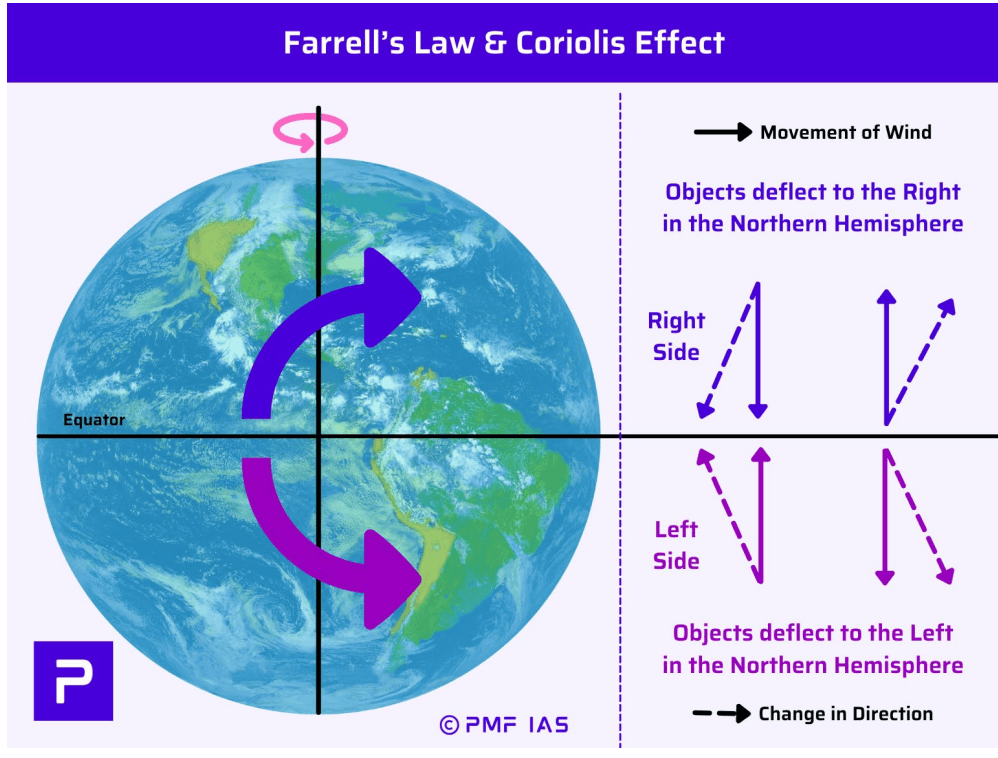
  • The rotation of the Earth about its axis affects the direction of the wind. This force is called the Coriolis force. It has a significant impact on the direction of the wind. Due to the earth’s rotation, winds do not cross the isobars at right angles as the pressure gradient force directs, but get deflected from their original path. This deviation is the result of the Earth’s rotation and is called the Coriolis effect or Coriolis force. Due to this effect, winds in the northern hemisphere get deflected to the right of their path and those in the southern hemisphere to their left, following Farrell’s Law (the law that wind is deflected to the right in the Northern Hemisphere and to the left in the Southern Hemisphere, derived from the application of the Coriolis effect to air masses). This deflection force does not seem to exist until the air is set in motion and increases with wind velocity, air mass, and latitude. The Coriolis force acts perpendicular to the pressure gradient force (pressure gradient force is perpendicular to an isobar). As a result of these two forces operating perpendicular to each other, in low-pressure areas, the wind blows around the centre (cyclonic conditions).

Farrell's Law and Coriolis Effect on Earth, showing wind movement and deflection directions relative to the equator. It includes arrows indicating wind movement, with objects deflecting right in Northern Hemisphere and left in Southern Hemisphere

Statement 2 is correct
  • The Coriolis force is directly proportional to the angle of latitude. It is at a maximum at the poles and absent at the equator. At the equator (Coriolis force is zero), wind blows perpendicular to the isobars. The low-pressure system fills instead of intensifying, i.e., there is no spiralling of air due to the zero Coriolis effect. The winds are directly uplifted vertically to form thunderstorms.
Answer: (c) Both 1 and 2: Difficulty Level: Easy

On June 21 every year, which of the following latitude(s) experience(s) a sunlight of more than 12 hours?

  1. Equator
  2. Tropic of Cancer
  3. Tropic of Capricorn
  4. Arctic Circle
Select the correct answer using the code given below:
  1. 1 only
  2. 2 only
  3. 3 and 4
  4. 2 and 4

Explanation

Equator is incorrect
  • The equator experiences approximately 12 hours of sunlight and 12 hours of darkness throughout the year, with only slight variations due to the Earth’s elliptical orbit.
Tropic of Cancer is correct
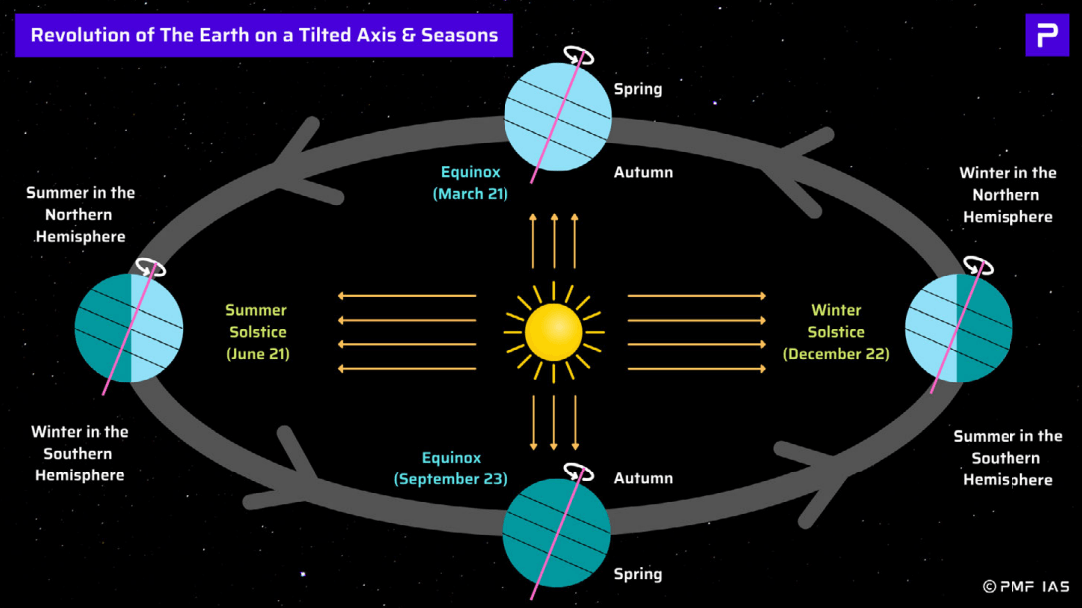
  • On June 21 (summer solstice in the Northern Hemisphere), the Sun is directly overhead at solar noon at the Tropic of Cancer. All locations on the Tropic of Cancer and northward up to the Arctic Circle experience sunlight for more than 12 hours on this day.
Tropic of Capricorn is incorrect
  • June 21 is the winter solstice in the Southern Hemisphere, and the Tropic of Capricorn experiences its shortest day of the year.
Arctic Circle is correct
  • During summer, the Arctic Circle experiences the midnight sun, with the sun remaining above the horizon for extended periods. As a result, places within the Arctic Circle have more than 12 hours of sunlight.

Earth's revolution around the sun with a tilted axis, showing four key positions: Summer Solstice (June 21), Winter Solstice (December 22), and Equinoxes (March 21 and September 23).

Answer: (d) 2 and 4: Difficulty Level: Easy

One of the following regions has the world’s largest tropical peatland, which holds about three years worth of global carbon emissions from fossil fuels; and the possible destruction of which can exert detrimental effect on the global climate.

Which one of the following denotes that region?
  1. Amazon Basin
  2. Congo Basin
  3. Kikori Basin
  4. Rio de la Plata Basin

Explanation

Option (b) is correct
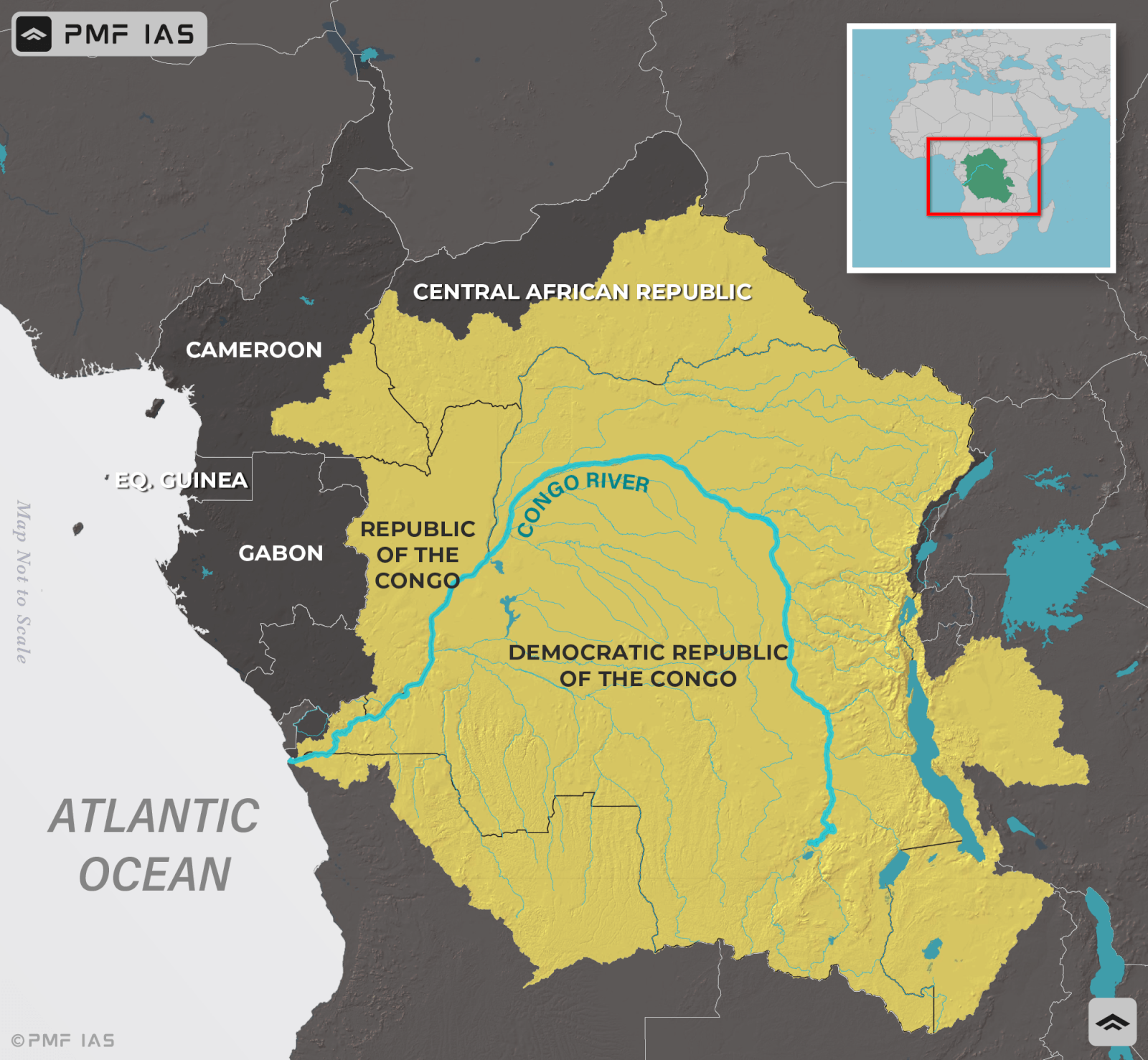
  • The Congo Basin is home to the world’s largest tropical peatlands, along with Brazil and Indonesia. The peat swamp forest of the Congo Basin stores around 29 billion tons of carbon – approximately equivalent to three years’ worth of global greenhouse gas emissions – while the Basin as a whole absorbs nearly 1.5 billion tons of carbon dioxide a year.

Map showing Republic of the Congo and Democratic Republic of the Congo highlighted in yellow within Central Africa, with surrounding countries and Atlantic Ocean labeled in dark gray. Congo River is marked in blue flowing through both countries, with an inset map indicating the region's location in Africa

Additional Information

  • Located in Central Africa, the Congo Basin is home to the world’s second-largest rainforest.
  • It covers six countries: Cameroon, Central African Republic, Democratic Republic of the Congo, Republic of the Congo, Equatorial Guinea, and Gabon.
  • The Congo Basin is the world’s second-largest carbon sink.
  • The Congo River (formerly the Zaire River) is the second-longest river in Africa.
    • It is the third-largest river in the world by discharge volume, following the Amazon and Ganges.
    • It is also the deepest river in the world.
    • It rises in the highlands of Zambia between Lakes Tanganyika and Nyasa (Malawi) as the Chambeshi River and drains into the Atlantic Ocean.
Option (a) is incorrect
  • The Amazon Basin is the largest ecosystem and tropical forest on the Earth.
  • It covers 9 countries: Brazil (60% of the Amazon rainforest), Peru, Ecuador, Colombia, Venezuela, Bolivia, French Guiana, Suriname, and the Republic of Guyana.
  • The Amazon River is the largest drainage system in the world in terms of the volume of its flow and the area of its basin.
    • Located in South America, it is the second-longest river in the world.
    • It originates in the Peruvian Andes and drains into the Atlantic Ocean.
    • It produces about 20% of the world’s freshwater flow into the oceans.
Option (c) is incorrect
  • The Kikori Basin stretches for over almost 23,300 km2 in Papua New Guinea’s (PNG) Southern Province.
  • The Kikori River is 445 km in length and is Papua New Guinea’s fifth largest river.
Option (d) is incorrect
  • The Río de la Plata drainage basin is one of the five greatest drainage basins in the world with special particularities to be recognized and admired.
  • It is formed by the discharge of waters from five countries — Argentina, Brazil, Uruguay, Bolivia and Paraguay — extending over some 3,100,000 km2.
Answer: (b) Congo Basin: Difficulty Level: Hard

With reference to perfluoroalkyl and polyfluoroalkyl substances (PFAS) that are used in making many consumer products, consider the following statements:

  1. PFAS are found to be widespread in drinking water, food and food packaging materials.
  2. PFAS are not easily degraded in the environment.
  3. Persistent exposure to PFAS can lead to bioaccumulation in animal bodies.
Which of the statements given above are correct?
  1. 1 and 2 only
  2. 2 and 3 only
  3. 1 and 3 only
  4. 1, 2 and 3

Explanation

All statements are correct
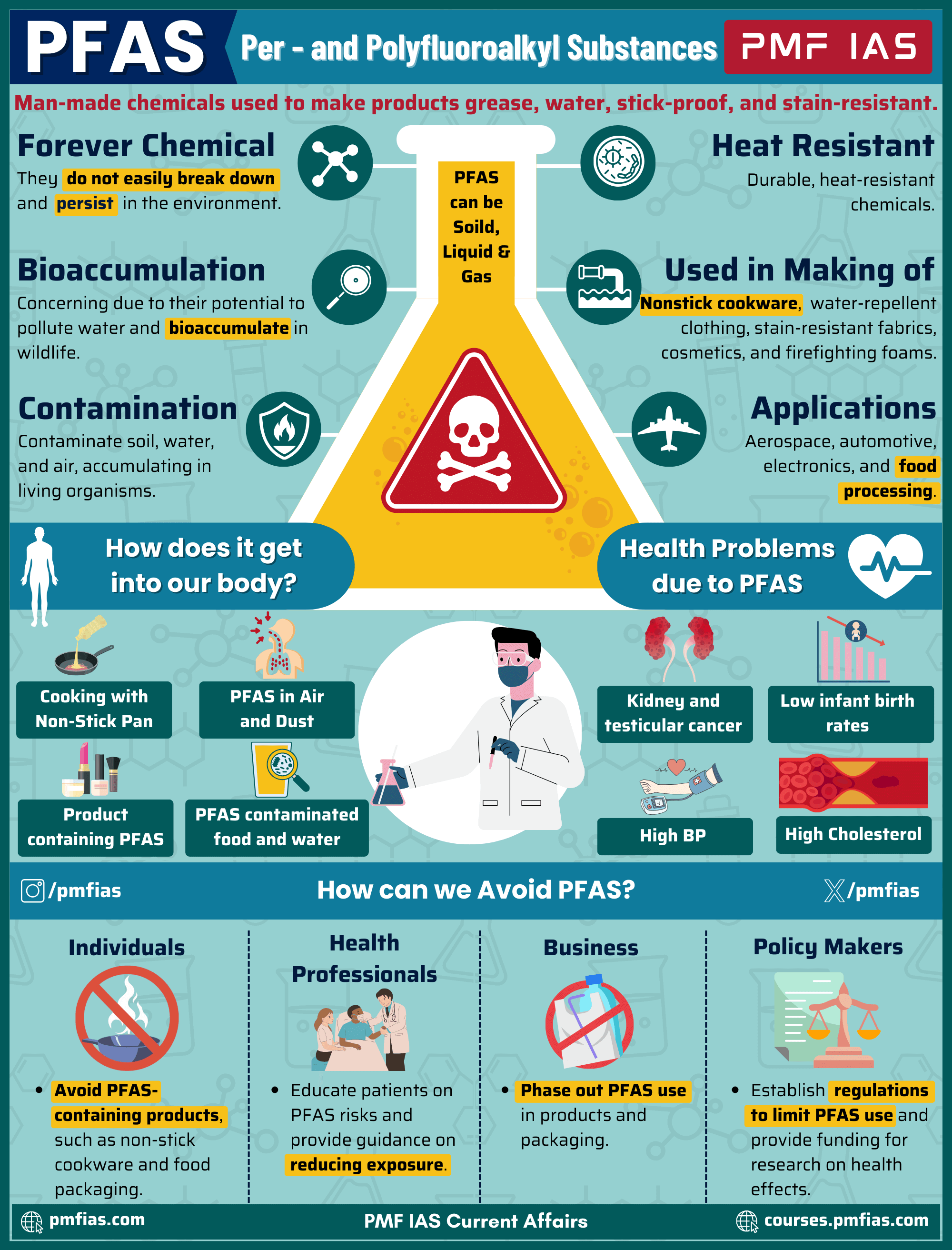
  • PFAS are widely used in various consumer products and, due to their persistent nature, can leach into the environment, contaminating water sources, food, and packaging materials. They are often referred to as “forever chemicals” because the strong carbon–fluorine bond makes them highly resistant to natural degradation processes, allowing them to persist in the environment for long periods. As a result, PFAS can accumulate in the tissues of animals and humans over time, raising potential health concerns.

PFAS (Per- and Polyfluoroalkyl Substances), highlighting their chemical stability, bioaccumulation, contamination routes, health risks like kidney cancer and high cholesterol, and common uses in nonstick cookware and textiles. It includes a warning triangle with a skull symbol, sections on exposure sources

Answer: (d) 1, 2 and 3: Difficulty Level: Medium

Consider the following:

  1. Carabid beetles
  2. Centipedes
  3. Flies
  4. Termites
  5. Wasps
Parasitoid species are found in how many of the above kind of organisms?
  1. Only two
  2. Only three
  3. Only four
  4. All five

Explanation

Option (b) is correct
  • Parasitoid species are organisms whose larvae live as parasites that eventually kill their hosts. They are primarily found among insects, particularly within certain orders. Many species of flies, carabid beetles (house beetles), and wasps are parasitoids. Centipedes and termites do not typically include parasitoid species.
Answer: (b) Only three: Difficulty Level: Hard

Consider the following plants:

  1. Groundnut
  2. Horse-gram
  3. Soybean
How many of the above belong to the pea family?
  1. Only one
  2. Only two
  3. All three
  4. None

Explanation

Groundnut is correct
  • The pea family, also known as the Fabaceae or Leguminosae family, includes a wide variety of plants commonly referred to as legumes. Legumes are vital sources of protein and nitrogen fixation in soil. Groundnuts, also known as peanuts, are members of the Fabaceae family, which is commonly referred to as the pea family or legume family.

Additional Information

  • India is the second largest producer of groundnuts behind China.
  • Major growing states are Gujarat, Andhra Pradesh, Tamil Nadu, Karnataka, Maharashtra, Rajasthan, Madhya Pradesh, Odisha, and Uttar Pradesh.
  • Groundnut is believed to have originated in South America, from where the cultivation of groundnut spread to Brazil, southern Bolivia and North-western Argentina. It is reported to have been introduced by the Portuguese from Brazil to West Africa and then to South-western India in the 16th century.
  • It is a tropical crop that requires 20°-30°C temperature and 50-75 cm rainfall.
  • Isohyet of 100 cm marks the upper limit for groundnut cultivation.
  • It is largely a rainfed kharif crop of drylands.
  • But in southern India, it is cultivated during the rabi season as well.
  • It is highly susceptible to frost, prolonged drought, continuous rain & stagnant water.
  • A dry winter is needed at the time of ripening.
  • Well-drained sandy loams, red, yellow and black cotton soils are well-suited.
Horse-gram is correct
  • Horse-gram belongs to the pea family (Fabaceae).

Additional Information

  • It is mainly cultivated in the states of Karnataka, Andhra Pradesh, Orissa, Tamil Nadu, M.P., Chhattisgarh, Bihar, W.B., Jharkhand, and in foot hills of Uttarakhand and H.P., in India.
  • Archaeological evidence suggests that horse gram has been consumed in India since 2000 BC, making it a culinary heritage with a deep-rooted history.
  • Horsegram is an extremely drought-resistant crop. Moderately warm, dry climatic conditions are suitable for its optimum growth.
  • Horse gram has antioxidant and osmolyte biosynthesis qualities which makes it a sturdy crop to thrive in extreme heat and long periods of drought.
  • It does not grow well on higher altitudes because of cool and wet climate.
  • The temperature range of 25-30°C and relative humidity between 50 and 80% is optimum for its growth.
  • A well-distributed rainfall of about 800 mm is sufficient for its successful cultivation, but it performs well even in low rainfall areas.
Soybean is correct
  • Soybean belongs to the pea family (Fabaceae).

Additional Information

  • The major soybean-producing states in India include Madhya Pradesh, Maharashtra, Rajasthan, Karnataka, and Telangana. Soybeans originated in China and were introduced to India centuries ago through the Himalayan routes, and also brought in via Burma (now Myanmar) by traders from Indonesia.
  • The crop is grown under warm conditions in the tropics, subtropics and temperate climates. Soybean is relatively resistant to low and very high temperatures but growth rates decrease above 35°C and below 18°C.
  • Soyabean needs about 15 to 32 degree C temperature for germination but for rapid growth the crop needs higher temperature.
  • The best soil type is sandy loam having good organic matter content.
Answer: (c) All three: Difficulty Level: Easy

Consider the following statements:

  1. Statement-I: The Indian Flying Fox is placed under the “vermin” category in the Wild Life (Protection) Act, 1972.
  2. Statement-II: The Indian Flying Fox feeds on the blood of other animals.
Which one of the following is correct in respect of the above statements?
  1. Both Statement-I and Statement-II are correct and Statement-II explains Statement-I
  2. Both Statement-I and Statement-II are correct, but Statement-II does not explain Statement-I
  3. Statement-I is correct, but Statement-II is incorrect
  4. Statement-I is incorrect, but Statement-II is correct

Explanation

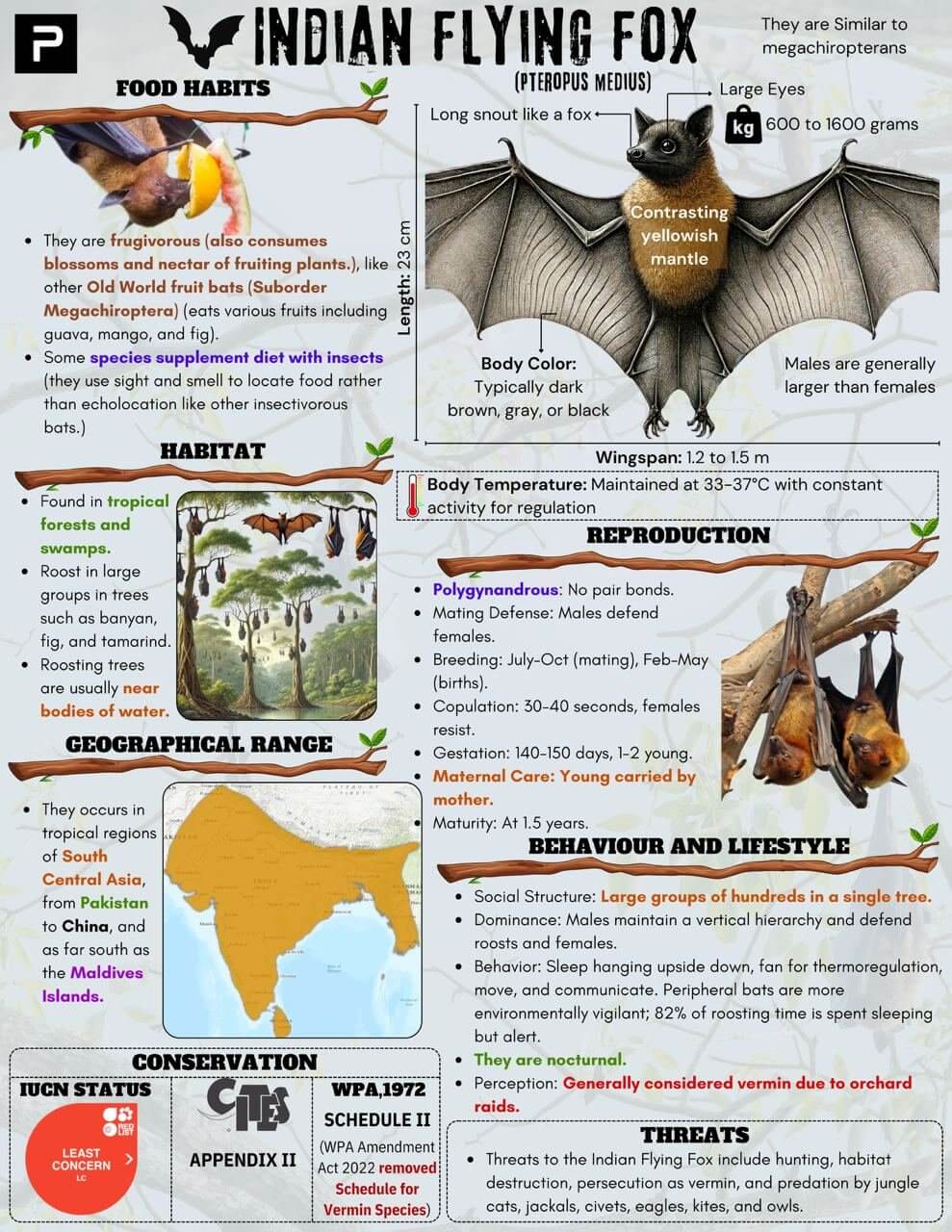
Indian Flying Fox (Pteropus medius) detailing food habits, habitat, geographical range, reproduction, behavior, and conservation status

Answer: (X) Dropped

The total fertility rate in an economy is defined as:

  1. the number of children born per 1000 people in the population in a year.
  2. the number of children born to a couple in their lifetime in a given population.
  3. the birth rate minus death rate.
  4. the average number of live births a woman would have by the end of her childbearing age.

Explanation

Option (d) is correct
  • The total fertility rate (TFR) is the average number of children a woman would have at the end of her reproductive years, expressed as births per woman.
  • How is the Total Fertility Rate calculated?
    • TFR is directly calculated as the sum of age-specific fertility rates (usually referring to women aged 15 to 49), or five times the sum if data are given in five-year age groups.
    • An age- or age-group-specific fertility rate is calculated as the ratio of annual births to women at a given age or age group to the population of women at the same age or age group in the same year for a given country, territory, or geographic area.

Additional Information: What does a Total Fertility Rate (TFR) of 2.0 mean?

  • A total fertility rate (TFR) of 2.0 is the replacement rate, which means that a population can replace itself from one generation to the next without external migration.

What is the Replacement Fertility Rate?

  • Replacement level fertility is the total fertility rate—the average number of children born per woman—at which a population exactly replaces itself from one generation to the next, without migration.
  • This rate is roughly 2.1 children per woman for most countries, although it may modestly vary with mortality rates.
Answer: (d) the average number of live births a woman would have by the end of her childbearing age: Difficulty Level: Easy

Consider the following statements:

  1. In India, Non-Banking Financial Companies can access the Liquidity Adjustment Facility window of the Reserve Bank of India.
  2. In India, Foreign Institutional Investors can hold the Government Securities (GSecs).
  3. In India, Stock Exchanges can offer separate trading platforms for debts.
Which of the statements given above is/are correct?
  1. 1 and 2 only
  2. 3 only
  3. 1, 2 and 3
  4. 2 and 3 only

Explanation

Statement 1 is correct
  • RBI’s website states that Primary Dealers can also access the facility. Since PDs are classified as NBFCs, the statement is correct.

Additional Information

  • The liquidity-adjustment facility (LAF) is a monetary policy tool used in India since 1998, when it was introduced by the RBI as part of the recommendations of the Narasimham Committee on banking sector reforms. The RBI manages liquidity using tools provided under the LAF and ensures financial stability by offering banks the opportunity to borrow money through repurchase agreements, or repos, or to make loans to the RBI via reverse repo agreements. Since liquidity in the system could be managed by using repo and reverse repo, it can also influence money supply and inflation.
Statement 2 is correct
  • Foreign Institutional Investors (FIIs) can hold Government Securities (G-Secs) in India. The Reserve Bank of India (RBI) introduced the Fully Accessible Route (FAR) in March 2020, allowing foreign investors, including NRIs and OCIs, to invest in specified central government bonds without any investment ceiling.
Statement 3 is correct
  • Stock Exchanges in India can offer separate trading platforms for debt securities. For example, the platform NSE-EBP (Electronic Debt Bidding Platform) was launched to facilitate online bidding for private placement of debt securities.
Answer: (c) 1, 2 and 3: Difficulty Level: Hard

In India, which of the following can trade in Corporate Bonds and Government Securities?

  1. Insurance Companies
  2. Pension Funds
  3. Retail Investors
Select the correct answer using the code given below:
  1. 1 and 2 only
  2. 2 and 3 only
  3. 1 and 3 only
  4. 1, 2 and 3

Explanation

All are correct
  • All three categories, Insurance Companies, Pension Funds, and Retail Investors, are permitted to trade in both corporate bonds and government securities in India.
    • Insurance companies can invest in both corporate bonds and government securities. Investment guidelines for Insurance companies are regulated by IRDAI.
    • Pension funds can invest in both corporate bonds and government securities for diversification and steady income. Investment guidelines for Pension funds are prescribed by PFRDA.
    • Retail investors, too, can invest in both corporate bonds and government securities in India. RBI Retail Direct Scheme, launched in November 2021, gives access to individual investors to maintain gilt accounts with the RBI and invest in government securities.
Answer: (d) 1, 2 and 3: Difficulty Level: Easy

Consider the following:

  1. Exchange-Traded Funds (ETF)
  2. Motor vehicles
  3. Currency swap
Which of the above is/are considered financial instruments?
  1. 1 only
  2. 2 and 3 only
  3. 1, 2 and 3
  4. 1 and 3 only

Explanation

Exchange-Traded Funds (ETFs) are correct
  • ETFs are financial instruments. It is called an exchange-traded fund because it’s traded on a stock exchange, like stocks, but holds multiple underlying assets rather than a single stock. Like mutual funds, an ETF pools money from investors and channels it into a basket of stocks, mirroring an index and its performance. Unlike mutual funds, an ETF trades like a common stock on a stock exchange, and its price fluctuates throughout the day. The trading value of ETF depends on the Net Asset Value (NAV) of the underlying stock it represents.
Motor vehicles are incorrect
  • Motor vehicles are tangible physical assets, not financial instruments. They are used for transport, not for capital transfer or financial contracts.
Currency swaps are correct
  • Currency swaps are derivative financial instruments. In a currency swap, counterparties exchange equivalent amounts of two different currencies and trade back at a later specified date. Swaps can be used to hedge against exchange-rate risk, speculate on currency moves, and borrow foreign exchange at lower interest rates.
Answer: (d) 1 and 3 only: Difficulty Level: Easy

With reference to the sectors of the Indian economy, consider the following pairs:

Activity Sector
  1. Storage of agricultural produce
Secondary
  1. Dairy farm
Primary
  1. Mineral exploration
Tertiary
  1. Weaving cloth
Secondary
How many of the pairs given above are correctly matched?
  1. Only one
  2. Only two
  3. Only three
  4. All four

Explanation

Pair 1 is incorrect
  • Storage is a tertiary (service) sector activity, as it involves services rather than the transformation of goods.
Pair 2 is correct
  • Dairy farming involves the production of milk and other dairy products and belongs to the primary sector.
Pair 3 is incorrect
  • Mineral exploration involves the extraction of raw materials from the earth, thus part of the primary sector.
Pair 4 is correct
  • Weaving cloth is a manufacturing process that transforms raw materials (such as cotton or wool) into finished products (fabric), and thus, it belongs to the secondary sector.

Additional Information

  • The three main types of economic sectors are primary, secondary and tertiary economic sectors.
    • Those economic activities in which people are directly dependent on nature to produce goods are known as primary sector economic activities such as agriculture and raising livestock.
    • Economic activities in which people are dependent on outputs of the primary sector and transform them to produce goods are known as secondary sector economic activities such as construction and water supply.
    • All those economic activities that provide support to people involved in primary and secondary activities are called tertiary sector economic activities such as healthcare and communication.
Answer: (b) Only two: Difficulty Level: Easy

Consider the following materials:

  1. Agricultural residues
  2. Corn grains
  3. Wastewater treatment sludge
  4. Wood mill waste
Which of the above can be used as feedstock for producing Sustainable Aviation Fuel?
  1. 1 and 2 only
  2. 2 and 4 only
  3. 1, 2, 3 and 4
  4. 1, 3 and 4 only

Explanation

All are correct
  • Also known as Bio-Jet Fuel, Sustainable Aviation Fuel (SAF) is a carbon-reduction solution that is available for use in aircraft and helicopters. It is a “drop-in” fuel that can be blended up to 50% with traditional jet fuel. Its chemical and physical properties are similar to conventional jet fuel. It can be used in existing aircraft engines without modifications and can be blended with conventional jet fuel, making it relatively easy to integrate into existing aviation infrastructure.
  • Feedstocks for SAF:
    • Corn grain
    • Oil seeds
    • Algae
    • Agricultural and forestry residues
    • Wood mill waste
    • Municipal solid waste streams
    • Wet wastes (manures, wastewater treatment sludge)
Answer: (c) 1, 2, 3 and 4; Difficulty Level: Easy

With reference to physical capital in Indian economy, consider the following pairs:

Items Category
  1. Farmer’s plough
Working capital
  1. Computer
Fixed capital
  1. Yarn used by the weaver
Fixed capital
  1. Petrol
Working capital
How many of the above pairs are correctly matched?
  1. Only one
  2. Only two
  3. Only three
  4. All four

Explanation

Pair 1 is incorrect
  • Fixed capital, comprising long-term assets like buildings and machinery, forms the foundation for sustained growth while working capital addresses short-term financial needs for day-to-day operations. A farmer’s plough is a tool used repeatedly over many years in agricultural production. Therefore, it is correctly categorised as fixed capital rather than working capital.
Pair 2 is correct
  • Computers are used over an extended period for various functions in production, education, business operations, etc. Hence, a computer is correctly categorised as fixed capital.
Pair 3 is incorrect
  • Yarn is a raw material consumed in the production of textiles. It is typically consumed in the production process and does not last beyond the product’s completion. Therefore, yarn used by a weaver is considered working capital, not fixed capital.
Pair 4 is correct
  • Petrol is a consumable resource used up during the operation of vehicles, machinery, etc. It is generally consumed within a short period, making it an example of working capital.
Answer: (b) Only two; Difficulty Level: Easy

Which one of the following words/phrases is most appropriately used to denote “an interoperable network of 3D virtual worlds that can be accessed simultaneously by millions of users, who can exert property rights over virtual items.”?

  1. Big data analytics
  2. Cryptography
  3. Metaverse
  4. Virtual matrix

Explanation

Option (c) is correct
  • The metaverse refers to a future iteration of the internet that uses virtual reality (VR), augmented reality (AR), and other technologies to create a persistent, shared virtual world.
  • Some key characteristics of the metaverse:
    • Three-dimensionality: It’s envisioned as a 3D space, unlike the current flat experience of the internet.
    • Social interaction: Users will be able to interact with each other in real-time through avatars, fostering a sense of community and presence.
    • Economic activity: It’s expected to have its own economy where users can buy, sell, and own virtual items using cryptocurrencies or other digital tokens.
Answer: (c) Metaverse: Difficulty Level: Easy

With reference to the rule/rules imposed by the Reserve Bank of India while treating foreign banks, consider the following statements:

  1. There is no minimum capital requirement for wholly owned banking subsidiaries in India.
  2. For wholly owned banking subsidiaries in India, at least 50% of the board members should be Indian nationals.
Which of the statements given above is/are correct?
  1. 1 only
  2. 2 only
  3. Both 1 and 2
  4. Neither 1 nor 2

Explanation

Statement 1 is incorrect
  • A wholly-owned subsidiary is a subsidiary that is fully owned and controlled by a parent firm. In banking terminology, it implies that a foreign bank can establish an Indian company in its full ownership and conduct banking locally, similar to Indian banks. The RBI’s “Scheme for Setting up of WOS by Foreign Banks in India” was introduced to give foreign banks greater freedom to grow in India while ensuring they comply with India’s banking regulations. Under this scheme, a foreign bank can either establish a new subsidiary or convert its existing branches into a subsidiary. The minimum paid-up voting equity capital for a wholly owned subsidiary is 5 billion rupees.
Statement 2 is incorrect
  • As per the Scheme for setting up wholly owned subsidiaries by foreign banks in India, at least 50% of the directors must be Indian nationals, NRIs, or PIOs, with the specific requirement that one-third of the directors must be Indian nationals residing in India. The statement is incorrect because it limits the 50% requirement only to “Indian nationals,” thereby excluding NRIs and PIOs. Additionally, there is a separate requirement that at least one-third of the directors must be Indian nationals who are resident in India.
Answer: (d) Neither 1 nor 2: Difficulty Level: Hard

With reference to Corporate Social Responsibility (CSR) rules in India, consider the following statements:

  1. CSR rules specify that expenditures that benefit the company directly or the employees will not be considered as CSR activities.
  2. CSR rules do not specify minimum spending on CSR activities.
Which of the statements given above is/are correct?
  1. 1 only
  2. 2 only
  3. Both 1 and 2
  4. Neither 1 nor 2

Explanation

Statement 1 is correct
  • Corporate Social Responsibility (CSR) integrates social and environmental considerations into business operations. In India, the CSR framework is established by Section 135 of the Companies Act, 2013, which mandates eligible companies to contribute towards societal development
  • NON-permissible CSR Activities:
    • Activities undertaken in pursuance of the normal course of business of the company.
    • Any activity undertaken by the company outside India except for the training of Indian sports personnel representing any State or Union territory at the national level or India at the international level.
    • Contribution of any amount directly or indirectly to any political party under section 182 of the Act.
    • Activities benefitting employees of the company.
    • Activities supported by the companies on a sponsorship basis for deriving marketing benefits for its products or services.
    • Activities carried out for the fulfilment of any other statutory obligations under any law in force in India.
Statement 2 is incorrect
  • Eligibility Criteria for CSR: The CSR law applies to companies that meet any of the following criteria: a net worth of ₹500 crore or more, an annual turnover of ₹1,000 crore or more, or a net profit of ₹5 crore or more in the previous financial year.
  • CSR Spend Requirement: Eligible companies must allocate at least 2% of their average net profit from the previous 3 years towards CSR activities.
  • Penalty for Non-Compliance: Penalties are imposed if companies fail to meet the 2% CSR spend requirement and do not transfer the unspent amount to a specified fund.
  • CSR Registration: Companies intending to undertake CSR activities must register with the Registrar of Companies. This ensures their CSR initiatives comply with the legal framework and are monitored.
Answer: (a) 1 only: Difficulty Level: Easy

With reference to radioisotope thermoelectric generators (RTGs), consider the following statements:

  1. RTGs are miniature fission reactors
  2. RTGs are used for powering the onboard systems of spacecrafts.
  3. RTGs can use Plutonium-238, which is a by-product of weapons development.
Which of the statements given above are correct?
  1. 1 and 2 only
  2. 2 and 3 only
  3. 1 and 3 only
  4. 1, 2 and 3

Explanation

Statement 1 is incorrect
  • RTGs do not involve nuclear fission reactions. Instead, they utilise the heat generated from the radioactive decay of isotopes to generate electricity.
Statement 2 is correct
  • RTGs have been used in various space missions to provide power to spacecraft where solar power is not feasible (e.g., missions beyond the orbit of Mars).
Statement 3 is correct
  • Plutonium-238 (a by-product of weapons development) is a suitable isotope for RTGs due to its long half-life and the high heat it generates during decay. The half-life of an isotope is the time required for half of the atoms in a sample of the isotope to undergo radioactive decay. It tells you the rate at which the isotope decays.
Answer: (b) 2 and 3 only: Difficulty Level: Medium

Consider the following statements:

  1. Statement-I: Giant stars live much longer than dwarf stars.
  2. Statement-II: Compared to dwarf stars, giant stars have a greater rate of nuclear reactions.
Which one of the following is correct in respect of the above statements?
  1. Both Statement-I and Statement-II are correct and Statement-II explains Statement-I
  2. Both Statement-I and Statement-II are correct but and Statement-II does not explains Statement-I
  3. Statement-I is correct, but Statement-II is incorrect
  4. Statement- I is incorrect, but Statement-II is correct

Explanation

Statement 1 is incorrect
  • Giant stars, due to their greater mass and higher rates of nuclear fusion, have shorter lifespans. Dwarf stars, being less massive, have lower internal temperatures and pressures, resulting in slower nuclear fusion rates and longer lifespans than Giant stars
Statement 2 is correct
  • Giant stars, being more massive, have higher core temperatures and pressures than dwarf stars, leading to faster nuclear fusion. This results in higher luminosity and faster fuel depletion.
Answer: (d) Statement-I is incorrect, but Statement-II is correct: Difficulty Level: Easy

Which one of the following is synthesised in human body that dilates blood vessels and increase blood flow?

  1. Nitric oxide
  2. Nitrous oxide
  3. Nitrogen dioxide
  4. Nitrogen pentoxide

Explanation

Option (a) is correct
  • Nitric oxide: It acts as a vasodilator, meaning it causes blood vessels to relax and widen, increasing blood flow to tissues throughout the body. It plays a crucial role in regulating blood pressure and overall cardiovascular health.
  • Examples of natural vasodilators:
    • L-arginine
    • L-citrulline
    • Glycine
    • propionyl-L-carnitine
    • (GPLC)
    • Nitric oxide
    • Ginger
    • Ginkgo biloba
    • Turmeric
  • Nitrous oxide: Also known as laughing gas, it is used for anaesthesia and pain relief.
  • Nitrogen dioxide: It is an air pollutant and can actually restrict blood flow.
  • Nitrogen pentoxide: It is a strong oxidising agent.
Answer: (a) Nitric oxide: Difficulty Level: Medium

Consider the following activities:

  1. Identification of narcotics on passengers at airports or in aircraft
  2. Monitoring of precipitation
  3. Tracking the migration of animals
In how many of the above activities can the radars be used?
  1. Only one
  2. Only two
  3. All three
  4. None

Explanation

Activity 1 is incorrect
  • Radars are not used for identifying narcotics. This is usually done through the use of other scanning technologies.
Activity 2 is correct
  • Radars can detect rain, snow, sleet, and other types of precipitation.
Activity 3 is correct
  • Radars can track the movement of birds, bats, and even insects over long distances.
Answer: (b) Only two: Difficulty Level: Easy

Consider the following aircraft:

  1. Rafael
  2. MiG-29
  3. Tejas MK-1
How many of the above are considered fifth generation fighter aircraft?
  1. Only one
  2. Only two
  3. All three
  4. None

Explanation

All are incorrect
  • Rafale: The Dassault Rafale is a French twin-engine, multi-role fighter aircraft. It is classified as a 4.5- generation fighter aircraft.

Dassault Rafale fighter jet, a 4.5 generation multirole combat aircraft with key features including two engines enabling supercruise, Mach 1.8 speed, 1,000 km combat radius, and advanced avionics like RBE2 AESA radar and Helmet Mounted Display.

  • MiG-29: The Mikoyan MiG-29 is a fourth-generation jet fighter aircraft designed in the Soviet Union.
  • Tejas MK-1: The HAL Tejas is an Indian single-engine, multirole light fighter. It is considered to be a fourth-generation fighter aircraft.
  • Fifth-generation fighter jets represent the most advanced operational aircraft, featuring stealth technology, advanced avionics, and networked data fusion. Key examples include the US F-22 Raptor and F-35 Lightning II, China’s Chengdu J-20 and Shenyang J-35, and Russia’s Sukhoi Su-57.

indigenous aircraft families of India's armed forces, categorized into Tejas, AMCA, and HAL Trainer families

Answer: (d) None: Difficulty Level: Easy

In which of the following are hydrogels used?

  1. Controlled drug delivery in patients.
  2. Mobile air-conditioning systems.
  3. Preparation of industrial lubricants.
Select the correct answer using the code given below:
  1. 1 only
  2. 1 and 2 only
  3. 2 and 3 only
  4. 1, 2 and 3

Explanation

Controlled drug delivery in patients is correct
  • Hydrogels are three-dimensional spatial network systems that use water as the dispersing medium, are soft in nature, can maintain a certain shape, and have strong water absorption capacity (water content can be as high as 99%). In addition, hydrogels also have good biocompatibility, biodegradability, etc. They are widely used in biomedical fields. They are extensively utilised in controlled drug delivery systems. They can encapsulate drugs and release them in a controlled manner in response to stimuli such as pH changes, temperature variations, or specific enzymes.
Mobile air-conditioning systems is incorrect
  • Although hydrogels can absorb moisture and have thermal properties, their application in air-conditioning is not significant. They are not yet in active use.
Preparation of industrial lubricants is incorrect
  • Hydrogels are not used in the preparation of industrial lubricants, which typically require oil-based or synthetic substances for reducing friction.
Answer: (a) 1 only: Difficulty Level: Hard

Which one of the following is the exhaust pipe emission from Fuel Cell Electric Vehicles, powered by hydrogen?

  1. Hydrogen peroxide
  2. Hydronium
  3. Oxygen
  4. Water vapour

Explanation

Option (d) is correct
  • Fuel Cell Electric Vehicles (FCEVs) powered by hydrogen use clean and efficient technology. In an FCEV, hydrogen gas reacts with oxygen from the air in a fuel cell to produce electricity.
    This electricity powers the electric motor that propels the vehicle. The only byproduct of this reaction is water vapour (H₂O). So, FCEVs emit clean water vapour instead of harmful pollutants like nitrogen oxides, carbon monoxide, and hydrocarbons typically found in exhaust from gasoline-powered vehicles.
Answer: (d) Water Vapour: Difficulty Level: Easy

Recently the term “pumped-storage hydropower” is actually and appropriately discussed in the context of which one of the following?

  1. Irrigation of terraced crop fields
  2. Lift irrigation of cereal crops
  3. Long duration energy storage
  4. Rainwater harvesting system

Explanation

Option (c) is correct
  • Pumped storage hydropower (PSH) is a type of hydroelectric energy storage. It is a configuration of two water reservoirs at different elevations that can generate power as water moves down from one to the other (discharge), passing through a turbine. The system also requires power to pump water back into the upper reservoir (recharge). PSH acts like a giant battery because it can store energy and release it when needed.
Answer: (c) Long Duration energy storage: Difficulty Level: Medium

“Membrane Bioreactors” are often discussed in the context of

  1. Assisted reproductive technologies
  2. Drug delivery nanotechnologies
  3. Vaccine production technologies
  4. Wastewater treatment technologies

Explanation

Option (d) is correct
  • Membrane Bioreactor (MBR) is an advanced wastewater treatment technology that integrates biological treatment based on the activated sludge process with membrane filtration, such as microfiltration or ultrafiltration. In this system, microorganisms break down organic pollutants in the bioreactor, and instead of using a conventional secondary clarifier for separation, membranes are employed to retain biomass and suspended solids, thereby producing high-quality treated water.
Answer: (d) Wastewater treatment technologies: Difficulty Level: Medium

With reference to the Indian economy, “Collateral Borrowing and Lending Obligations” are the instruments of:

  1. Bond market
  2. Forex market
  3. Money market
  4. Stock market

Explanation

Option (c) is correct
  • A collateralised borrowing and lending obligation (CBLO) is a money market instrument in India that connects borrowers and lenders for short-term funds. Similar to bonds, CBLOs involve lending and borrowing, but they require collateral, which helps reduce the risk of default. Primarily used to manage short-term liquidity, they are overseen by the Clearing Corporation of India Limited (CCIL) and regulated by the Reserve Bank of India (RBI). The collateral provides security for lenders, making them safer and more reliable in the money market.
Answer: (c) Money Market: Difficulty Level: Easy