Context (TH | IE): ISRO completed human rating of its CE20 cryogenic engine that powers the cryogenic stage of the human-rated LVM3 launch vehicle for Gaganyaan mission.
Human-rating refers to rating a system that is capable of safely transporting humans.
The final test was carried out at the High Altitude Test Facilityat ISRO Propulsion Complex, Mahendragiri, to simulate the flight conditions.
The ground qualification tests involved life demonstration tests, endurance tests, and performance assessment under nominal operating conditions as well as off-nominal conditions w.r.t thrust, mixture ratio, and propellant tank pressure.
CE20 Cryogenic Engine
The CE-20 is a cryogenic rocket engine developed by the Liquid Propulsion Systems Centre (LPSC), a subsidiary of the Indian Space Research Organisation (ISRO).
It has been developed to power the upper stage of the LVM3.
It is the first Indian cryogenic engine to feature a gas-generator cycle.
LVM3 Launch Vehicle
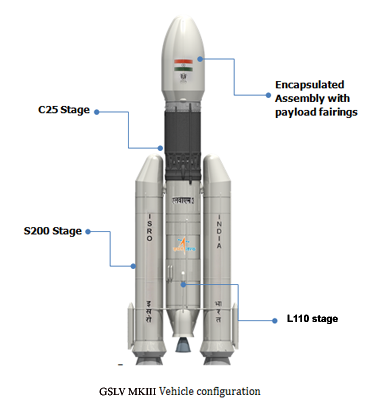
It is a three-stage vehicle with a 110 ton core liquid propellant stage (L-110) and a strap-on stage with two solid propellant motors, each with 200 tons propellant (S-200).
The upper stage will be cryogenic fueled with a propellant loading of 25 tons (C-25).
The LVM-3 has a lift-off mass of 640 tonnes, and it can carry a payload of up to 4,000 kilograms into geosynchronous transfer orbit (GTO) at 35,000km.
Gaganyaan Mission
Gaganyaan is the 1st human space flight programme of ISRO.
Objective: To demonstrate indigenous capability of human space flight to low earth orbit.
Launch vehicle: GSLV-Mk III, also called the LVM-3 (Launch Vehicle Mark-3).
Payloads:
Crew Module: It is the spacecraft carrying human beings.
Service Module: It will support the crew module and is powered by liquid propellant engines.
This mission consists of:
Two unmanned missions (G1 & G2): 2nd uncrewed mission (G2) will carry “Vyommitra” (a female-looking humanoid robot developed by ISRO to function on-board the Gaganyaan).
One manned mission (G3): The Orbital Module of the crewed mission will carry three Indian astronauts, including a woman into space for 7 days. It will orbit the Earth at a low-earth-orbit at an altitude of 300-400 km.
Russia and France are cooperating with India for Gaganyaan mission.