

PSLV C56 Mission, Polar Satellite Launch Vehicle (PSLV), New Space India Ltd (NSIL)
PSLV C56 Mission
- Context (TH | LM ): During PSLV C56 mission, ISRO’s PSLV successfully placed seven Singaporean satellites into intended orbits.
Significance of PSLV C56 Mission
- PSLV C56 mission is the second commercial mission of ISRO’s NSIL.
- The mission is designed to mitigate the space debris problem.
- Normally, after a successful mission, a rocket stays in orbit for “decades” as space debris, before re-entering into Earth’s atmosphere.
- But in this mission after placing customer satellites at an altitude of 536 km, the rocket will be lowered into a 300 km high orbit.
- Due to the orbit-lowering, the duration of space debris generated from this mission in space will be reduced to two months.
|
Polar Satellite Launch Vehicle (PSLV)
- PSLV is an indigenous expendable launch system developed in the 1990s by ISRO.
- It is called the ‘workhorse of ISRO’ because it has the highest number of successful launches.
|
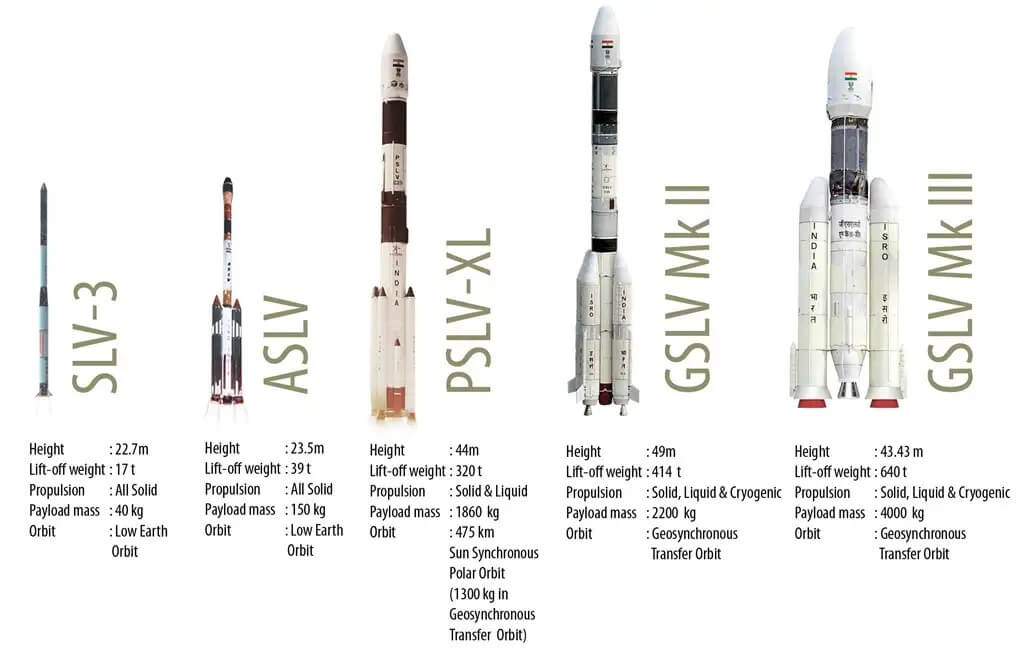
Orbits in which PSLV Places Satellites
Polar and Near Polar (e.g. sun-synchronous orbit) Lower Earth Orbits
- PSLV was developed to place satellites (mostly remote sensing satellites) in polar and near polar (e.g. sun-synchronous orbit) Lower Earth Orbits.
- E.g., Astrosat (India’s first space observatory)
Geosynchronous Transfer Orbits
- Initially PSLV was developed to place satellites only on Low Earth Orbits. But, in the last decade, PSLV was successful in sending several satellites also toward geosynchronous transfer orbits.
- E.g. Chandrayaan-1 (India’s first lunar probe) and Mars Orbiter Mission or Mangalyaan (India’s first interplanetary mission).
Stages of PSLV
- PSLV is a four stage launch vehicle.
- First stage and third stage are solid-fuelled stages.
- Second stage and fourth stage are liquid-fuelled stages.
- The second stage engine, Vikas, is a derivative of France’s Viking engine.
New Space India Ltd (NSIL)
- New Space India Ltd (NSIL) is a Public Sector Enterprise (under the Companies Act, 2013).
- It is under the administrative control of the Department of Space.
- It is the commercial wing of the ISRO.
- Objective: to commercially exploit the Research and Development work of the ISRO.
Space Business Activities of NSIL
- Owning satellites for Earth Observation and Communication applications.
- Building satellites and launching them as per demand.
- Providing launch services for satellite belonging to customer.
- Building launch vehicles through Indian Industry and Launch as per satellite customer requirement.
- Space-based services related to Earth Observation and Communication on a commercial basis.
- Satellite building through Indian Industry
- Technology Transfer to Indian Industry
- Marketing spin-off (commercial) technologies and products/services emanating out of ISRO.


