Download Prelims Magnum 2026 — Yearly [FREE] ★                      ★ Prelims Cracker 2026 Combo Deal ⚡️ Magnum Crash Course + Test Series ★                      ★ PMF IAS Impact 🎯 53 Direct Hits in Prelims 2025 ★

World Health Organisation (WHO): Governance, Achievements & Issues

Prelims Cracker
Prelims Cracker
  • Context (TH): Trump signs executive order withdrawing U.S. from the World Health Organization (WHO).

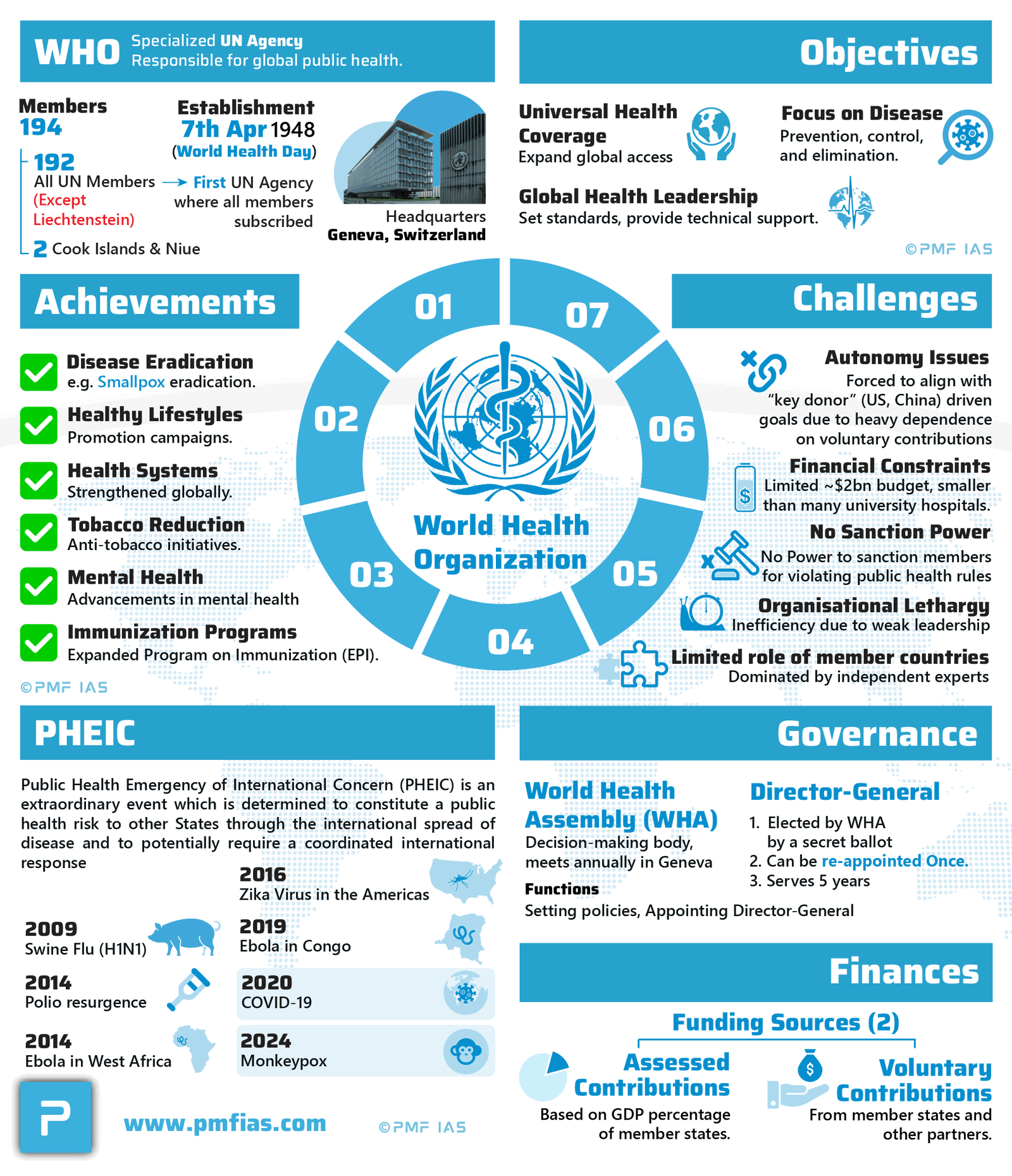
About World Health Organisation

  • World Health Organisation is a specialised agency of the UN responsible for international public health.
  • It was established on 7 April 1948. The day is now being celebrated every year as World Health Day.
  • Headquarters: Geneva, Switzerland.
  • The World Health Report (WHR) is a series of annual reports produced by the WHO.
  • Currently, it has 194 members (including India). All UN member states except for Liechtenstein (192 countries), plus Cook Island and Niue.
  • It became the first specialised agency of the UN to which every member subscribed.

World Health Organisation (WHO)

Governance

World Health Assembly (WHA)

  • The World Health Assembly is the decision-making body.
  • It is held annually in Geneva, Switzerland, and is attended by all Member States delegations.
  • The main functions of the World Health Assembly are to:
    1. Determine the policies of the Organization.
    2. Appoint the Director-General.

Director-General

  • The director-general is WHO’s chief technical and administrative officer.
  • A Director-General is elected by the World Health Assembly by a secret ballot.
  • The director-general holds the office for five years and can be re-appointed once.

Executive Board

  • It is composed of 34 technically qualified members elected for three-year terms.
  • The main function of the Board is to implement the decisions and policies of the Health Assembly.

Objectives of WHO

  • Lead global efforts to expand universal health coverage.
  • Focus on the areas of disease prevention, control and elimination, and the promotion of health and well-being.
  • Provide leadership on global health issues, set standards for public health, and provide technical assistance and support to countries.
  • Collaborate with various partners, including other UN agencies, governments, civil society organizations, and the private sector.

Regional Offices

  • WHO Member States are grouped into six regions. These are:
    1. WHO Africa Region
    2. WHO Americas Region
    3. WHO Europe Region
    4. WHO Western Pacific Region
    5. WHO Eastern Mediterranean Region
    6. WHO South-East Asia Region
  • Each region has a regional office and regional committee.

WHO South-East Asia Region

  • It has eleven Member States: Bangladesh, Bhutan, Democratic People’s Republic of Korea, India, Indonesia, Maldives, Myanmar, Nepal, Sri Lanka, Thailand, and Timor-Leste.
  • The WHO South-East Asia Regional office is based in New Delhi, India.

Regional Committee of the WHO

  • It consists of all the Health Department heads, in all the governments of the countries in that Region.
  • It generally meets once a year.
  • It elects the regional director who serves for a once-renewable five-year term.

WHO Finances

  • WHO gets its funding from two main sources:
    1. Member States paying their assessed contributions (countries’ membership dues), and
    2. Voluntary contributions from Member States and other partners.

Assessed Contributions (AC)

  • Assessed contributions are a percentage of a country’s gross domestic product (the percentage is agreed by the United Nations General Assembly).
  • Member States approve them every two years at the World Health Assembly.
  • They cover less than 20% of the total budget.

Voluntary Contributions

  • Voluntary contributions come from Member States (in addition to their assessed contribution) or from other partners.
  • In recent years, voluntary contributions have accounted for more than three-quarters of the Organization’s financing.

Core voluntary contributions

  • Core voluntary contributions are fully unconditional (flexible), i.e. WHO has complete discretion on how these funds should be used to fund the organisation’s programmatic work.
  • These represent 4.1% of all voluntary contributions.

Specified voluntary contributions

  • Specified voluntary contributions represent 88% of all voluntary contributions.
  • They are tightly earmarked to specific programmatic areas and/or geographical locations and must be spent within a specified timeframe.

WHO Foundation

  • The WHO Foundation is an independent grant-making foundation focused on addressing the most pressing global health challenges of today and tomorrow.
  • Headquartered in Geneva and legally independent from WHO, the Foundation works with individual donors, the general public and corporate partners to support global public health needs.

Public health emergency of international concern (PHEIC)

  • A PHEIC is defined in the IHR (2005) as, “an extraordinary event which is determined to constitute a public health risk to other States through the international spread of disease and to potentially require a coordinated international response”.
  • WHO has declared PHEIC eight times:
    1. In 2009 (swine flu (H1N1) epidemic)
    2. In 2014 (reversal of progress in eradicating polio);
    3. In 2014 (Ebola outbreak in West Africa);
    4. In 2016 (Zika virus outbreak in the Americas);
    5. In 2019, (Ebola epidemic reached the city of Goma in the Democratic Republic of Congo);
    6. In 2020 (novel coronavirus).
    7. In 2022 (Monkeypox outbreak Clade II)
    8. In 2024 (Monkeypox outbreak Clade I)

International Health Regulations (IHR)

  • International Health Regulations (2005) represents a binding international legal agreement involving 196 countries, including all WHO Member States plus Liechtenstein and the Holy See.
  • It was first adopted by the WHA in 1969 and last revised in 2005, were conceived to maximise collective efforts to manage public health events while minimising disruption to travel and trade.
  • Aim: To help the international community prevent and respond to acute public health risks that have the potential to cross borders and threaten people worldwide.

Achievements

  • Disease eradication and prevention: In 1980, smallpox was declared eradicated due to WHO’s efforts. Guinea worm disease and wild-type polio diseases are on the verge of eradication. Further, there have been significant reductions in vaccine-preventable diseases like measles, diphtheria, and whooping cough.
  • Strengthening of health system: The 1978 Alma-Ata Declaration called for “health for all” with global access to primary care as the goal. Although the WHO never achieved Alma Ata’s vision, its “triple billion” campaign calls for 1 billion more people to reap the benefits of universal health coverage.
  • Reducing Tobacco Consumption: Adoption of the Framework Convention on Tobacco Control (2005) has influenced domestic tobacco control laws and resulted in decreased tobacco usage.
  • Promoting healthy living: The REPLACE initiative of WHO aims to free the world of trans fats by 2023.
  • Advancing Mental Health: by raising awareness of mental health issues.

Challenges faced by WHO

  • Financial constraints: Low annual operating budget.
  • Lack of autonomy: Heavy reliance on voluntary contributions puts pressure on it to align its goals with its key donors like China & USA.
  • Organizational lethargy: Absence of decisive leadership and bureaucratic rigidity leading to inefficiencies in its working.
  • Limited power: Lack of powers to sanction member countries regarding violation of public health issues.
  • Limited role of member countries: Most of the work is done in Technical Committees, which are composed of independent experts.

WHO’s Relevance in a Multipolar World

  • Assists developing countries prepare their state capacity for disease prevention and fighting, train medical professionals, etc.
  • Provides emergency health response to health emergencies, releasing treatment guidelines, expediting financial and medical assistance.
  • Curbing misinformation & bust myths during disease outbreaks. E.g. WHO Information Network for Epidemics.
  • Monitors outbreaks: and shares data to facilitate evidence-based policy. E.g. WHO’s Global Health Observatory.
  • Produces health standards: The WHO’s International Classification of Diseases enables all countries to use a common standard for reporting diseases and identifying health trends.

Reforms in WHO: Way Ahead

  • Unearmarking voluntary contributions to provide greater flexibility in funds usage.
  • Leveraging global health diplomacy to foster cooperation among nations and ensuring scientific evidence to drive health initiatives.
  • Improving transparency within WHO through independent oversight bodies.
  • Strengthening partnerships with civil society and other organizations to regain its authority and addressing global health issues effectively.

Never Miss an Update!

Leave a Reply

Your email address will not be published. Required fields are marked *