| Functions |
Description |
| Issuer of Currency Notes |
- The system followed by RBI for the issue of currency notes is known as the Minimum Reserve System.
- Under the Minimum Reserve System, the RBI is required to hold a minimum reserve of gold and foreign securities equivalent to ₹200 crore, of which at least ₹115 crore should be in the form of gold.
- The RBI can issue currency notes beyond this minimum reserve based on its requirements and the needs of the economy.
- The currency notes issued by the RBI are liabilities of the RBI and are backed by the assets held in the form of gold and foreign securities.
- The RBI has the authority to issue and withdraw currency notes from circulation as per the needs of the economy.
|
| Banker to other Banks |
- The Central Bank acts as a custodian of the cash reserves of commercial banks. Banks of the country are required to keep a certain percentage of their deposits with the Central Bank (known as Cash Reserve Ratio).
- As a lender of last resort, the Central Bank extends loans to commercial banks when all other sources of raising funds are practically closed.
- It acts as a bank for central clearance, settlements, and transfers. As all commercial banks have accounts with the Central Bank, they can easily settle claims of various commercial banks against each other by making debit and credit entries in their accounts.
|
| Banker to the Government |
- The RBI Act of 1934 mandates that the Central Government must delegate all its financial operations, including money management, remittance, exchange, and banking transactions within India, to the Reserve Bank.
- Additionally, the Reserve Bank has the authority to serve as a banker to State Governments through mutual agreements.
- As a banker to the Government, the Reserve Bank receives and pays money on behalf of the various Government Departments.
- It provides Ways and Means Advances, a short-term interest-bearing advance to the Governments to meet temporary mismatches in their receipts and payments.
- Besides, like a portfolio manager, it also arranges for the investment of surplus cash balances of the Government.
|
| Foreign Exchange Management |
- Custodian: The Reserve Bank serves as the custodian of the country's foreign exchange reserves.
- Exchange Control: The RBI regulates the forex market through stringent exchange control regulations.
- Banks are not allowed to purchase dollars from the RBI for speculative purposes in the interbank market.
- The central bank prohibits the sale of these dollars in the overseas cross-currency market.
- Managing Currency Volatility: RBI intervenes in the forex market to mitigate currency volatility, especially in the dollar/rupee exchange rate.
- Through agreements with other banks, the RBI takes measures to stabilise currency fluctuations and maintain market confidence.
|
| Credit control |
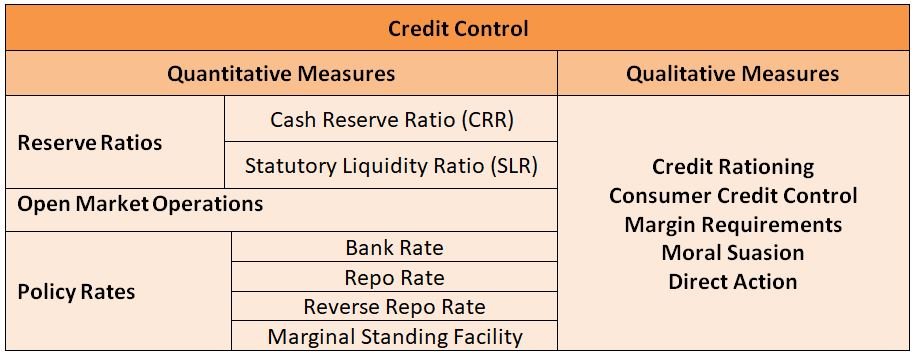
- It regulates the credit creation capacity of commercial banks by using various credit control tools.
- The primary objective is to control inflationary tendencies present in the economy to ensure high economic growth with an adequate level of liquidity and maximum utilisation of resources.
|
| Supervisory Function |
- It has the power to issue licenses for setting up new banks, opening new branches, deciding minimum reserves, inspecting the functioning of commercial banks in India and abroad, and guiding and directing commercial banks in India.
- It can have periodical inspections and audit of the commercial banks in India
|
| Promotional Functions of RBI |
- Development of Agriculture: In an agrarian economy like ours, the RBI must pay special attention to the credit needs of agriculture and allied activities.
- Provision of Industrial Finance: In this regard, the RBI has always been instrumental in setting up special financial institutions such as ICICI Ltd. IDBI, SIDBI, EXIM BANK, etc.
- Provisions of Training: The RBI has always tried to provide essential training to the banking industry's staff. The RBI has set up bankers' training colleges in several places.
- Collection of Data: Being the apex monetary authority of the country, the RBI collects, processes and disseminates statistical data on several topics. It includes interest rate, inflation, savings and investments etc.
- Publication of the Reports: The RBI regularly publishes reports and bulletins, including weekly reports, the annual Report, and the Report on Trend and Progress of Commercial Banks India.
- Promotion of Banking Habits: It has established many institutions, such as the Deposit Insurance Corporation (1962), UTI (1964), IDBI (1964), NABARD (1982), and NHB (1988). These organisations develop and promote banking habits among the people.
- Promotion of Export through Refinance: The Export-Import Bank of India (EXIM Bank India) and the Export Credit Guarantee Corporation of India (ECGC) are supported by refinancing their lending for export purposes.
|


