About PM Jan Dhan Yojana
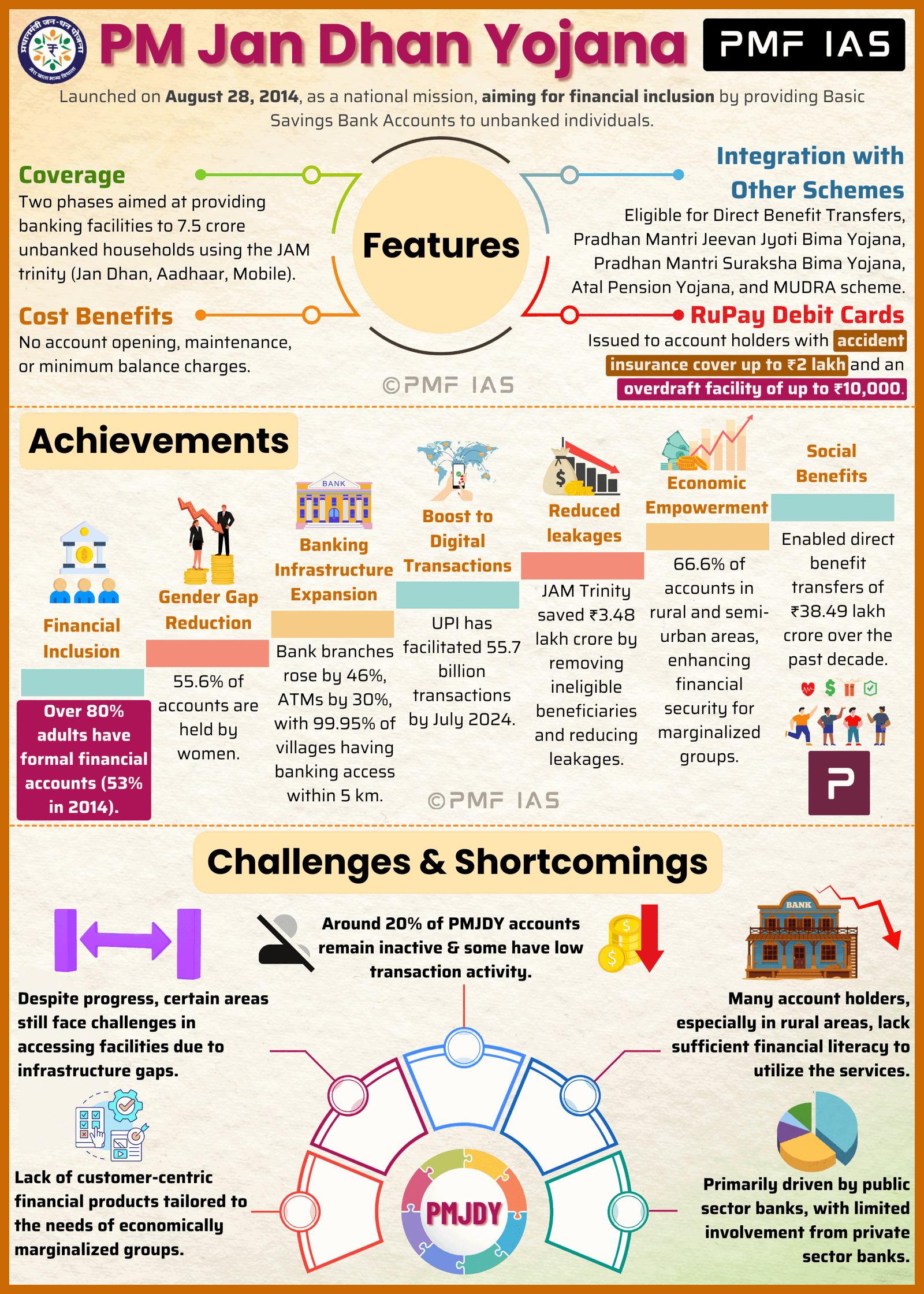
- PM Jan Dhan Yojana was launched in 2014.
- Objective: Financial inclusion through Basic Savings Bank Accounts for unbanked individuals.
- RuPay Debit Cards: Issued to account holders with accident insurance cover up to ₹2 lakh and an overdraft facility of up to ₹10,000.
- Cost Benefits: No account opening, maintenance, or minimum balance charges.
- Small Account/Chota Khata: For individuals without formal legal documents, small accounts can be opened. These are valid for 12 months and may be extended by another 12 months with document application.
- Integration with Other Schemes: Eligible for Direct Benefit Transfers (DBT), Pradhan Mantri Jeevan Jyoti Bima Yojana (PMJJBY), Pradhan Mantri Suraksha Bima Yojana (PMSBY), Atal Pension Yojana (APY), and MUDRA scheme.
- PMJDY holds the Guinness World Record for opening 1.8 crore accounts in a week during its launch.
Core Tenets of the Scheme
- Banking the unbanked: Opening of basic savings bank deposit (BSBD) account with minimal paperwork, relaxed KYC, e-KYC, account opening in camp mode, zero balance & zero charges.
- Securing the unsecured: Issuance of Indigenous Debit cards for cash withdrawals & payments at merchant locations, with free accident insurance coverage of Rs. 2 lakhs.
- Funding the unfunded: Offer financial products like micro-insurance, overdraft for consumption, micro-pension & micro-credit.
Successes of PMJDY
- Financial Inclusion: Over 80% of adults have formal financial accounts, up from 53% in 2014 also since its launch, over 53 crore accounts have been opened.
- Gender Gap Reduction: 55.6% of accounts (29.56 crore) are held by women.
- Infrastructure Expansion: Bank branches have increased by 46% and ATMs by 30% since 2014.
- Boost to Digital Transactions: UPI has facilitated 55.7 billion transactions by July 2024.
- Leakage Reduction: JAM Trinity has saved Rs 3.48 lakh crore by eliminating ineligible beneficiaries and reducing leakages.
- Behavioural Changes: Increased PMJDY usage has been linked to reduced alcohol and tobacco consumption and decreased thefts in states like UP, Maharashtra, and Haryana.
- Economic Empowerment: The scheme has enhanced financial security and independence for marginalized groups, with 66.6% of accounts in rural and semi-urban areas.
- Increase in Banking Habits: Deposits reached Rs 2.31 lakh crore, with 36.14 crore RuPay debit cards issued. The average account balance rose from Rs 1,065 in 2015 to Rs 4,352 in 2024.
- Access to Banking Facilities: 99.95% of inhabited villages have banking access within a 5-km radius.
- Social Benefits: PMJDY has facilitated direct benefit transfers, with Rs 38.49 lakh crore transferred via DBT over the past decade, as well as COVID-19 financial assistance and PM-KISAN.
Challenges and Shortcomings
- Inactive Accounts: Nearly 20% of PMJDY accounts remain dormant, reducing scheme effectiveness.
- Over-Indebtedness Risk: Push for inclusion raises concerns of excessive borrowing among the poor.
- Low Financial Literacy: Rural beneficiaries struggle to utilize services due to inadequate awareness.
- Minimal Transactions: Several accounts show low activity, indicating weak engagement.
- Infrastructure Gaps: Remote areas face limited access to banking facilities.
- Lack of Tailored Products: Absence of customized financial solutions restricts long-term security.
Way Forward
- Strengthen Financial Ecosystem: Enhance private-sector participation in financial inclusion through partnerships and collaborations.
- Promote Financial Literacy: Focus on financial education to ensure that account holders, especially in rural areas, can effectively use banking services.
- Expand Product Penetration: Increase the availability of micro-insurance, credit, and other financial products while avoiding the risk of over-indebtedness among new entrants.
- Enhance Consumer Protection: Develop a robust consumer protection framework to safeguard users of digital financial services from fraud and exploitation.
- Customer-Centric Design: Tailor financial products to meet the specific needs of PMJDY account holders, considering their irregular income patterns and unique financial requirements.
- Digital Technology: Continue to integrate digital solutions like UPI and the Unified Lending Interface to make banking more accessible, efficient, and user-friendly.
- Interlink Schemes: Explore the integration of PMJDY accounts with other government welfare programs to ensure a comprehensive approach.
PMJDY is a milestone in access but a work-in-progress in empowerment. While it has succeeded in building the world’s largest financial inclusion infrastructure, true empowerment will emerge only when access translates into sustained usage, literacy-driven participation, and financial resilience for the vulnerable.
UPSC Mains PYQs – Theme – Scheme
- [UPSC 2016] Pradhan Mantri Jan Dhan Yojana (PMJDY) is necessary for bringing the unbanked to the institutional finance fold. Do you agree with this for the financial inclusion of the poorer section of Indian society? Give arguments to justify your opinion.
PMF IAS Pathfinder for Mains – Question 310
Q. “Mere expansion of financial access does not ensure meaningful empowerment” In this context critically examine whether PMJDY embodies substantive financial inclusion or merely reflects a quantitative illusion of empowerment (250 Words) (15 Marks)
Approach
- Introduction: Write a brief introduction about the financial inclusion and mention the current status of PMJDY.
- Body: Write achievement; substantive financial inclusion, challenges; Illusion of Empowerment and way forward.
- Conclusion: Emphasis on true empowerment through multi-pronged approach.


