- Context (TH): Centre hikes Minimum Support Price (MSP) for copra for 2025 by up to ₹420.
About Minimum Support Price
- Minimum Support Price (MSP) is a “minimum price” for any crop that the government considers as remunerative for farmers and hence deserving of “support”.
- It is also the price that government agencies pay whenever they procure a particular crop. Simply, the MSP is the rate at which the government buys grains from farmers.
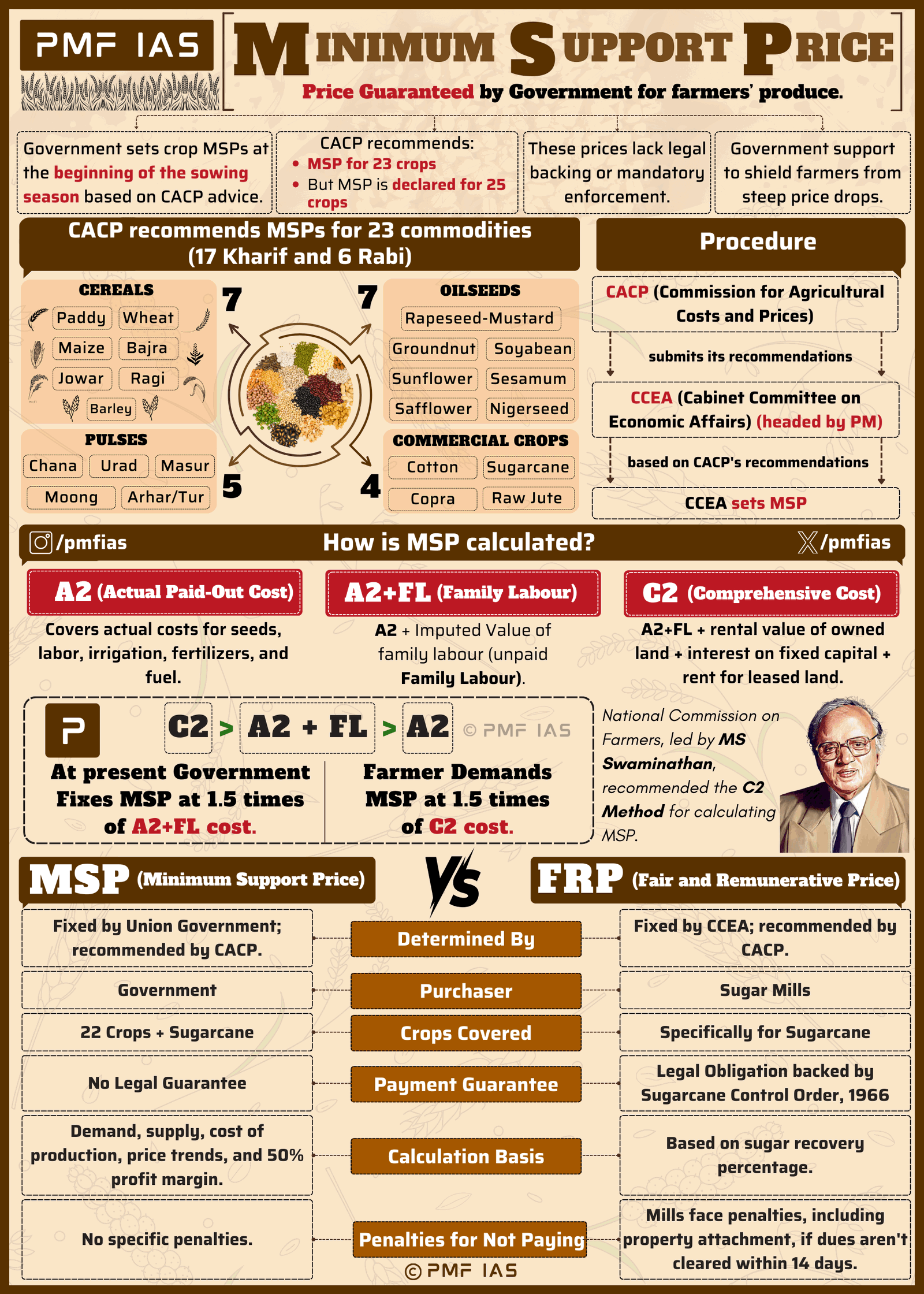
- The Commission for Agricultural Costs & Prices (CACP) in the Ministry of Agriculture recommends MSPs for 23 crops (22 mandated crops and fair and remunerative price (FRP) for sugarcane) but MSP is declared for 25 crops (toria and de-husked coconut). MSP is announced at the beginning of the sowing season.
- The MSP is fixed by the Central government on the recommendations of the CACP.
- After receiving the feedback, the Cabinet Committee on Economic Affairs (CCEA) of the Union government makes a final decision on the level of MSPs and other recommendations made by the CACP.
- The Food Corporation of India (FCI), the nodal agency, along with other State Agencies undertakes procurement of crops.
- There is neither statutory backing for these prices nor any law mandating their enforcement. Thus, the government is not legally bound to pay these even if open market rates for the said produce are ruling below their announcement floor prices.
Crops for which MSP is announced
- 7 cereals (paddy, wheat, maize, bajra, jowar, ragi and barley),
- 5 pulses (chana, arhar/tur, urad, moong and masur),
- 7 oilseeds (rapeseed-mustard, groundnut, soyabean, sunflower, sesamum, safflower and nigerseed)
- 4 commercial crops (cotton, sugarcane, copra and raw jute).
Factors taken into consideration for fixing MSP
- Supply and demand situation for the commodity
- Market price trends (domestic and global)
- Parity vis-à-vis other crops
- Cost of production (A2 + FL method)
- Implications for consumers (inflation)
- Environment (soil and water use)
- Terms of trade between agriculture and non-agriculture sectors
About Commission for Agricultural Costs & Prices (CACP)
- The CACP is an attached office of the Ministry of Agriculture and Farmers Welfare.
- It is a statutory body formed in 1965.
- It comprises a Chairman, a Member Secretary, one Member (Official) and two Members (Non-Official). The non-official members are representatives of the farming community and usually have an active association with the farming community.
- It recommends the MSP of the notified Kharif and Rabi crops to the Cabinet Committee on Economic Affairs (CCEA). It also motivates cultivators and farmers to adopt the latest technology.
- Its suggestions are not binding on the Government.
|
How is MSP calculated?
- The CACP does not do any field-based cost estimates itself. It merely makes projections using state-wise, crop-specific production cost estimates provided by the Directorate of Economics & Statistics in the Agriculture Ministry.
- The Commission for Agricultural Costs & Prices (CACP) details three major formulae to arrive at MSP.
- A2: Costs incurred by the farmer in production of a particular crop. It includes several inputs such as expenditure on seeds, fertilisers, pesticides, leased-in land, hired labour, machinery and fuel.
- A2+FL: Costs incurred by the farmer + the value of family labour.
- C2: A comprehensive cost, which is A2+FL cost + imputed rental value of owned land + interest on fixed capital, rent paid for leased-in land.
- At present, the CACP adds both A2 and FL to determine the MSP.
- The government adds 50 percent of the value obtained by adding A2 and FL only, i.e. 1.5 times A2 + FL cost to fix the MSP.
- Issue: Farmers say they should be given MSP after adding 50 per cent to the cost under C2, i.e., 1.5 times C2 (Dr M S Swaminathan Commission's recommendation).
Effectiveness of MSP in Supporting Farm Income
- Limited Reach: According to the ICAR-National Institute of Agricultural Economics and Policy Research, only 15% of paddy and 9.6% of wheat farmers benefit from MSP-backed procurement.
- Structural Barriers: Small and marginal farmers, who constitute 86.1% of the agricultural workforce (Agricultural Census 2015-16), are often excluded due to a lack of resources, market linkages, and insufficient marketable surplus.
- Unequal Access: Larger farmers with better awareness and financial capacity dominate MSP benefits, exacerbating income inequality.
- Environmental Impact: The focus on water-intensive crops like wheat and paddy has led to groundwater depletion and soil degradation, particularly in states like Punjab and Haryana.
- High Fiscal Cost: The Food Corporation of India (FCI) struggles with procurement expenses, storage shortages, and wastage, reducing MSP’s cost-effectiveness.
- Market Distortions: By setting prices above market rates, MSP disrupts price discovery, creating an excess supply of supported crops while leaving non-MSP farmers vulnerable.
Challenges and Unintended Consequences
- Fiscal Burden: Heavy procurement and subsidy costs divert funds from crucial infrastructure and research investments.
- Ecological Imbalance: The overproduction of wheat and rice has resulted in soil degradation and declining groundwater levels.
- Storage Inefficiencies: Lack of storage infrastructure leads to wastage of surplus grains.
- Legal Enforcement Debate: A legally mandated MSP could discourage private trade, increase fiscal pressure, and deepen market distortions.
- Exclusion of Vulnerable Farmers: The benefits remain concentrated among wealthier farmers, failing to support those most in need.
Alternative Measures to Enhance Agricultural Competitiveness
- Strengthening Market Infrastructure & Value Chains: Developing cold storage, rural roads, and modernising mandis to improve market access and minimize post-harvest losses while encouraging private-sector participation.
- Promoting Crop Diversification: Shifting focus from water-intensive cereals to pulses, oilseeds, fruits, and vegetables through targeted incentives and investment in climate-resilient crops.
- Upscaling Price-Deficiency Payments: Expanding schemes like Madhya Pradesh’s Bhavantar Bhugtan Yojana to compensate farmers for price gaps without distorting market dynamics, backed by robust digital tracking.
- Developing Agri-Derivatives Markets: Enhancing futures and options trading to help farmers hedge against price volatility and integrate into global commodity markets with improved financial literacy.
- Encouraging Private Procurement: Reducing dependence on government procurement by fostering private-sector participation through tax incentives and regulatory reforms for fair pricing.
- Investing in Agricultural Research & Technology: Increasing research funding for high-yield, climate-resilient crops and promoting precision farming with advanced technologies like drones, IoT, and AI-based analytics.
- Addressing Global Trade Pressures: Shifting towards export-oriented agriculture by promoting crop diversification, strengthening value chains, and maintaining food security through strategic reserves instead of blanket procurement.
Implementation Challenges
- High Investment & Coordination Needs: Strengthening value chains demands substantial financial resources and seamless coordination between state and central governments.
- Market Price Tracking Issues: Price-deficiency payment schemes require accurate market price monitoring to prevent fraud and ensure fair compensation.
- Regulatory & Awareness Gaps: Expanding agri-derivatives markets necessitates a robust regulatory framework and extensive farmer education on risk management.
- Political & Logistical Hurdles: Resistance from MSP beneficiaries and inadequate rural infrastructure pose significant challenges to implementing alternative measures.
|
Why do farmers demand a legal guarantee for MSP?
- Market conditions favouring buyers over seller: Farmers sell their crops, except for perhaps milk, in large quantities. This results in a sudden increase in supply compared to demand. The surplus supply puts downward pressure on prices.
- Farmers don't have the market influence to impact their produce prices: Unlike many industries, they can't set the Maximum Retail Price (MRP). Instead, they sell their products at rates determined by prevailing supply and demand.
- Farmer's burden: Farmers sell their crops in bulk at wholesale rates. However, they purchase everything they need, such as seeds, pesticides, diesel, tractors, cement, medicines, toothpaste, and soap, at retail prices.
- Farmer Suicides & Debt Crisis: 4-7 lakh farmer suicides in three decades (SC committee); Rs 14.72 lakh crore loss in 2023 (OECD).
- Agricultural & Economic Stability: Farmers in Bihar, UP, Rajasthan forced to sell below MSP; stable MSP will reduce distress and migration.
- Water Conservation & Crop Diversification: Paddy requires 3,000- 3,500L water/kg; MSP for 23 crops can cut electricity use by 60% and save groundwater.
- Reducing Import Dependence: India spends Rs 2 lakh crore on oilseeds & pulses imports; MSP can boost domestic production.
- Public Health & National Wealth: MSP ensures healthier alternatives, reduces palm oil dependence, curbs farmer debt, and strengthens the economy.
How can MSP be guaranteed?
- Make buyers pay MSP enforced by law: For instance, sugar mills must pay cane growers a fair price within 14 days. However, this approach can face implementation challenges, as seen with recurring cane payment delays or private trade opting not to buy.
- Government agencies buying all the marketable produce from farmers at MSP: Yet this is impractical both physically and financially.
- Price deficiency payments (PDP): Here, the government doesn't physically buy crops but pays farmers the difference between the market price and MSP if the former is lower. This payment is based on the quantity of crops sold to the private trade.
- For procuring all 23 crops at MSP, the Union government will have to spend Rs 17 lakh crore, according to the rough estimate from government officials.
|
National Commission on Farmers
|
Madhya Pradesh & Haryana Model on MSP
- Both Madhya Pradesh and Haryana have demonstrated the feasibility of delivering MSP via PDP to farmers, at least in some crops other than rice, wheat, and sugarcane.
- PDP was tried out first in Madhya Pradesh through a Bhavantar Bhugtan Yojana.
- But despite 21 lakh-odd farmers registering and payments of about Rs 1,952 crore being made, the scheme couldn’t be continued for lack of Central support.
- Haryana’s PDP scheme, called Bhavantar Bharpai Yojana (BBY).
- If a nationwide PDP scheme with 50% Central funding were to be implemented, it could perhaps incentivise other states to follow the examples of Madhya Pradesh and Haryana.
|
MSP vs FRP
| Features |
MSP |
FRP (Fair and Remunerative Price) |
| Who determines it? |
- Fixed by: Union government (Cabinet Committee on Economic Affairs (CCEA)).
- Recommended by: Commission for Agricultural Costs and Prices (CACP).
|
- Fixed by: Cabinet Committee on Economic Affairs (CCEA).
- Recommended by: Commission for Agricultural Costs and Prices (CACP).
|
| Purchased by? |
Government |
Sugar Mills
|
| Crops Covered |
22 crops + Sugarcane. |
Specifically for sugarcane.
Sugarcane has both FRP and Minimum Selling Price. |
| Payment Guarantee |
The government commits to buying the crop at MSP if market prices fall below it. No Legal guarantee. |
Legal obligation for sugar mills to pay FRP to sugarcane farmers.Backed by: Sugarcane Control Order (1966). |
| Basis of calculation? |
- Demand and supply.
- Cost of production.
- Market price trends (Domestic and international).
- Inter-crop price parity.
- Terms of trade.
- 50% margin over the cost of production.
- implications on consumers.
|
- The FRP is based on the recovery of sugar from the cane.
- Sugar recovery is the ratio between sugar produced versus cane crushed, expressed as a percentage.
- The higher the recovery, the higher the FRP, and the higher the sugar produced from the cane.
|
| Penalties for Non-Payment |
No specific penalties were mentioned. |
Cane commissioners can take action, including attachment of mill properties as arrears of land revenue if FRP dues are not cleared within 14 days of the sale. |
MSP, though a crucial support mechanism, remains limited in scope and distorts markets. A shift towards market-driven reforms strengthening infrastructure, promoting crop diversification, leveraging price-deficiency payments, and expanding agri-derivatives is essential. These measures will enhance farm incomes, improve sustainability, and make Indian agriculture globally competitive.
Reference: Business Standard
PMF IAS Pathfinder for Mains – Question 109
Q. Evaluate the effectiveness of MSP in supporting farm income and suggest alternative measures to enhance agricultural competitiveness in India. (10 Marks) (150 Words)
Approach
- Introduction: Start with a statement on MSP’s intent, like income support, food security, etc.
- Body: Highlight its effectiveness using data and issues associated with it. Suggest practical solutions as alternatives to MSP.
- Conclusion: Link alternatives to reducing MSP dependence, aligning with demand, and enhancing global competitiveness.


the infographics are very good. thank you ssso much for makingg them informative ass weell as creative.
offlate PMF IAS team has been providing to the point information needed for the exam. It has become a onestop solution and most trusted source for me to fetch some information. Kudos to the team . Please bring more refined content like these
so what?