- Context (IE): Every year, July 26 is celebrated as the International Day for the Conservation of the Mangrove Ecosystem. It was adopted during the 38th session of the general conference of UNESCO held in 2015.
What are Mangroves?
- Mangroves are salt-tolerant trees and shrubs typical of estuarine and intertidal regions, meaning they grow in areas where freshwater and saltwater meet.
- Mangroves typically have aerial, breathing roots and waxy, succulent leaves, and are flowering plants.
- They thrive in high-rainfall areas (1,000–3,000 mm) with temperatures ranging from 26°C to 35°C.
- The seeds actually germinate on the tree itself, and then fall off from the tree into the water, taking root only when encumbered by mud and sediment. This is a unique adaptation in the mangroves that helps them perpetuate in the harsh saline conditions. This phenomenon is scientifically termed vivipary.
- Abundant in swampy and marshy areas, mangroves represent a littoral forest ecosystem, which means they thrive in saline or brackish waters in coastal regions.
Mangrove Cover in India (ISFR) 2023
- Total Extent: India’s total mangrove cover is 4,991.68 km², accounting for 0.15% of the total geographical area. This reflects a net decrease of 7.43 km² compared to 2021.
- Geographic Spread: Mangroves are present in 12 States/UTs (9 States and 3 UTs). All regions recorded an increase in cover, except for Gujarat and the Andaman & Nicobar Islands, where slight declines.
- Major Mangrove States/UTs: West Bengal, Gujarat, Andaman & Nicobar Islands, Andhra Pradesh, Maharashtra, Odisha, Tamil Nadu, Goa, Karnataka, Kerala, Daman & Diu, and Puducherry.
- Sundarbans (spread across India and Bangladesh) is the largest contiguous mangrove forest in the world, while Bhitarkanika is the second largest in India.
Ecological and Socioeconomic Importance of Mangroves
- Natural coastal defense (Bio-shields): Protect coastal communities from cyclones, storm surges, and erosion (e.g., Odisha’s mangroves mitigated cyclone impacts).
- Biodiversity Hotspots: Serve as breeding grounds for fish, crustaceans, birds, and endangered species.
- Livelihood Support: Fisheries, honey, and sustainable wood for local communities.
- Climate Mitigation: Sequester carbon, contributing to India’s climate goals under Paris Agreement. According to UNESCO, One hectare of mangrove can store 3,754 tons of carbon.
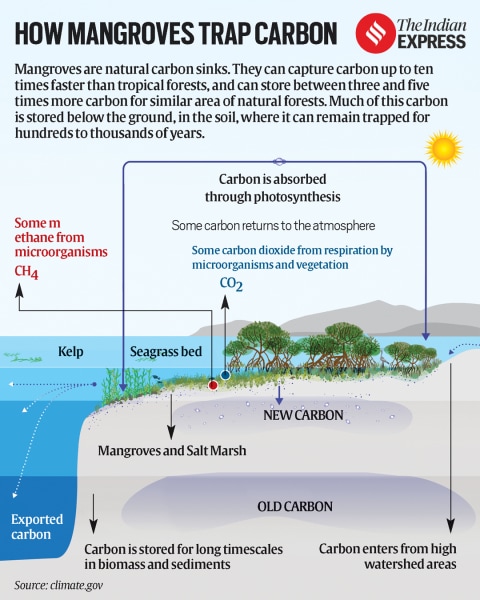
Credits: IE
Challenges in Mangrove Conservation
- Coastal Development: Ports, tourism infrastructure, & aquaculture often lead to mangrove degradation.
- Pollution: Industrial waste and untreated sewage harm mangrove ecosystems.
- Lack of Community Awareness: Inadequate stakeholder participation hinders long-term success.
- Climate Change: Sea-level rise & salinity changes pose a threat to mangrove regeneration & biodiversity.
Policy Frameworks for Mangrove Protection
- MISHTI (Mangrove Initiative for Shoreline Habitats & Tangible Incomes Initiative) 2023:
- Implemented by Ministry of Environment, Forest & Climate Change (MoEFCC) as a part of Budget 2023-24.
- Its objective is to undertake mangrove afforestation and reforestation along India’s coastline and estuarine regions, protecting biodiversity and enhancing local livelihoods.
- National Coastal Mission Programme:
- Implemented under the National Action Plan on Climate Change (NAPCC).
- Includes a dedicated component for “Conservation & Management of Mangroves & Coral Reefs”.
- Focuses on integrated coastal zone management, vulnerability assessment, & ecological restoration.
- SAIME (Sustainable Aquaculture In Mangrove Ecosystem) Initiative:
- Promotes sustainable aquaculture by involving local communities in mangrove regeneration and maintenance.
- Encourages a livelihood-environment synergy, especially among coastal fisherfolk.
- Coastal Regulation Zone (CRZ) Notification, 2019:
- Mangroves are classified as Ecologically Sensitive Areas (ESAs).
- Projects impacting mangroves >1,000 m² require a 50-meter buffer zone (CRZ-IA).
- Projects causing mangrove loss must undertake compensatory plantation by replanting three times the number of mangroves affected.
Way Forward
- Strengthen MISHTI: Leverage local knowledge, provide incentives, and ensure inclusive benefit-sharing.
- Scientific Monitoring: Use satellite data and GIS tools to monitor degradation and replantation efforts.
- Policy Measures: Strengthening existing laws such as the Indian Forest Act, 1927, the Environmental Impact Assessment (EIA) Notification, 1986, and the Forest Conservation Act, 1980.
Mangroves are vital coastal ecosystems that protect livelihoods and sequester carbon, as emphasized by India’s MISHTI initiative promoting restoration and resilience. Urgent action through policy and community involvement is essential for their sustainable future.
Reference: PIB
PMF IAS Pathfinder for Mains – Question 260
Q. “Mangroves act as natural carbon sinks and frontline defenders against climate-induced disasters”. Critically assess India’s policy and institutional efforts in integrating their roles in climate mitigation and disaster resilience. (250 Words) (15 Marks)
Approach
- Introduction: Write briefly about the mangroves and mention mangroves cover.
- Body: Write India’s policy & institutional measures, challenges and way forward.
- Conclusion: Emphasis on urgent restoration and community-driven conservation of mangroves.


