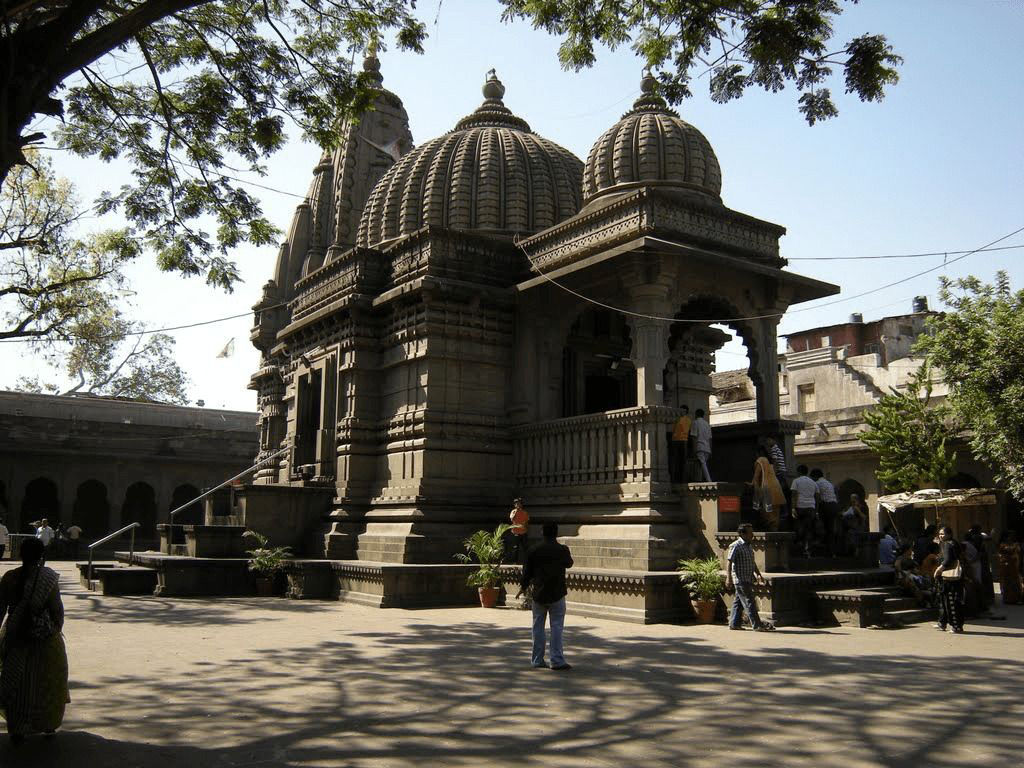
Context (IE): PM visited the Kalaram Mandir on the banks ofGodavari river in the Panchavati area.
The temple is the site of agitation led by B.R Ambedkar, who demanded temple entry rights for Dalits in 1930.
Kalaram Temple is a Hindu temple in Nashik city’s Panchavati area in Maharashtra.
The temple derives its name from a black statue of Lord Kala Ram translates literally to “Black Ram”.
Kalaram Temple History and Architecture
The original temple dedicated to an unknown deity was ancient, estimated to be of the Rashtrakuta Period from the 7th–11th centuries.
During the early Turkish invasions, the idol of the deity was thrown in the Godavari River by the Temple Brahmins to save it.
The New temple was built in 1792 with the efforts of one Sardar Rangarao Odhekar.
Sardar Odhekar dreamt of a black-coloured statue of Lord Ram in the Godavari, recovered the statues from the river, and built the temple.
The place where statues were found was named Ramkund.
Architecture and the Temple Complex
The sanctum sanctorum houses the statues of Lord Ram, the goddess Sita and Lakshmana.
The main entrance has a Hanuman deity, which is black.
The Temple is designed so that Rama’s idol can be visible from Hanuman’s idol.
The main temple has 14 steps, representing the 14 years of Ram’s exile.
84 temple pillars signify a cycle of 84 lakh species, the completion of which leads to birth as a human.
There is also an ancient tree with Dattatreya’s footprintimpressions marked on a stone.
Dattatreya is a paradigmatic Sannyasi (monk) and one of the lords of yoga.
There is a statue of Sardar Odhekar in the temple.
The architectural design of this temple is similar to the temple of Trimbakeshwar.
The temple has been constructed of black stones and four entrance doors in all four directions.
Several smaller temples surround the temple, such as the Vithal, Ganapathi, and Maruti.
Panchvati: Its linkages with Ramayana
Several significant events described in the Ramayana occurred in the Panchvati area.
Ram, Sita and Lakshman spent the first few years of their 14-year exile in Dandakaranya, the dense forest in central India of which Panchavati was a part.
Panchavati derives its name from five sacred banyan trees in the vicinity, symbolising the auspiciousness of the area where Lord Ram, Sita, and Lakshman chose to establish their hut.
Ravan, the demon king of Lanka, abducted Sita from the forest, Dandkaranya.
Kalaram Temple Entry Movement
In 1930, B R Ambedkar and the Marathi teacher and social activist Pandurang Sadashiv Sane, known as Sane Guruji, led an agitation to demand access to Hindu temples for Dalits.
It is also known as Kalaram Mandir Satyagraha.
Many Dalit protesters arrived in the town by trucks; they surrounded the temple and sat around it.
Mode of Protest: They sang songs and often raised war cries, demanding to enter the temple.
Reaction of Locals: The people of Nashik boycotted the protesters.