★ 🆕 Agriculture 1st Edition ⚡️ Order Now! ★                      ★ 🆕 Environment 4th Edition ⚡️ Order Now! ★                      ★ Download Prelims Magnum 2026 — Yearly [FREE] ★                      ★ Prelims Cracker 2026 Combo Deal ⚡️ Magnum Crash Course + Test Series ★                      ★ PMF IAS Impact 🎯 53 Direct Hits in Prelims 2025 ★

Current Affairs – July 15, 2025

Prelims Cracker
PMF IAS Foundation Course (History) ()
Table of contents

{GS2 – Polity – IC – FRs} Supreme Court Concern Over Digital Free Speech Abuse

  • Context (TH): The SC observed that the right to free speech is increasingly being abused, especially on social media, and stressed the need for self-restraint and regulation. It noted that using free speech to instigate divisive tendencies, particularly online, must be curbed.
  • The Court also said that while the state has its limitations in restricting speech to maintain harmony, citizens themselves must take the initiative to avoid spreading hate on social media.
  • In light of these concerns, the Court has also stated that it is considering the development of guidelines to regulate abusive and divisive content on digital platforms.

The Right to Freedom of Speech and Expression

  • The right to freedom of speech and expression is a fundamental right under Article 19(1)(a) of the Indian Constitution. However, it is not absolute.
  • Article 19(2) provides for reasonable restrictions in the interest of Sovereignty and integrity of India, Security of the State, Public order, Decency or morality, Friendly Relations with foreign states, and Contempt of Court, among others.

Need for Regulating

  • Protecting Public Order: Unchecked speech on social media can incite violence, disturb peace, and lead to law-and-order problems.
  • Safeguarding National Integrity: Hateful content targeting religion, caste, or region can fuel division and threaten the unity of the nation. What was once a tool for public empowerment is now, at times, exploited to spread toxicity and disrupt social harmony.
  • Preventing Misinformation: Fake news spreads rapidly online, particularly during elections or crises, misleading the public and eroding trust.
  • Protecting Individual Dignity: Trolling, cyberbullying, and hate speech infringe on personal dignity and violate the right to life under Article 21.
  • Filling Legal Gaps: Outdated laws, such as the IT Act, 2000, and the IPC, lack provisions to effectively address today’s digital challenges.
  • Aligning with Fundamental Duties: Citizens have a duty under Article 51-A to uphold harmony and national values, rather than misusing speech irresponsibly.

Way Forward

  • Judicial Guidelines: Frame clear SC-led norms to regulate hate speech without curbing legitimate dissent.
  • Platform Accountability: Mandate social media platforms to enforce transparent content moderation policies.
  • Legal Reforms: Update existing laws like the IT Act and IPC to address digital-era speech challenges.
  • Civic Responsibility: Promote digital literacy and self-restraint, aligning with Article 51-A (Fundamental Duties).

{GS2 – Polity – IC – Governor} Appointment of Governor

  • Context (TH): Recently, the President appointed Kavinder Gupta as Lieutenant Governor of Ladakh, Ashim Kumar Ghosh as Governor of Haryana, and P. Ashok Gajapathi Raju as Governor of Goa.
  • The Governor is the nominal executive head of the state under Article 154 and is appointed by the Union government to ensure constitutional governance and federal coordination.

Appointment of Governor

  • The Governor is not elected directly or indirectly, but is a nominated constitutional authority appointed by the Union executive.
  • The Governor is appointed by the President under Article 155, acting on the advice of the Union Council of Ministers.
    • In Pant v. Tilak (1979), the Supreme Court held that the Governor is a constitutional authority, not a government servant.
  • Multiplicity of Office: Article 153 allows one person to serve as Governor for two or more states.
  • Tenure: Under Article 156, the Governor holds office during the pleasure of the President.
    • The conventional five-year term is customary but not legally binding.
    • In Surya Narain case, the SC held that the President’s pleasure under Article 156 is non-justiciable.
  • The Constitution does not require consultation with the Chief Minister during appointment or removal.

Qualifications (Article 157-158)

  • Citizenship: The individual must be a citizen of India.
  • Age: He must be at least 35 years old.
  • Member of Legislature: He cannot be a member of either the Parliament or a State Legislature.
  • Office of Profit: The individual cannot hold any other office of profit.

Recent Controversies Regarding Governors

  • Tamil Nadu Assent Case: The SC ruled that the Governor’s indefinite delay in granting assent to state bills was unconstitutional and imposed a “reasonable time” requirement under Article 200.
  • Kerala VC Row: The Kerala High Court quashed the Governor-appointed interim Vice Chancellors for violating UGC norms and state statutes.
  • Raj Bhavan Symbolism: The Kerala Governor was criticised for displaying saffron ‘Bharat Mata’ flags in Raj Bhavan, raising questions over constitutional neutrality.
  • Puducherry Conflict: The Lt. Governor bypassed the Chief Minister in top-level appointments, leading to a ministerial boycott and administrative breakdown.
  • Chakma Council Dissolution: The Mizoram Governor imposed direct rule over the Chakma Council in 2024, drawing federalism concerns from the elected government.

Recommendations on Governor’s Appointment

  • Various commissions have suggested reforms to promote transparency and maintain federal balance in Governor appointments.

Sarkaria Commission (1988)

  • The Chief Minister must be consulted before appointing the Governor.
  • The Governor should be politically neutral and not recently active in politics.
  • The Governor must be perceived as impartial and independent of Union control.

Punchhi Commission (2010)

  • The Governor must resign if they lose the confidence of the elected government.
  • A fixed five-year tenure should be protected from arbitrary removal.

Venkatachaliah Commission (2002)

  • Appointment should follow a collegium process involving the PM, HM, Speaker, and CM.
  • A two-year cooling-off period is needed for active or retired politicians.
  • A transparent, rule-based mechanism should govern appointments.

{GS2 – MoFPI – Initiative} One District One Product (ODOP) Awards 2024

  • Context (PIB): The 2nd edition of the One District One Product (ODOP) Awards, announced by the Department for Promotion of Industry and Internal Trade (DPIIT), Ministry of Commerce & Industry.
  • The ODOP awards were instituted to recognise and celebrate the efforts of States and Union Territories, Districts, and Indian Missions Abroad in advancing the vision of Aatmanirbhar Bharat through the ODOP initiative.

ODOP 2024 Awardees

  • ‘Mission Abroad’ Category: The High Commission of India in Singapore was awarded the Gold, the Consulate General of India in New York received the Silver.
  • States/UTs-Category A: Andhra Pradesh, Maharashtra, Punjab, and Uttar Pradesh won Gold. Madhya Pradesh received Silver at Rank 2, & Gujarat, Rajasthan, and West Bengal shared Rank 3 with a Bronze.
  • States/UTs-Category B: Jammu and Kashmir secured Gold at Rank 1, Sikkim received Silver at Rank 2, and Meghalaya and Ladakh shared Rank 3 with a Bronze.
  • Districts: Category A – Agriculture: At Rank 1, Guntur (Andhra Pradesh) won Gold for Chillies, and Ratnagiri (Maharashtra) shared the top spot for Alphonso Mangoes.
  • Districts: Category B – Non-Agriculture: Bapatla (Andhra Pradesh) secured Gold at Rank 1 for Chirala Silk Sarees (Kuppadam).

One District One Product Scheme

  • It is under the DPIITMinistry of Commerce and Industry.
  • It is a centrally sponsored scheme shared by the GoI and states in a 60:40 contribution ratio.
  • It is operationally merged with the ‘Districts as Export Hub’ initiative.
  • Aim: To foster balanced regional development across all districts of the country.
  • Objectives:
    • To help districts reach their full potential.
    • To foster economic and sociocultural growth.
    • To create employment opportunities, especially in rural areas.

{GS2 – Social Sector – Education} Common University Entrance Test

  • Context (IE): The Common University Entrance Test (CUET) framework is facing increasing scrutiny due to admission delays, over-centralisation, and rising concerns of educational equity.

About CUET

  • CUET is a national-level computer-based entrance exam introduced in 2022 and conducted by the NTA under the NEP 2020 reforms.
  • It serves as a single-window eligibility platform for UG admissions to 45 Central Universities, replacing board marks as the primary criterion.
    • Board exam scores are considered only for meeting minimum eligibility thresholds.
  • The exam is conducted in 13 languages and allows candidates to choose from 27 domain subjects.
  • CUET is mandatory for Central Universities, and optional for state, private, and deemed universities.
    • Each university retains autonomy over counselling, merit criteria, and seat allocation.

Benefits of CUET

  • Evaluation Parity: CUET addresses disparities from uneven evaluation standards across school boards.
  • Student Mobility: It enables wider mobility and access through a nationally standardised platform.
  • Curriculum Alignment: Its NCERT-based syllabus lowers reliance on commercial coaching centres.
  • Social Inclusion: Multilingual format and subject diversity improve regional and demographic inclusion.
  • Academic Synchrony: A standardised calendar aligns admission timelines across universities.
  • Digital Efficiency: The CBT format enhances scalability, transparency, and test delivery efficiency.
  • Single Window Access: By replacing multiple exams, it eases preparation and admission effort.

Challenges of CUET

  • Vacancy: Persistent seat vacancies reflect misalignment with student readiness and admission demand.
  • Coaching Dependence: Growing coaching networks undermine CUET’s aim of ensuring equal access.
  • Board Bias: CBSE-oriented test pattern disadvantages students from diverse regional and state boards.
  • Operational Delays: Uncertain test timelines disrupt academic calendars and student admission cycles.
  • Admission Spillover: Prolonged mop-up rounds delay course timelines and batch stability.
  • Digital Divide: Weak digital infrastructure restricts access to tests for rural & underprivileged students.
  • Autonomy Erosion: Excessive central control limits flexibility in institutional admission processes.

Way Forward

  • Link application data with counselling rounds to ensure full seat saturation across universities.
  • Involve subject experts from state boards in test design to correct CBSE-centric patterns.
  • Establish a fixed national CUET calendar for tests, result declaration, and admissions.
  • Implement uniform admission deadlines to limit mop-up rounds and prevent academic disruptions.
  • Expand certified CBT centres and offer offline backup modes in low-connectivity regions.
  • Allow universities flexibility in cut-off settings, interviews, and institutional quota policies.
  • Strengthen NTA capacity through regular tech audits, encrypted papers, and accountability systems.

{GS2 – IR – India-US} India-US Trade Talks

  • Talks cover agriculture, automobiles, dairy products, and digital services sectors.

NITI Aayog’s Suggestions for Trade Negotiations

  • While retaining restrictions on dairy and GM crops, NITI Aayog suggests focusing on services-led trade and digital sectors.
  • Services Orientation: NITI Aayog proposes a trade agreement targeting the IT, finance, education, and professional sectors.
  • Visa Demands: India aims to relax H‑1B and L‑1 visa rules to increase skilled worker mobility.
  • H‑1B Visa: It lets U.S. companies hire skilled foreign workers for IT, engineering, and research jobs.
  • L‑1 Visa: It enables companies to transfer seasoned employees from foreign offices to U.S. branches.
  • Digital Framework: India aims for digital trade provisions and seamless cross-border services.
  • Emerging Sector Access: India demands U.S. market access for AI, cybersecurity, telecom, and design.

India–US Current Trade Scenario

  • The U.S. became India’s largest trading partner in FY 2024–25 with bilateral trade of USD 131.8 billion.
  • India’s Trade Surplus: It increased by 16.59% from FY 2023–24 to FY 2024–25, driven by 11.6% export growth surpassing 7.44% import growth.
  • Strategic Target: India and the U.S. aim to increase bilateral trade to USD 500 billion by 2030.

{GS2 – IR – Groupings} India and the Global South

  • Context (IE): PM Modi visited Ghana, Trinidad & Tobago, and Argentina on his way to the BRICS Leaders’ Summit in Brazil, reaffirming India’s strategic focus on the Global South.

About the Global South

  • The Global South refers to economically developing countries mainly in Asia, Africa, Latin America, and Oceania with histories of colonial exploitation.
  • Common Challenges: The group faces shared vulnerabilities in climate impact, debt burden, digital divide, and access to healthcare.

Significance of the Global South

  • The Global South comprises over 80% of the world’s population and a rising middle class.
  • Geoeconomic Leverage: BRICS+ and South–South trade has amplified economic cooperation and alternative development models.
  • Multilateral Pressure: The Global South’s collective efforts have pushed for fairer climate finance, vaccine equity, and WTO reforms.
  • Strategic Autonomy: It challenges Western dominance and encourages multipolarity through forums like the G77, NAM, and IBSA.
  • G77 (Group of 77): A coalition of developing countries formed in 1964 to promote collective economic interests at the UN.
  • NAM (Non-Aligned Movement): A group of states not formally aligned with any significant power bloc, founded in 1961 during the Cold War.
  • IBSA: The India-Brazil-South Africa Dialogue Forum is a trilateral platform for South-South cooperation among three major democracies from Asia, South America, and Africa.

Challenges to India’s Role in the Global South

  • Humanitarian Gaps: India’s limited aid to Gaza and Sudan sparked criticism from Africa and West Asia.
  • UNESCO Defeat: India lost the UNESCO Vice-Chair vote in 2023, reflecting discontent over India’s muted stance on Gaza.
  • Perception Shift: Growing alignment with Western powers has weakened India’s image as an independent leader in the Global South.
  • BRICS Discord: The BRICS expansion has created divisions, with no consensus on UNSC reform, thereby weakening India’s reform agenda.
  • Manufacturing Doubts: The non-renewal of India’s ₹1.9 lakh crore PLI scheme raised concerns about its industrial reliability.

India’s Attempt to Reconcile the Global South

  • Balanced Diplomacy: India reiterated support for a two-state solution in Palestine while maintaining strategic neutrality.
  • Voice Amplification: PM Modi’s speeches in the G7 and G20 outreach platforms reaffirmed India’s Global South commitment.
  • BRICS Advocacy: India pushed for an equitable development focus within BRICS and highlighted the AU’s G20 inclusion.
  • Institutional Reform Push: India renewed calls for UNSC restructuring and advocated Global South inclusion in global finance.
  • Development Cooperation: India has extended concessional credit, tech sharing (like UPI, Co-WIN), and ITEC training to partner nations.
  • Tech Partnerships: India offered DPI solutions, AI collaboration, and digital governance models to partner countries.
  • Cultural Diplomacy: PM’s diaspora outreach in Argentina and Caribbean states boosted people-to-people linkages.
  • ITEC Scheme: India’s flagship foreign aid program offering training, technical assistance, and capacity building to partner developing countries.

{GS2 – IR – India-China} Normalising India-China Relations

  • Context (TH): The External Affairs Minister’s first high-level engagement with China since the Galwan clash signals a shift toward structured normalisation, aimed at reviving the long-stalled Dragon-Elephant tango through calibrated diplomatic, economic, and military steps.

Why Stability Matters

Economic Leverage

  • Trade and Investment: Stable ties facilitate a $120 bn bilateral trade relationship and enable calibrated Chinese investment in non-sensitive sectors.
  • Supply Chain Access: Normalisation secures critical input access—APIs, chips, rare earths—for industrial self-reliance.
  • Diversification Push: Strategic calm enables supply chain diversification through China+1 shifts and Quad-led technology realignment.

Strategic Gains and Autonomy

  • Border Dividend: Border tranquillity dividend eases two-front military pressure and restores India’s strategic planning bandwidth.
  • Strategic Autonomy: Balanced engagement enables India to deepen Quad ties while maintaining a functional dialogue with China.
  • Multilateral Leverage: Stability enables India to engage constructively with China in the BRICS and SCO, while safeguarding India’s normative space.

Connectivity, Water, and Climate Cooperation

  • Border Trade:  Border stability enabled the reopening of Nathu La trade and reinforced economic recovery in frontier regions.
  • Hydro Cooperation: Hydro-diplomacy revived Brahmaputra flood data sharing and fostered a basic trust framework in water relations.
  • Climate-Tech Link: Clean-tech collaboration supports India’s just energy transition and secures rare-earth access for net-zero ambitions.

Steps Toward Normalisation

  • 75-Year Milestone: In 2025, India and China marked 75 years of diplomatic ties with renewed calls to revive Dragon-Elephant ties.
  • LAC Disengagement: Military disengagement protocols at Depsang and Demchok were fully completed by late 2024.
  • Border Trade: The Nathu La trade route in Sikkim officially reopened, signalling intent to stabilise frontier economies.
  • SR Dialogue: The Special Representatives’ meeting in 2024 revived Track-I diplomatic engagement on border resolution.
  • BRICS Interaction: The Modi-Xi meeting at the 2023 BRICS Kazan Summit marked the first structured leader-level dialogue since 2019.
  • River Cooperation: China resumed Brahmaputra and Sutlej flood data sharing in 2025 under a renewed hydro-diplomatic framework.
  • Pilgrimage Resumed: The Kailash Mansarovar Yatra resumed in April 2025 as a people-centric confidence-building initiative.

Key Roadblocks Ahead

  • Border Tensions: Galwan clash and incremental encroachments reveal the fragility of disengagement protocols.
  • Trust Deficit: China’s selective engagement, lack of transparency, and delayed responses undermine diplomatic confidence.
  • Map Aggression: China’s cartographic assertion and Arunachal Pradesh renaming fuel territorial perception warfare.
  • Trade Imbalance: India’s ~$100B trade deficit and Chinese restrictions on rare earth exports highlight an asymmetric trade relationship.
  • Pakistan Nexus: China’s deep defence, nuclear, and economic relations with Pakistan directly undermine India’s primary security interests.
  • Neighbourhood Pressure: Growing Chinese influence in Nepal, Myanmar, and Sri Lanka steadily limits India’s regional strategic space.
  • Terrorism Divide: SCO talks continue to stall due to China’s reluctance to endorse zero-tolerance on Pakistan-linked terror groups.

Path to Stable Engagement

  • Permit Chinese investment selectively in low-risk, non-strategic sectors to rebuild basic trust.
  • Institutionalise joint border verification and hotline-based alert protocols to prevent miscalculation.
  • Propose long-term water-sharing rules beyond seasonal data to build hydrological trust.
  • Launch low-sensitivity trade packages to revive stalled economic ties without strategic concessions.
  • Use BRICS-SCO to push functional cooperation while keeping border issues on a parallel track.
  • Launch academic, media, and youth initiatives to counter entrenched threat narratives.

{GS3 – Infra – Railways} Bullet Train in India

  • Context (PIB): The Ministry of Railways announced that the next-generation bullet train, E10 Shinkansen, will be launched simultaneously in India and Japan.

About Bullet Trains

  • Bullet trains are high-speed rail systems built for speeds over 250 km/h, providing fast intercity transportation.
  • Japan’s Shinkansen system, in operation since 1964, sets the global standard for high-speed rail.
  • The Japanese Shinkansen is an integrated high-speed rail system that features dedicated tracks, streamlined trainsets, advanced signalling, and earthquake-resistant safety measures.
  • Types of Shinkansen Trains-
    • E5 Shinkansen: This is the currently operational model originally selected for MAHSR.
    • E10 Shinkansen: This is the upcoming model scheduled for launch in India and Japan (2029–30).

Bullet Train Project – Mumbai-Ahmedabad High-Speed Rail (MAHSR)

  • The MAHSR is the country’s first high-speed rail corridor (508 km), connecting Mumbai and Ahmedabad using Japanese Shinkansen technology.
  • Launched in 2017, the project deadline was extended from 2022 to 2028 due to delays in land acquisition and construction.
  • The project is financed by JICA through a 50-year soft loan and is implemented by the National High-Speed Rail Corporation Ltd. (NHSRCL).
  • A soft loan is a low-interest loan offered to support development projects by easing the repayment burden.
  • Recent Developments: 310 km of viaducts, 15 river bridges, and 2.7 km of the Bandra-Kurla Complex–Shilphata tunnel have been completed.
    • The tunnel features a 7 km undersea section beneath Thane Creek, making it a first in Indian rail history.
  • Bandra-Kurla Complex station will be India’s first underground bullet train terminal, located 32.5 m below ground.

{GS3 – Envi – Degradation} Sulphur Dioxide Exemption for Thermal Plants

  • Context (TH): In a major policy reversal, the Ministry of Environment, Forest and Climate Change (MoEFCC) has exempted most coal-fired power plants from installing Flue Gas Desulphurisation (FGD) systems, previously mandated in 2015 to curb sulphur dioxide (SO₂).

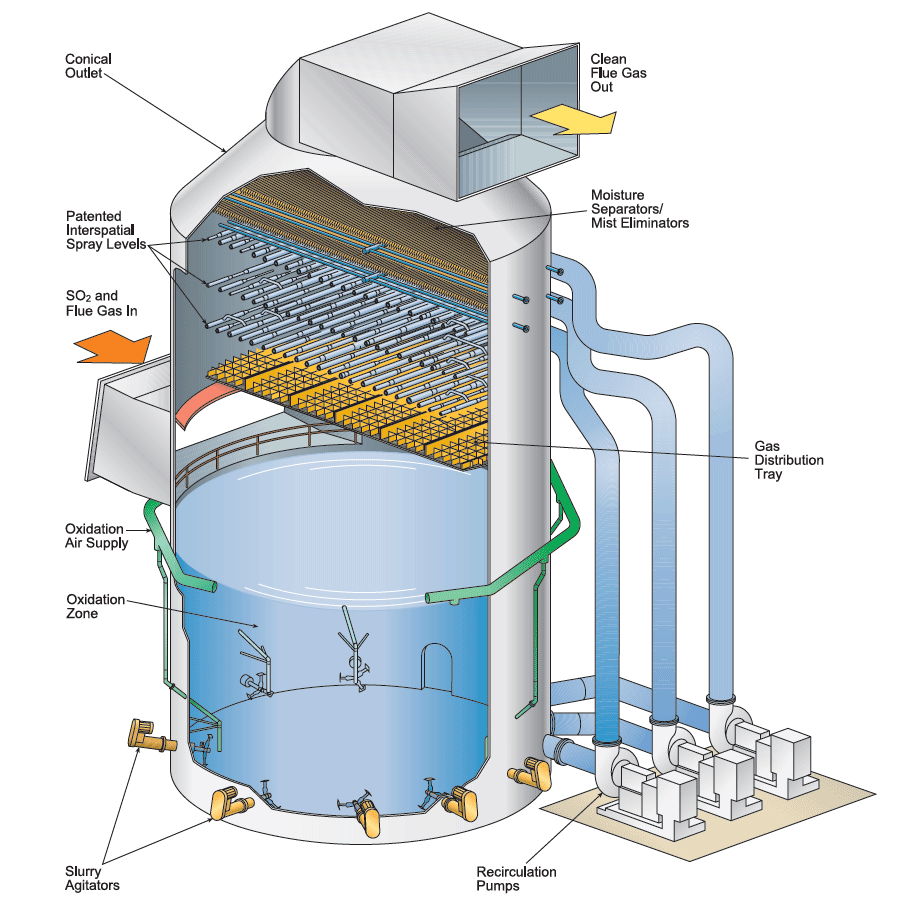
Flue Gas Desulphurisation

Credit: B&W

Why FGDs Matter

  • Flue Gas Desulphurisation (FGD) systems are used to remove sulphur dioxide (SO₂) from emissions of coal-based power plants.
    • SO₂ emissions contribute to acid rain and PM2.5 pollution, both of which are harmful to human health and the environment.
  • Despite the 2015 mandate, only about 8% of plants, mainly NTPC units, have installed FGDs.
  • Implementation deadlines were repeatedly extended, with the latest missed in 2024.

Key Highlights of the Decision

  • The Ministry has now exempted around 80% of plants from the FGD requirement.
  • Only about 20% of the plants must install FGDs, primarily:
    • Those within a 10 km radius of Delhi-NCR
    • In cities with over 1 million people, or
    • Located in pollution hotspots
  • The deadline for these selected plants to comply has been extended to 2028.

Rationale Cited by Government

  • Cost & Supply Issues: Limited domestic FGD suppliers and high installation costs make procurement difficult and could lead to higher electricity tariffs, burdening producers and consumers.
  • Post-COVID Delays: Implementation delays were also attributed to pandemic-related disruptions.
  • Low-Sulphur Indian Coal: An expert committee claimed that domestic coal has low sulphur content, and SO₂ levels near most plants are within permissible limits.
  • Climate Argument: Some officials argued that sulphates formed from SO₂ counteract global warming by reflecting sunlight, a claim that is scientifically questionable and controversial.

Key Concerns

  • Health Hazards Overlooked: SO₂ exposure is linked to respiratory ailments, while sulphates contribute to PM2.5 pollution and acid rain, posing serious public health and environmental risks.
  • Non-Uniform Standards: The exemption introduces unequal environmental protections, violating the principle of equal safeguards for all citizens.
  • Lack of Transparency: The rollback was done without adequate public or parliamentary scrutiny, undermining accountability and scientific integrity in policymaking.
  • Misleading Climate Rationale: Justifying sulphate emissions as a climate mitigation tool contradicts the IPCC’s findings, which view their cooling effect as short-term and overall harmful.

Way Forward

  • Uniform Standards: A pollutant like SO₂ should not be regulated differently across regions. Uniform air quality norms must be enforced nationwide.
  • Technology Access: Encourage domestic manufacturing of low-cost FGDs through incentives and support under Make in India.
  • Evidence-Based Policy: Any major shift in pollution control norms should undergo peer review and public consultations, ensuring evidence-based and participatory governance.
  • Health-Centric Energy policy: Treat pollution control as a public health investment, not merely an environmental expense.
  • Strengthen Monitoring: Enhance the capacity of the Central and State Pollution Control Boards to monitor SO₂ and sulphate levels and make data publicly accessible.

{GS3 – S&T – Cybersecurity} Cybercrime Syndicates in Southeast Asia

  • Context (IE): Recently, an MHA analysis highlighted that Indians are losing ₹1,000 crore monthly to cyber frauds originating from Cambodia and other Southeast Asian nations. In response, Indian and Cambodian authorities have initiated coordinated efforts to crack down on identified scam hubs.

Key Findings (I4C–MHA Report, 2025)

  • Massive Financial Losses: Over ₹7,000 crore lost to cyber scams (Jan–May 2025), with more than half traced to transnational networks in Southeast Asia.
  • Scam Hubs & Trafficking: Cambodia, Myanmar, Laos, Vietnam, and Thailand were identified as major scam hubs, where over 5,000 Indians were trafficked and forced into cyber fraud.
  • Organised Transnational Crime: Operations run from high-security compounds, allegedly controlled by Chinese operators, making it a complex cross-border cybercrime threat.

Nature and Modus Operandi

  • Stock Trading & Investment Scams: Fake platforms promise high returns to lure victims into losing large sums.
  • Digital Arrest Frauds: Scammers impersonate law enforcement to extort money under threats of fake legal charges.
  • Task-Based & Investment Traps: Victims are initially offered online tasks with small rewards, leading to larger investments and eventual fraud.
  • Recruitment Modus: Indian agents from various states lure unsuspecting job seekers with fake overseas employment offers, ultimately pushing them into exploitative cyber scam operations abroad.

Identified Systemic Gaps

  • Banking Sector: Ghost accounts and fake Point-of-Sale (PoS) machines are widely used to move scam proceeds and launder money undetected.
  • Telecom Sector: Issuance of ghost SIM cards through fraudulent Know Your Customer (KYC) processes by rogue agents, enabling anonymous communication for scam operations.
  • Immigration Sector: Lax visa and emigration checks enable traffickers to send Indians abroad under false job promises, leading to exploitative conditions.

Institutional Response and Initiatives

  • An Inter-Ministerial Panel was constituted to identify and address loopholes in financial and administrative systems.
  • The CBI registered an FIR against Point-of-Sale (PoS) agents involved in issuing ghost SIMs, which enabled digital fraud.
  • The Ministry of External Affairs (MEA) convened meetings with Cambodian officials, during which Cambodia requested the geographical coordinates of scam centres to facilitate enforcement actions.
  • Intelligence inputs and testimonies of rescued victims led to the identification of 45 scam compounds in Cambodia, 5 in Laos, and 1 in Myanmar.

Challenges in Tackling Transnational Cybercrime

  • Jurisdictional Complexities: Law enforcement agencies face limited authority over crimes committed abroad.
  • Human Trafficking Overlap: Many victims are trafficked, making these cases both cybercrime and human rights violations.
  • Diplomatic Limitations: Enforcement depends on cooperation with foreign governments, which may be slow or politically sensitive.
  • Resource Constraints: Indian cyber cells and investigative agencies often lack technical and linguistic capabilities to track global scam networks.

Way Forward

  • Legal & Technical Reform: Modernise cyber laws and equip I4C and state cyber units with AI-based fraud tracking tools.
  • International Cooperation: Engage with platforms like Interpol, UNODC, and ASEAN-India to establish rapid extradition, intelligence sharing, and joint crackdowns.
  • Public Awareness: Launch multilingual fraud alert campaigns to educate citizens about cyber scams and reporting channels.
  • Migration Oversight: Regulate job platforms and travel agencies sending workers to Southeast Asia. Tighten Emigration Clearance (ECNR) norms in states prone to trafficking.
  • Stricter KYC Compliance: Enforce real-time fraud detection across banks, fintech platforms, and telecom providers to disrupt scam infrastructure.

{GS3 – S&T – Space} Axiom-4 Mission: Successful Completion of Microgravity Experiments

  • Context (TH): Gaganyatri Shubhanshu Shukla, the first Indian to go to space in 41 years, has completed all seven Indian microgravity experiments aboard the International Space Station (ISS) during the Axiom-4 mission.
  • These experiments were designed to study biological responses in microgravity and support the development of future space exploration and human survival in extraterrestrial environments.

Key Experiments Conducted

  • Muscle Regeneration (Myogenesis): Studied muscle loss in microgravity and tested metabolic supplements to prevent atrophy (partial or complete wasting away of a part of the body).
  • Crop Seed Growth: Observed six crop varieties (including moong and methi) for changes in germination, genetics, microbial content, and nutrition, contributing to future space farming solutions.
  • Sprouting Salad Seeds: Focused on the sprouting behaviour of moong and fenugreek seeds in space, followed by Earth-based growth to assess adaptive changes.
  • Microalgae Study: Monitored three microalgae strains to understand genetic and metabolic responses in space, supporting oxygen generation and food production in closed space habitats.
  • Cyanobacteria Research: Studied two cyanobacteria strains for photosynthetic efficiency and resilience, with applications in life-support systems for extended space missions.
  • Voyager Tardigrades: Rehydrated and observed Indian strains of tardigrades (water bears) to explore their survival and reproduction in space.
  • Voyager Displays (Human–Machine Interface): Analysed astronaut interaction with digital displays in microgravity, measuring pointing accuracy, gaze, performance, and stress to improve future spacecraft interface design.

Never Miss an Update!

Leave a Reply

Your email address will not be published. Required fields are marked *