What are Critical Minerals?
- A critical mineral is a metallic or non-metallic element crucial for modern technologies, economies, and national security, with the potential risk of disruptions to its supply chains. It includes both primary and processed minerals.
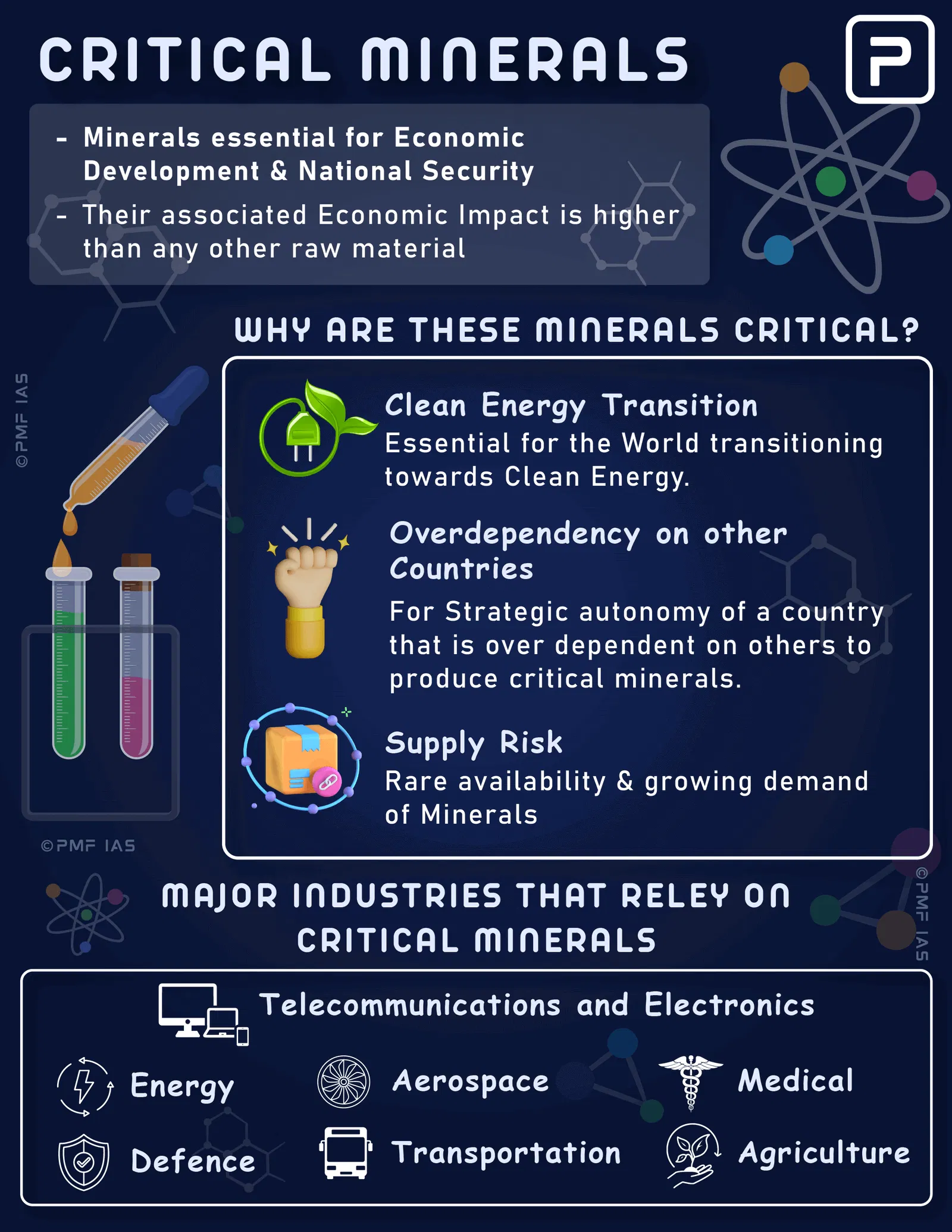
- A mineral is critical when the risk of supply shortage and associated economic impact is (relatively) higher than other raw materials.
- Countries create their own critical minerals list based on strategic needs.
- These are minerals that are essential for economic development and national security.
- The lack of availability of these minerals or the concentration of extraction or processing in a few geographical locations can lead to “supply chain vulnerabilities and even disruption of supplies”.
Critical Minerals of India
- The government has unveiled the country’s first report on “Critical Minerals for India” and has identified 30 critical minerals, including nickel, titanium, vanadium, tungsten, etc.
- The identification of the critical minerals is a part of multiple strategic value chains, which include:
- Clean technologies initiatives (such as zero-emission vehicles, wind turbines, and solar panels);
- Information and communication technologies (including semiconductors);
- Advanced manufacturing inputs and materials (defence applications, permanent magnets, & ceramics).
- The minerals were identified based on a report by an Expert Committee of the Ministry of Mines.
|


