Download Prelims Magnum 2026 — Yearly [FREE] ★                      ★ Prelims Cracker 2026 Combo Deal ⚡️ Magnum Crash Course + Test Series ★                      ★ PMF IAS Impact 🎯 53 Direct Hits in Prelims 2025 ★

Atlantic Meridional Overturning Circulation (AMOC)

Prelims Cracker
Prelims Cracker
  • Context (DTE): The study warns that the collapse of Atlantic Meridional Overturning Circulation (AMOC) could plunge winter temperatures across northern Europe to unprecedented lows.
  • Human-induced climate change, particularly the melting of Greenland’s ice sheet, has been adding enormous amounts of freshwater to the North Atlantic. This influx reduced the salinity and density of seawater, disrupting the sinking process that drove the AMOC.

What is AMOC?

  • AMOC is part of a system of currents characterised by a northward flow of warm, salty water in the upper layers of the Atlantic, and a southward flow of colder, deep waters that are part of the thermohaline circulation.
  • It is driven by differences in the density of water, which determines their temperature.
  • It acts as a conveyor belt, redistributing heat throughout the Earth’s climate system by bringing it from the tropics in the Southern Hemisphere to Greenland and carrying cold water back south.
  • It is a potential climate tipping point; its collapse could trigger rapid & irreversible climate changes.
  • A 2021 study found that the AMOC is already at its weakest in over 1,600 years.

Atlantic Meridional Overturning Circulation (AMOC)

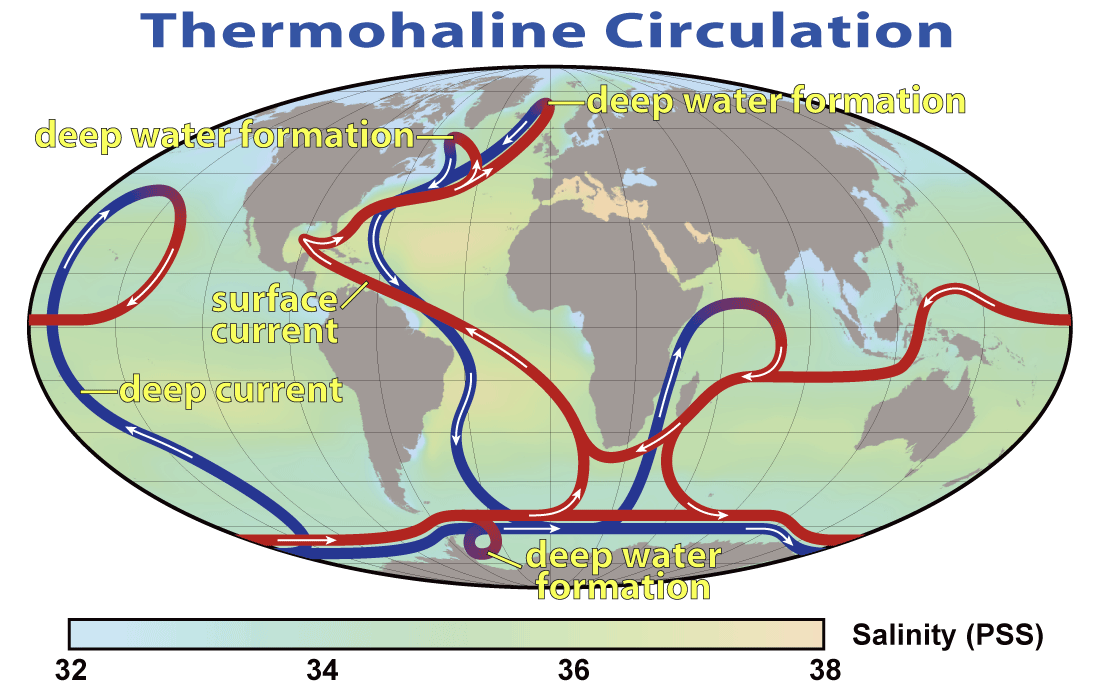
Thermohaline Circulation

  • Winds drive ocean currents in the upper 100 meters of the ocean’s surface.
  • However, ocean currents also flow thousands of meters below the surface.
  • These deep-ocean currents are driven by differences in the water’s density, which is controlled by temperature (thermo) and salinity (haline).
  • This process is known as thermohaline circulation.
  • The thermohaline circulation is sometimes called the ocean conveyor belt, the great ocean conveyor, or the global conveyor belt.
  • Ocean bottom relief greatly influences thermohaline circulation.
Thermohaline Circulation

Thermohaline Circulation (Wikipedia)

Working of AMOC

  • As warm water flows northwards in the Atlantic, it cools, while evaporation increases its salt content.
  • Low temperature and a high salt content raise the density of the water, causing it to sink deep into the ocean.
  • The cold, dense water deep below slowly spreads southward.
  • Eventually, it gets pulled back to the surface and warms again, and the circulation is complete.

Atlantic Meridional Overturning Circulation (AMOC)

Credits: The Economist

Importance of AMOC

  • Regulates Global Climate: It regulates global climate by transporting heat from the tropics to the North Atlantic, keeping regions like Europe warmer.
  • Carbon regulation: It helps absorb and store atmospheric CO₂, playing a vital role in the global carbon cycle.
  • Nutrient Circulation: It circulates nutrients in the ocean, supporting marine ecosystems and fisheries.
  • Influences Weather: It influences weather patterns, including rainfall in West Africa and South America, as well as hurricane activity in the Atlantic.

Impact of Weakening of AMOC

  • Severe Winter in Europe: North-Western Europe could experience significant cooling and more intense winter extremes.
  • Sea Ice Expansion: Cooling from the reduced heat transfer from ocean currents would be amplified by “extensive” sea ice expansion to the coasts of northwest Europe.
  • Weakening of Monsoon: A shutdown of the AMOC could shift the Intertropical Convergence Zone southward, weakening monsoon systems across India, West Africa, and the Amazon and altering rainfall patterns in the tropics.
  • Ice Melt: Greenland and Arctic ice melt may accelerate, increasing freshwater input into the ocean and further amplifying AMOC weakening.
  • Droughts: The Sahel region in Africa is at risk of severe droughts, which could disrupt agriculture and livelihoods.
  • Impact on Marine Ecosystems: Marine ecosystems may be altered due to disruptions in nutrient and heat distribution.
  • Sea Level Rise: Sea levels may rise significantly along the U.S. East Coast because of changes in ocean currents and pressure systems.
  • Global Warming: The ocean’s ability to absorb CO₂ could decline, worsening global warming.

Never Miss an Update!

One comment

Leave a Reply

Your email address will not be published. Required fields are marked *