Critical Mineral Recycling Incentive Scheme


- The Ministry of Mines has issued guidelines for implementing the ₹1,500 crore Critical Mineral Recycling Incentive Scheme (CMRIS) under the National Critical Minerals Mission (NCMM).
About Critical Mineral Recycling Incentive Scheme (CMRIS)
- Critical Mineral Recycling Incentive Scheme (CMRIS) is a central sector scheme under the National Critical Minerals Mission (NCMM) to promote recycling of critical minerals from secondary sources (e.g., e-waste, spent lithium-ion batteries, etc).
- Nodal Agency: Ministry of Mines.
- Objective: To establish a secondary domestic supply chain for critical minerals, thereby reducing India’s dependence on imports.
- Output Target: An annual recycling capacity of 270 kilotons, along with 40 kilotons of recovered critical minerals each year by FY 2031.
- Tenure: Six financial years (FY 2025–26 to FY 2030–31), with a total outlay of ₹1,500 crore.
- Incentive Structure: Incentives are provided on a reimbursement basis for both capital expenditure (Capex) and operational expenditure (Opex) components.
- Coverage Focus: Covers all stages of recycling, from collection and processing to extraction and purification, ensuring full and transparent mineral recovery.
- Feedstock Sources: E-waste, spent lithium-ion batteries, catalytic converters, and other secondary metal waste.
- Process Eligibility: The scheme is open to entities engaged in the extraction, separation, and purification of critical minerals; Those engaged solely in black-mass production are excluded.
- It applies to both new investments and the expansion, modernisation, or diversification of existing recycling operations.
Classification of Beneficiaries
- Beneficiary Group A: Large recyclers with annual revenues above ₹200 crore, investing at least ₹100 crore, and maintaining 10,000-tonne capacity.
- Beneficiary Group B: Smaller recyclers and startups with revenues under ₹200 crore, investing at least ₹25 crore, and maintaining 5,000-tonne capacity.
- Incentive Caps: Financial assistance is capped at ₹50 crore for Group A entities and ₹25 crore for Group B entities, covering both capital expenditure (Capex) and operating expenditure (Opex).
- Outlay Reservation: One-third of the total ₹1,500 crore outlay is reserved exclusively for Group B startups and smaller recyclers.
National Critical Mineral Mission
- Aimed at Innovation: Promote research in advanced mineral processing & cutting-edge technologies for mineral processing and recovery, and establish Centres of Excellence.
- Comprehensive Mineral Value Chain: Encourages both public & private investment in global mining projects encompassing exploration, mining, beneficiation, processing & recycling of critical minerals.
- Financial Support: ₹16,300 cr. from the government for exploration and recovery of minerals through subsidies and grants & ₹18,000 cr. expected investment from PSUs & private companies.
- Infrastructure Development: Establishment of mineral processing parks and promotion of critical mineral recycling.
- Stockpile Strategy: Plans to build a national reserve of critical minerals to ensure long-term supply security.
- Faster Regulatory Approvals for critical mineral mining projects to ensure smooth operations.
- Self-Reliance in Critical Minerals: Reduce dependence on imports by enhancing domestic production and acquiring foreign assets.
Critical Minerals Under NCMM
- Lithium & Cobalt: Essential for electric vehicle (EV) batteries and electronics.
- Graphite & Nickel: Used in battery storage and alloys.
- Rare Earth Elements (REEs): Key for high-tech manufacturing and defense applications.
- Titanium & Tungsten: Critical for aerospace and industrial applications.
- Vanadium & Molybdenum: Used in steel production and energy storage solutions.
Technological and Legislative Support
- Mines and Minerals (Development and Regulation) Act, 1957: The 2023 amendments enhance exploration and mining of critical minerals.
- Geological Survey of India (GSI): Conducting large-scale exploration projects for critical minerals, with 368 projects ongoing.
- S&T PRISM Program: Encourages start-ups and MSMEs in mineral research and commercialization.
- KABIL’s Foreign Acquisitions: KABIL, a JV of the Ministry of Mines, has secured mining rights in Argentina for Lithium.
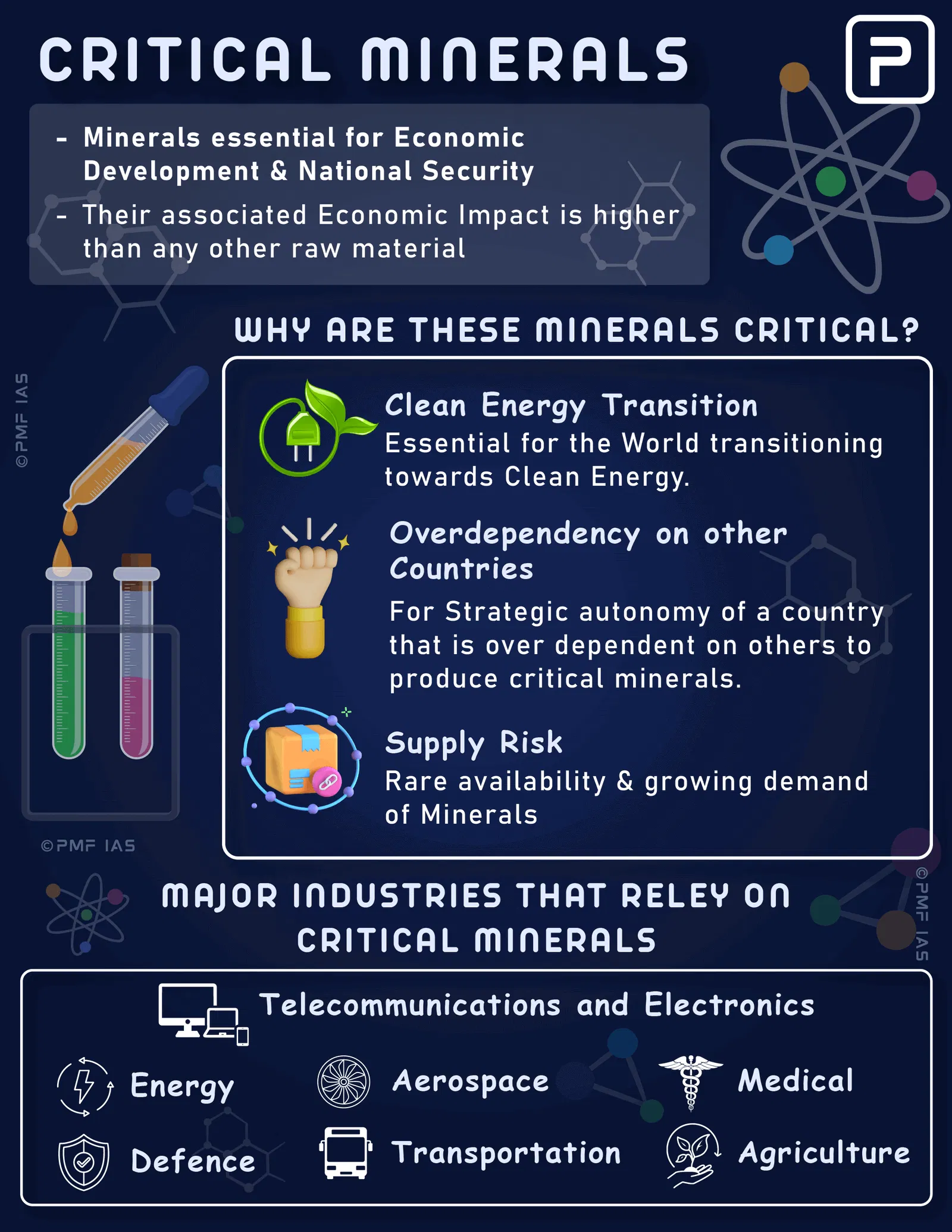
What are Critical Minerals?
Critical Minerals of India
|