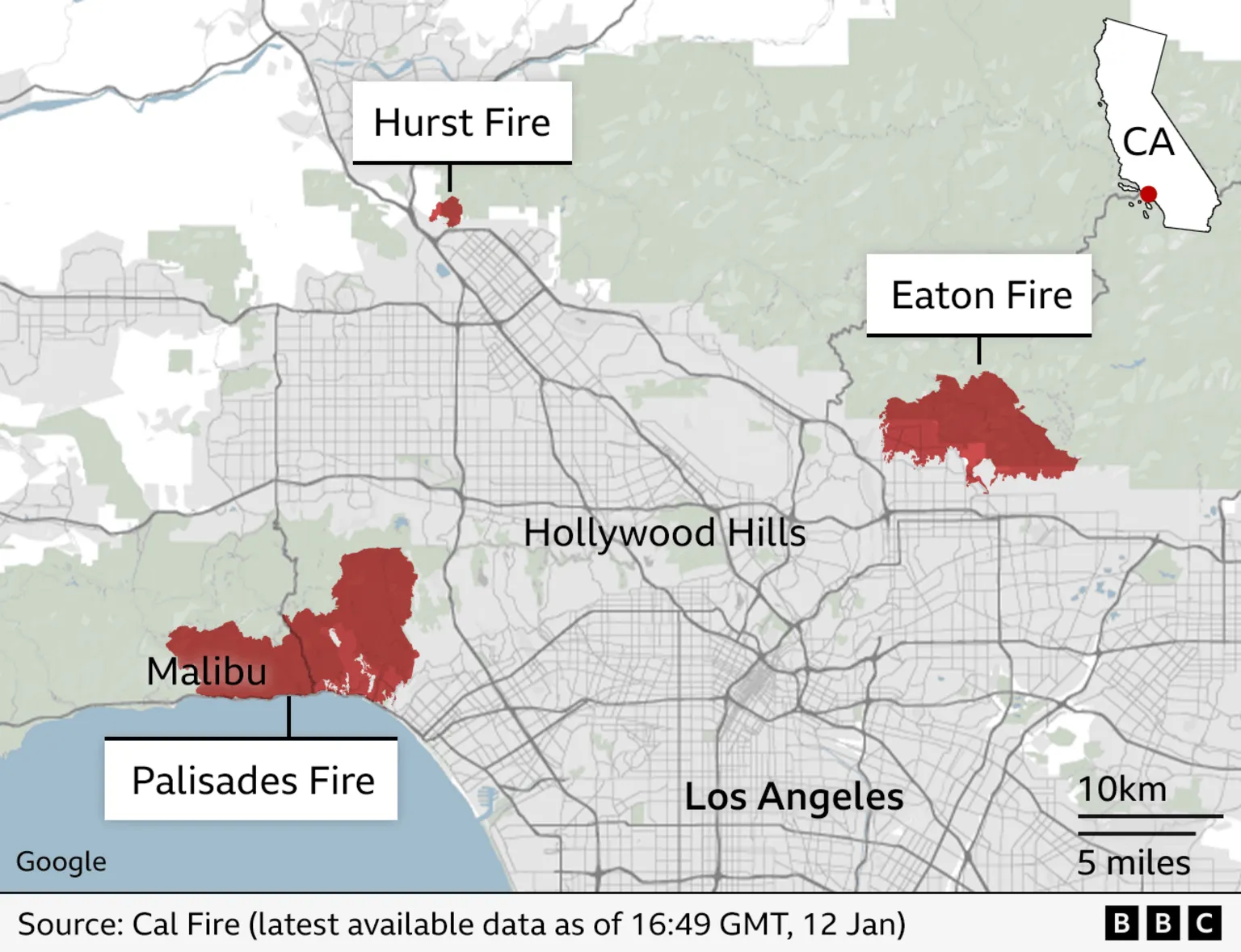
Context (CNN): The Los Angeles area is experiencing unprecedented winter wildfires, including the Palisades fire (largest and most destructive), Eaton fire, Sunset fire, Hurst fire, and Lidia fire.
While California frequently battles wildfires, this particular flare-up is notable for its size, speed, and unusual timing—occurring in the winter, a season typically less prone to wildfires.
Previous Years: Unusually wet winters led to extensive vegetation growth.
Current Winter (2023-2024): Exceptionally dry conditions (according to NASA, since October, Southern California has recorded negligible rainfall) have turned this vegetation into fuel.
Santa Ana Winds
The Santa Ana winds (strong, dry, and hot katabatic wind), a typical feature of California’s climate, significantly fanned the flames.
Between October and January, a high-pressure system develops over the Great Basin deserts, causing winds to blow westward towards the coast.
As these winds descend over the Sierra Nevada and Santa Ana mountains, they lose humidity (descending winds undergo compression temperature rises reduces humidity), heat up, and accelerate as they pass through mountain gaps. When they reach Southern California, the winds are fast, dry, and warm, fueling wildfires. Unusually strong Santa Ana winds are accelerating fire spread.
While lightning is a common cause of wildfires in the U.S., it was ruled out as a potential cause, as no lightning was reported in the affected areas.
The wind blows down a slope due to gravity (air moves downhill)
Blows up a hill or mountain slope facing the Sun (air moves higher slopes).
Occurs at night.
Occurs during the day.
It is caused by the cooling of highlands and subsequent denser air flowing downhill.
It is more pronounced in calm air conditions.
It is caused by the Sun heating the slope, leading to rising warm air.
It is best formed on sunny days with clear skies.
Foehn (warmed by compression) and Fall Wind (rapid descent without warming) are the types of Katabatic winds
It has no specific subtypes.
Impact of Climate Change
Research published in Nature Scientific Reports (2021) highlighted that California’s fire season has lengthened over the past two decades, with the peak shifting from August to July.
Global Warming early snowmelt and longer dry seasons moisture-stressed vegetation more susceptible to wildfires (plants have less water).
As climate change progresses, extreme weather events become more severe, leading to prolonged and intense wildfire seasons.
In 2024, California experienced its hottest June and July, along with the second-hottest October.
Potential Ignition Causes
Strong winds can cause power lines to sway and come into contact with trees or other objects, potentially generating sparks and igniting dry vegetation. For example, the 2017 Thomas Fire was caused by Southern California Edison power lines.
Accidental or intentional human activities, such as campfires, fireworks, etc, can also trigger wildfires.
Wildfires and Urban Water Systems
Wildfires in urban settings pose unique challenges to water supply systems. The 2017 Tubbs Fire in Santa Rosa highlighted the potential for devastating impacts on urban water infrastructure.
While water demand surges during firefighting efforts, many factors can disrupt water supply, including:
Contamination of water supplies due to low pressure and debris.
Post-fire Water Concerns
Many areas in Los Angeles are under boil water notices due to concerns of contamination during low-pressure periods, allowing ash and debris to infiltrate the system.
Post-fire recovery involves assessing and repairing damaged water pipes and pumps.
Red Alert is a general term indicating the need for extreme caution due to imminent danger, whereas Red Warning by IMD specifically means “Take Action” for extreme weather events like heavy rainfall or cyclones to safeguard life and property.
Way Forward
Technological Upgrades: Expand the Doppler network and adopt advanced AI for real-time predictions.
Public Awareness Campaigns: Educate citizens about interpreting weather alerts.
Collaborative Efforts: Enhance coordination among IMD, disaster management authorities & local govt.
Agricultural Practices: Use hail nets, frequent irrigation, and protective coverings for vulnerable crops.
Livestock Protection: Ensure dry bedding and animal warmth, particularly during extreme cold.
{GS3 – IS – Cyber Security} Jumped Deposit Scam
Context (LM | ET): Rising digital payment usage in India has led to the emergence of new scams, including the Jumped Deposit Scam, targeting UPI users.
Fraudsters deposit a small amount of money into a victim’s account and later request a larger refund, citing a false reason. When victims verify their balance by entering their UPI PIN, fraudsters use a fake payment request to steal money.
Preventive Measures
Delay in Balance Check: Wait 15-30 minutes before checking your balance after an unexpected deposit to let fraudulent requests expire.
Use Incorrect PIN to prevent unauthorised transactions in case immediate verification is necessary.
Do Not Share UPI PIN with anyone, including those claiming to be bank representatives.
Verify Source of Deposit: Contact your bank to confirm the legitimacy of unexpected deposits.
Block Suspicious Requests: Decline & report any unsolicited payment requests from unknown sources.
Steps to Take if Victimized
Report to Cyber Crime Police: File a complaint on the National Cyber Crime Reporting Portal (www.cybercrime.gov.in).
Notify Your Bank: Immediately inform your bank about the fraudulent transaction to block further unauthorised activities.
UPI (Unified Payments Interface): A real-time payment system developed by the National Payments Corporation of India (NPCI) that facilitates inter-bank transactions via mobile platforms.
UPI Security Guidelines
Follow RBI guidelines for digital payments and fraud reporting.
Use multi-factor authentication where possible and regularly update banking app passwords.
Regularly check your bank statements for unusual transactions and set up transaction alerts.
Be cautious of phishing links and fake websites mimicking bank or UPI platforms.
Other Notorious Digital Cyber Financial Frauds/Crimes
Phishing: Fraudsters trick individuals into revealing sensitive information like passwords and credit card details through deceptive emails or websites.
RansomwareAttacks: Cybercriminals encrypt a victim’s data and demand payment for its release.
Identity Theft: Hackers steal personal information to commit fraud or open accounts in victim’s name.
Online Investment Scams: Fraudulent investment opportunities promising high returns that lead to financial loss.
Credit Card Fraud: Hackers steal card details and make unauthorised purchases.
Fake E-commerce Websites: Scammers create fake online stores to steal payment information and deliver fake or no products.
Context (TH): India is advancing AI integration in defence but faces challenges in infrastructure, policy, and implementation.
Achievements in Military AI
Increased Defence Budget: The ₹6.21 lakh crore ($75 billion) defence budget (2023-24) prioritises modernisation and AI integration for national security.
Indrajaal System: Development of autonomous drone security systems like Indrajaal to bolster air defence capabilities.
Foreign Investment: India has attracted significant investments, such as Microsoft’s $3 billion commitment to AI infrastructure in Telangana, aiding its AI ecosystem.
Government Initiatives: The establishment of the Defence Artificial Intelligence Council (DAIC) and the Defence AI Project Agency (DAIPA) to guide AI adoption in military applications.
Grene Robotics claimed to have designed and developed a 100% Indigenous unified, distributed, and wide-area autonomous drone defence dome called Indrajaal. It can autonomously protect a large area of 1000-2000 sq. km per system against threats such as Unmanned Aerial Vehicles (UAVs), incoming weapons, loitering munitions, and the like.
Issues
Policy and Regulatory Gaps
Fragmented Policy Framework: India’s existing AI policies, such as the National Strategy for Artificial Intelligence (NSAI)and “Responsible AI for All,” lack specific guidelines for military AI deployment.
Lack of Clear Regulations: Ethical concerns persist due to insufficient regulations, with debates on AI’s potential misuse, likening it to nuclear weapons.
Infrastructure and Technological Hurdles
High Costs of AI Infrastructure: The expense of establishing data centres needed for AI systems.
Aging Legacy Systems: India’s military is focused on replacing outdated hardware, diverting resources from AI system development.
Interoperability Issues: The historically siloed nature of the armed forces (Army, Navy, Air Force) hinders seamless integration and joint operations of AI systems.
Procurement and Industrial Limitations
Overreliance on PSUs: The dominance of public sector units restricts the diversity and innovation needed for cutting-edge AI systems.
Limited Private Sector Engagement: Insufficient PPPs hinder the development of advanced AI systems, and there’s a need to encourage private participation.
Global AI Landscape
AI Adoption by Global Powers: Countries like China and Israel have rapidly developed and deployed military AI, setting benchmarks in technology deployment and integration.
Global Concerns and Regulation: The international community, including platforms like the Global Partnership on AI (GPAI), stresses caution and establishes ethical guidelines to ensure AI is used responsibly.
Way Forward
Unified Vision for Armed Forces: A joint military doctrine is needed to ensure interoperability across the Army, Navy, and Air Force to effectively integrate AI systems in national defence.
Invest in AI Infrastructure: Increase investment in state-of-the-art AI research and development centres, focusing on building a solid AI infrastructure to support military needs.
Expand Public-Private Partnerships (PPPs): Encourage collaboration with the private sector, similar to developments in the space sector, to accelerate AI innovation and scale solutions for the military.
Global Collaborations: Strengthen ties with leading AI nations for knowledge exchange, technology sharing, and cross-border partnerships in military AI development.
Support AI Startups: Provide funding and policy support to AI startups to foster innovation in defence technologies, creating an indigenous ecosystem.
Skilling Defence Personnel: Focus on training military personnel in AI systems to ensure they can effectively operate, manage, and adapt to AI-powered tools.
{Prelims – In News} Pink Fire Retardant in Wildfire Control
Context (IE):Southern California wildfires raise concerns over pink fire retardants’ safety and efficacy amid growing reliance due to climate-induced wildfire severity.
Pink Fire Retardant
Primarily consists of ammonium phosphate-based slurry, with salts like ammonium polyphosphate to improveadhesionto vegetation.
Bright pink dye added for visibility.
Used alongside other firefighting techniques, such as water drops and ground efforts.
Application Method: Dropped from planes and helicopters ahead of advancing fires to coat vegetation, slowing combustion by restricting oxygen.
Concerns with Aerial Retardants
Toxic Composition: Aerial retardants contain carcinogenic heavy metals harmful to organs. Over 400 tons of heavy metals were released between 2009-2021, contributing to pollution.
Aquatic Harm: Runoff from retardants threatens aquatic ecosystems and life.
Pollution in Waterways: Retardants are significant pollutants, raising long-term ecological concerns.
Cumulative Ecosystem Risk: Frequent chemical releases from wildfires escalate risks to ecosystems.
Terrain & Weather Limitations: Effectiveness of retardants varies with terrain, vegetation & weather.
Narrow Operational Range: Limited impact under specific conditions reduces overall effectiveness.
Climate Change Effects: Rising wildfire severity reduces the window for effective retardant use.
High Costs: Expensive to produce and deploy, requiring substantial funding.
Resource Allocation Concerns: Resources may be better spent on prevention & ground-based methods.
Measures to Address Wildfire Challenges
Forest Management: Improve forest practices to minimise fire risks.
Climate-Resilient Strategies: Invest in ecosystem-based and climate-adaptive firefighting methods.
Eco-Friendly Retardants: Develop fire retardants with reduced environmental harm.
Advanced Technologies: Use remote sensing and AI for early fire detection and response.
Environmental Regulations: Enforce strict norms on fire retardant usage and composition.
Public-Private Partnerships: Promote collaborations to fund sustainable firefighting innovations.
{Prelims – In News} Trump’s Unconditional Discharge
Context (IE | IE): President-elect Donald Trump received an unprecedentedunconditional discharge in the New York hush-money case days before his presidential inauguration.
Hush Money Case
Payments to suppress potentially damaging information, often linked to legal or political repercussions.
In this case, Trump was found guilty of falsifying business records to conceal a $130,000 payment to adult film actress Stormy Daniels before the 2016 elections, breaching the New York election laws.
Unconditional Discharge
A legal sentence where a convicted person is released without imprisonment, probation, or fines.
No further conditions or obligations are imposed, but the conviction remains on record.
Issues Highlighted
Immunity for High-ranking Officials: Raises concerns about accountability for individuals in top offices.
Complexities in Prosecuting High-office Holders: Broad immunity for official acts complicates legal actions against presidents.
Balancing Legal Accountability and Political Implications: Lenient sentencing reflects challenges in addressing legal violations without disrupting governance.
{Prelims – PIN} Lal Bahadur Shastri
Context (ET | OWN | IE): Lal Bahadur Shastri,India’ssecond PM, is celebrated for his humility, visionary leadership, and national contributions. His mysterious demise on January 11, 1966, shortly after the Tashkent Agreement, left a profound impact on the country.
Early Life and Educational Journey
Birth and Upbringing: Born on October 2, 1904, in Mughalsarai, Uttar Pradesh, into a modest family.
Education: Graduated in philosophy and ethics from Kashi Vidyapith, earning the title “Shastri” in 1925.
Influences: Inspired by Mahatma Gandhi, Bal Gangadhar Tilak, and Swami Vivekananda, shaping his values of simplicity and public service.
Role in India’s Freedom Struggle
Early Involvement: Joined Gandhi’s Non-Cooperation Movement at 13 and actively participated in the Salt Satyagraha (1930) and Quit India Movement (1942).
Imprisonment: Spent seven years in jail for his participation in the independence struggle.
Congress Leadership: Played a key role in the Indian National Congress, advocating for independence and national unity.
Political Career
Early Roles: Served as Parliamentary Secretary of UP (1946) and later as Home Minister.
Union Minister: Held critical portfolios in the Union Cabinet, including Railways, Transport & Industry.Resigned as Railways Ministerafter a train accident in 1956, demonstrating integrity.
Prime Minister: Succeeded Jawaharlal Nehru in 1964 as India’s second Prime Minister.
Key Contributions as Prime Minister
Domestic Policies
Secular Democracy: Focused on building a secular, mixed-economy democracy promoting peace.
Linguistic Unity: Addressed anti-Hindi protests in Tamil Nadu, ensuring English remained an official language in non-Hindi regions.
White Revolution: Supported Dr. Verghese Kurien and Amul, spearheading the White Revolution and boosting milk production.
Green Revolution
Modernized agriculture with improved techniques, fertilisers, and irrigation.
Aimed at food self-sufficiency, reducing reliance on imports and combating hunger.
Indo-Pak War of 1965
Led India during the 1965 war, demonstrating strategic leadership & resilience despite limited resources.
Coined “Jai Jawan! Jai Kisan!” to emphasise the role of soldiers and farmers in national growth.
Tashkent Agreement
Signed on January 10, 1966, with Pakistan’s President Ayub Khan to end the Indo-Pak war. The agreement was brokered by the Soviet Union.
Challenges and Leadership During Crisis
War Challenges: Displayed diplomatic strength, ensuring India negotiated from a position of advantage.
Domestic Issues: Tackled anti-Hindi riots with assurance and promoted national harmony.
Economic Stability: Strengthened agriculture and industrial policies for sustainable growth.
Mysterious Demise
Died on January 11, 1966, in Tashkent, Uzbekistan, officially from a heart attack.
Speculation: Lack of a post-mortem and anomalies led to theories of foul play, sparking debates.
Legacy and Recognition
Honors: Posthumously awarded the Bharat Ratna in 1966. Memorialised at Vijay Ghat, Delhi.
Inspirational Leadership: Renowned for honesty, simplicity, and moral integrity in governance.
National Influence: Institutions like Lal Bahadur Shastri National Academy of Administration (LBSNAA) commemorate his contributions.