

Sickle Cell Disease
- Context (TH): India bears the world’s second-largest burden of sickle cell disease (SCD).
- Sickle cell disease is a genetic disorder caused by an abnormality in haemoglobin. When both parents carry the sickle cell trait, their child has a significant chance of being born with it.
About Sickle Cell Disease

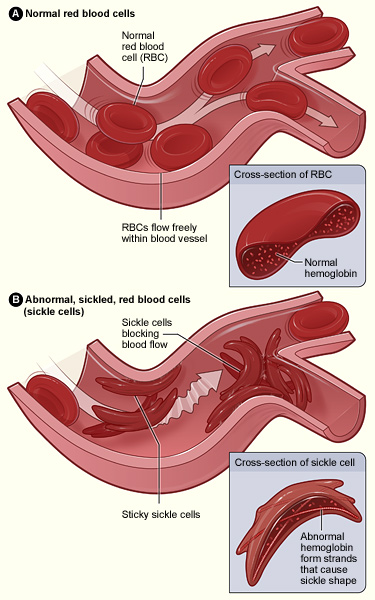
- SCD is a group of inherited red blood cell (RBC) disorders that affect haemoglobin, the protein that carries oxygen through the body.
- Normally, RBCs are flexible disc-shaped cells that move easily through blood vessels.
- In SCD, RBCs become crescent or sickle-shaped due to a genetic mutation of haemoglobin.
- These sickled RBCs do not bend or move easily and can block blood flow to the rest of the body.
- Symptoms/complications of SCD: Pain, anaemia, jaundice, stroke, organ failure etc.
- Treatment: A blood and bone marrow transplant was the only cure for SCD, but it was not for everyone because of the dearth of donors and the associated risk.
|
Sickle Cell Disease in India
- Over a million people in the country are affected, with a majority concentrated in the tribal belt spanning Odisha, Jharkhand, Chhattisgarh, Madhya Pradesh, and Maharashtra.
- Patients with sickle cell disease face a significantly reduced lifespan, with life expectancy shortened to around 40 years. The disease drastically affects their quality of life due to continuous health problems.
- Individuals with SCD are often viewed as “genetically inferior” and are sometimes ostracised, with the condition being misattributed to “God’s curse” or “black magic.”
- Government has launched the National Sickle Cell Anaemia Elimination Mission in 2023.
- Currently, only 18% of affected individuals in India receive consistent treatment for sickle cell disease. Drop-offs are at various stages – screening, diagnosis, treatment initiation, and adherence.
- While there is no permanent cure for SCD, affordable drugs like hydroxyurea can improve a patient’s quality of life if taken consistently. However, access to these medicines is unreliable.
- Medication shortages and low vaccination coverage further complicate disease management.
Sickle Cell Anaemia (SCA)
- SCA is a type of SCD that causes the most severe anaemia.
- It is the most common type of SCD.
Gene Therapy for SCA
- Gene-editing therapy has been successfully used in the UK to cure SCA patient.
- The drug Casgevy, uses the gene-editing tool CRISPR-Cas9 (Clustered Regularly Interspaced Short Palindromic Repeats and associated protein 9) for this purpose.
- This therapy involves modifying the patient’s DNA by specifically targeting and replacing the faulty haemoglobin gene with a healthy one.
- To do this, stem cells are taken out of the bone marrow, edited, and infused back into the patient.
- This restores normal haemoglobin function, offering a potential cure for a lifetime.
|

Why Gene Therapy for SCA is Significant for India?
- India has the second-highest disease burden of SCA globally after African countries.
- An estimated 30,000-40,000 children in India are born with the disorder every year.
- It is more prevalent among India’s tribal population; SCA affects one in 86 births among the Scheduled Tribe (ST) population.
- SCA is highly prevalent in 15 Indian states, with Maharashtra leading in incidence.
Initiatives by India for SCA
National Health Mission (NHM)
- Under NHM, GoI supports the states for prevention and management of SCA.
- NHM aims for universal access to affordable, quality healthcare services that are accountable and responsive to people’s needs.
State Haemoglobinopathy Mission
- It has been established in MP to tackle the challenges in screening and managing SCA.
- It was launched in 2021.
National Sickle Cell Anaemia Elimination Mission (NSCAEM)
- NSCAEM aims to eliminate SCA as a public health problem in India before 2047.
- It was introduced in the Union Budget 2023.
- It is being implemented in 17 states: Gujarat, Maharashtra, Rajasthan, MP, Jharkhand, Chhattisgarh, WB, Odisha, TN, Telangana, Andhra Pradesh, Karnataka, Assam, UP, Kerala, Bihar, and Uttarakhand.
- It is executed in a mission mode as part of the National Health Mission (NHM).


