

Purple Frog (Nasikabatrachus sahyadrensis)


- Context (TH): Tamil Nadu established a special fund to save Purple Frog in the Western Ghats.
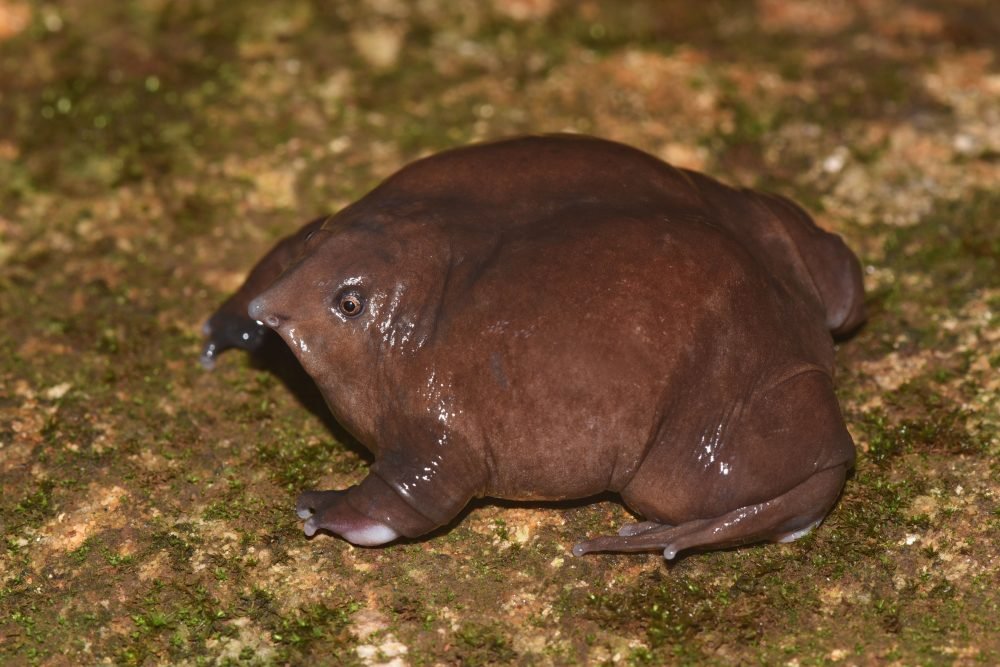
- The Purple Frog is believed to be a ‘living fossil’ having co-existed with dinosaurs.
- It has similarities to the Sooglossidae family of frogs in Seychelles.
- It has been acknowledged by bio-geographers all over the world as one of the rarest kinds and a ‘once in a century find’.
- The frog spends most of its life underground and surfaces only during the monsoon, for a period of two weeks, for mating.
- Physical description: The purple frog has a bloated body with short stout limbs and is dark purple to greyish in colour.
- It has a small head in comparison to the body length, and an unusually pointed snout.
- Unlike other frogs, it has very short hind legs, which does not allow it to leap from one spot to another.
- Habitat: It prefers loose, damp and well-aerated soil close to ponds and ditches or streams.
- Range: It is endemic to select habitats in the Western Ghats in Kerala and Tamil Nadu.
- Conservation Status: IUCN: Near Threatened | WPA: Schedule I
- It ranked four on the ‘EDGE (Evolutionarily Distinct and Globally Endangered) of Existence’ priority amphibians list collated by the Zoological Society of London.
- Threats: Clearance of forest for coffee, cardamom and ginger plantations, consumption of its tadpoles, climate change, etc.
|


