- The Supreme Court ruled that the age limits under the Surrogacy (Regulation) Act, 2021, do not apply to couples who had frozen their embryos and initiated the surrogacy process before the law came into force on January 25, 2022.
What is Surrogacy?
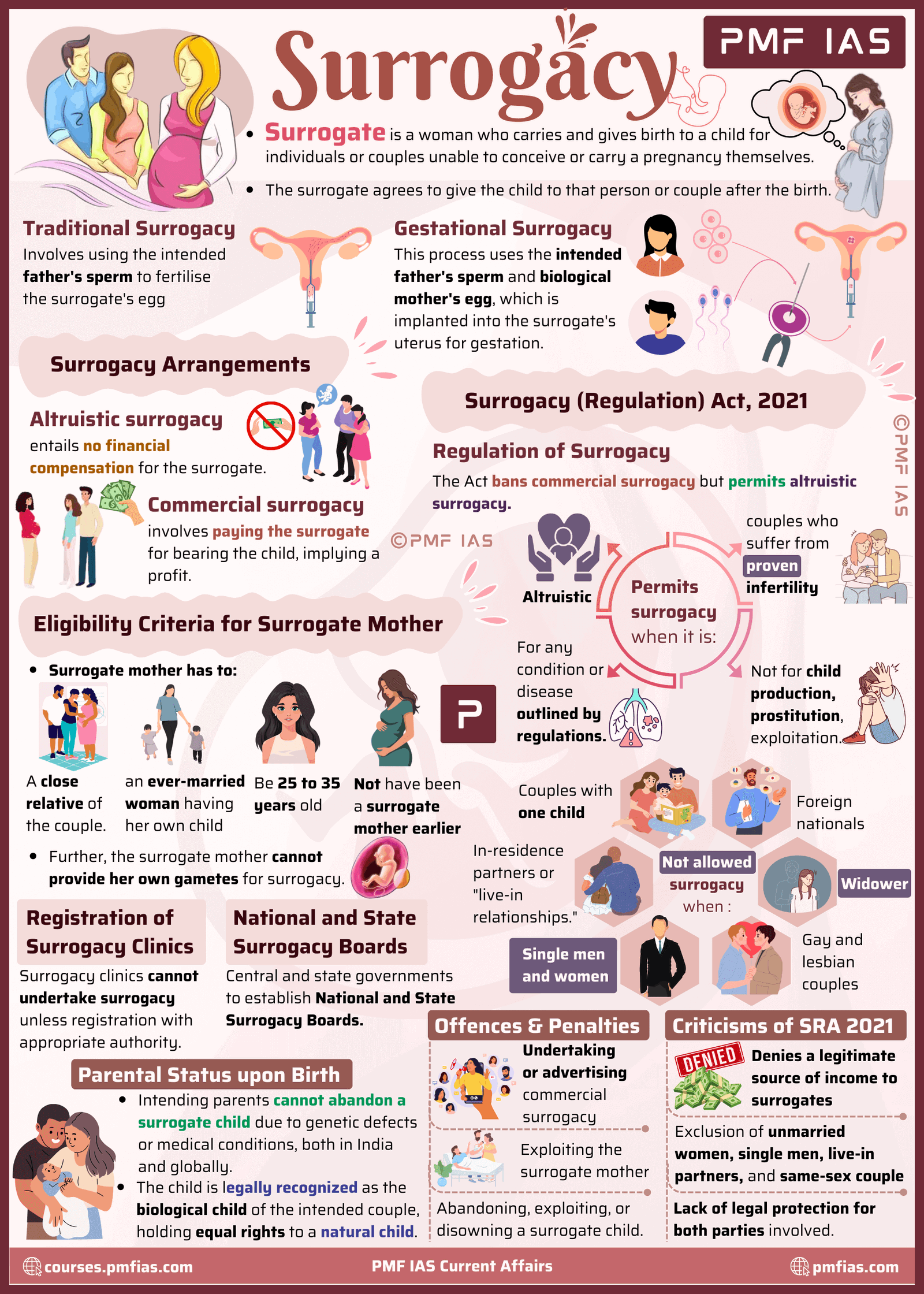
- Surrogacy is an arrangement where a woman (the surrogate) carries and gives birth to a child for another individual or couple who are unable to conceive or carry a pregnancy of themselves.
Types of Surrogacy
- Traditional Surrogacy: Traditional surrogacy involves using the intended father’s sperm to fertilise the surrogate’s egg.
- The surrogate carries the pregnancy to term, and the resulting baby is biologically related to the surrogate mother and the intended father.
- Gestational Surrogacy: In gestational surrogacy, the baby is not biologically related to the surrogate.
- An embryo, created using the intended father’s sperm (or donor sperm) and the biological mother’s egg (or donor egg), is implanted into the surrogate’s uterus for her to carry to term.
Surrogacy Arrangements
- Altruistic Surrogacy: It refers to a surrogacy arrangement where the surrogate does not receive financial compensation beyond reimbursement for medical expenses and other related costs.
- In altruistic surrogacy, the surrogate’s primary motivation is typically to help another individual or couple achieve their dream of having a child.
- Commercial Surrogacy: It involves a contractual agreement where the surrogate mother receives financial compensation beyond just reimbursement for medical expenses and other costs associated with the pregnancy.
- This compensation may vary depending on factors such as location, legal regulations, and the specific terms of the surrogacy agreement.
Surrogacy Regulation Act, 2021
- The Act prohibits commercial surrogacy and allows altruistic surrogacy.
- The Act permits surrogacy when it is:
- For intending couples who suffer from proven infertility;
- Altruistic;
- Not for commercial purposes;
- Not for producing children for sale, prostitution or other forms of exploitation; and
- For any other condition or disease specified through regulations.
- Offences & Penalties: Engaging in or advertising commercial surrogacy, exploiting the surrogate mother, abandoning the surrogate child, or selling human embryos for surrogacy can lead to imprisonment for a term that may extend to 10 years and a fine of up to ₹10 lakh.
Eligibility Criteria For Intending Parents
- Citizenship &Marital Status: They must be Indian citizens and have been legally married for at least five years.
- Age: The intending mother must be between 23 and 50 years old, and the intending father between 26 and 55 years old.
- Medical Necessity: The couple must possess a "Certificate of Essentiality" which includes proof of infertility, a court order establishing parentage and custody.
- No Prior Children: They should not have any surviving biological, adopted, or surrogate child, with exceptions for children with life-threatening conditions.
- Intending Woman: The Act also allows a widow or a divorcee between the ages of 35 and 45 to avail of surrogacy.
- People who are not allowed to use the services of surrogacy are:
- Couples with one child,
- Foreign nationals,
- In-residence partners or people in "live-in relationships",
- Single men and women,
- Gay and lesbian couples, and
- Widowers
Eligibility Criteria for Surrogate Mother
- To obtain a certificate from the appropriate authority, the surrogate mother has to:
- be a close relative of the intending couple;
- be an ever-married woman having a child of her own;
- Be 25 to 35 years old;
- Not having been a surrogate mother earlier; and
- Have a certificate of medical and psychological fitness.
- A surrogate is prohibited from providing her own gametes for surrogacy by the Act.
- The surrogate mother will have an option to withdraw from surrogacy before the embryo is implanted in her womb.
- Abortion of the fetus requires consent from both the surrogate mother and the relevant authorities, following the provisions of the Medical Termination of Pregnancy Act.
- A surrogate must not receive any compensation for carrying the child in her womb other than the necessary insurance and medical costs.
Registration of Surrogacy Clinics
- Surrogacy clinics cannot undertake surrogacy or its related procedures unless the appropriate authority grants them registration.
Regulatory Framework
To oversee the implementation of the law, the Act establishes a multi-tiered regulatory structure:
- National Surrogacy Board (NSB): Responsible for advising the central government on policy matters, laying down a code of conduct for surrogacy clinics, and supervising the functioning of State Surrogacy Boards.
- State Surrogacy Boards (SSBs): Function at the state level to implement the regulations and monitor the activities of surrogacy clinics within their jurisdiction.
- Appropriate Authorities: Appointed at the national and state levels to grant, suspend, or cancel the registration of surrogacy clinics and to enforce the standards set for them.
Rights of the Surrogate Child
- A child born out of a surrogacy procedure is deemed to be the biological child of the intending couple and is entitled to all the rights and privileges available to a natural child.
- The intending couple is prohibited from abandoning the child under any circumstances, including any genetic defect, birth defect, or the sex of the child.
Limitations of the Act
- Restrictive Eligibility: The narrow definition of who can opt for surrogacy excludes single men, unmarried couples, and the LGBTQ+ community, which many argue violates the right to reproductive autonomy.
- "Close Relative" Clause: Finding a willing and eligible "close relative" to be a surrogate can be incredibly difficult for many couples and may lead to coercion within families.
- Exploitation of Surrogates: The Act does not sufficiently protect the long-term physical, mental, and psychological health of surrogates. Withdrawal of compensation or inadequate support may still leave them vulnerable.
- Commercialisation: The commercialisation of surrogacy raised ethical questions about treating childbirth as a transactional service.
- It brought up concerns about the commodification of women’s bodies and whether financial motives were overriding ethical considerations.
- Lack of Legal Clarity: Ambiguity in laws regarding parentage, citizenship, and rights of the child born through surrogacy created uncertainties for intended parents, surrogates, and the children. The absence of clear laws makes it challenging to address disputes or protect the rights of all parties.
Way Forward
- Expand Eligibility Criteria: Amend the law to broaden eligibility, ensuring that constitutional guarantees of equality, dignity, and personal autonomy are honored.
- Institutionalise Comprehensive Care: Mandate holistic care — pregnancy, delivery, postpartum — plus insurance, psychological counselling, and a modest “compassionate payment” (beyond medical costs) to ensure dignity and fairness.
- Informed Consent: Establish standardized, independent counselling protocols — legal, medical, and psychological — with periodic monitoring to guarantee genuine informed consent from all parties involved.
- Promote Synergy: Harmonise the Surrogacy Regulation Act with the ART Regulation Act to avoid overlapping provisions, streamline implementation, and facilitate ethical cross-border cooperation in reproductive technologies..
- Clarify Legal Parentage: Establish clear laws regarding parental rights, citizenship, and responsibilities from the outset of the surrogacy arrangement to avoid legal ambiguities.


