Interpol: Organisational Structure, Functions & Major Interpol Notices
- Context (TH): Concerns have been raised about the misuse of Interpol’s notice system, especially the issuance of blue corner notices, which are less scrutinised than their red corner notices.
About Interpol

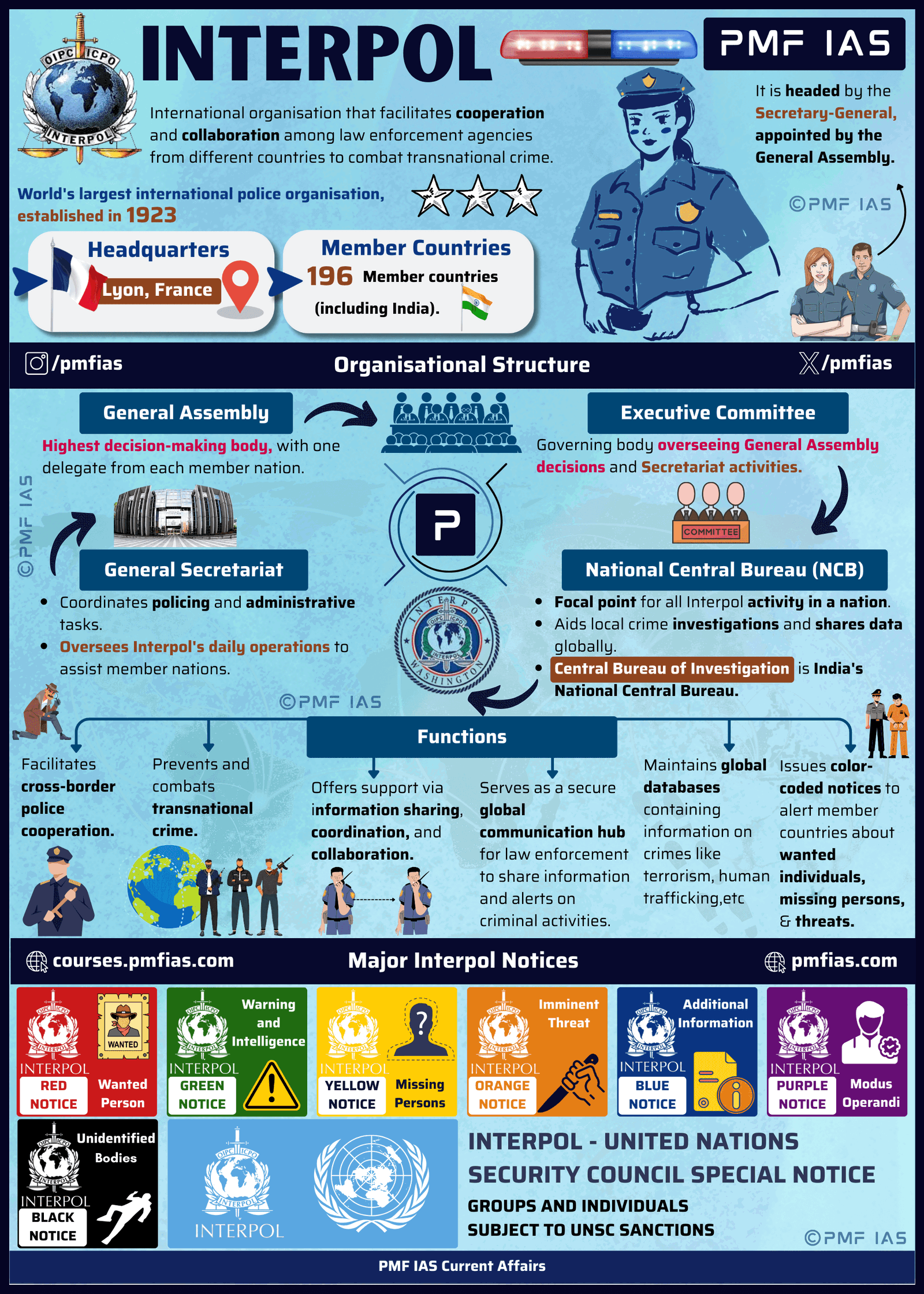
- It is an international organisation that facilitates cooperation and collaboration among law enforcement agencies from different countries to combat transnational crime.
- It is the world’s largest international police organisation, established in 1923.
- It is headquartered in Lyon, France.
- It has 196 member countries (including India).
- It is headed by the Secretary-General, appointed by the General Assembly.
Organisational Structure
General Assembly
- It is Interpol’s highest decision-making body, with one delegate from each member nation.
Executive Committee
- It is the governing body overseeing the implementation of General Assembly decisions as well as the administration and activities of the General Secretariat.
General Secretariat
- It is the organisation in charge of coordinating the policing and administrative functions.
- It manages Interpol’s day-to-day operations to assist member nations with international policing.
National Central Bureau (NCB)
- The National Central Bureau is the focal point for all Interpol activity in a nation.
- It helps investigate crime in their own country and share criminal data to assist another country.
- The Central Bureau of Investigation (CBI) is designated as the National Central Bureau of India.
Functions
- Facilitates cross-border police cooperation.
- Prevents and combats transnational crime.
- Provides support through information sharing, coordination, and collaboration.
- Serves as a global communication hub for law enforcement agencies by providing secure platform for sharing information, intelligence, and alerts related to criminal activities.
- It maintains several global databases containing information on various types of crimes, including terrorism, human trafficking, drug trafficking, cybercrime, etc.
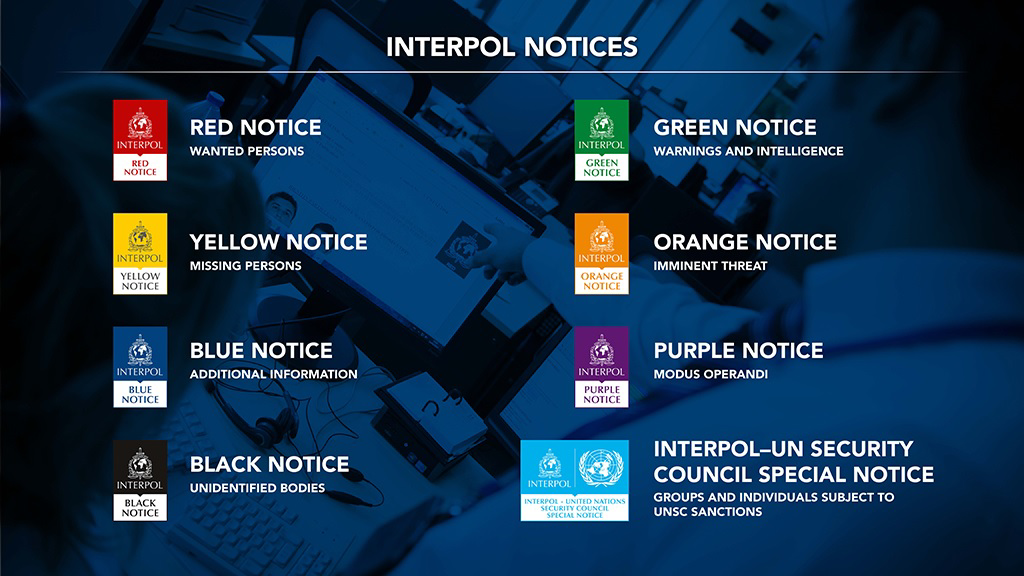
- It issues color-coded notices to alert member countries about individuals wanted internationally, missing persons, and threats.
- Critics argue that countries often exploit existing protocols to target political refugees and dissidents.
- Much of this outrage is directed at Russia, which has repeatedly issued notices and diffusions for the arrest of Kremlin opponents.
Major Interpol Notices

Blue Corner Notice
- A blue corner notice, also known as an enquiry notice, allows police forces in member states to share critical crime-related information, such as obtaining a person’s criminal record and location and having his or her identity verified, among others.
- For instance, in January 2020, Interpol issued a blue corner notice to help locate fugitive selfstyled godman Nithyananda.
Red Corner Notice
- A red corner notice is issued by a member state to arrest a wanted criminal through extradition or any other similar lawful action.
- Such notices are issued against persons wanted by national jurisdictions for prosecution or to serve a sentence based on an arrest warrant or a court decision.
- The country issuing the request need not be the home country of the fugitive. Interpol acts even on the request of a country where the alleged crime has been committed.
- While blue corner notices are issued prior to the filing of criminal charges, red corner notices generally follow criminal convictions.
- The concerned individual can be stopped and arrested while traveling through a member state.
- There will also be other detrimental consequences, such as the closure of bank accounts.
- However, Interpol cannot compel law enforcement authorities in any country to arrest the subject of a red corner notice as the exercise of such powers is entirely discretionary.
- In 2018, a red corner notice was issued against fugitive billionaire Nirav Modi in relation to the Punjab National Bank scam.
- However, in October 2022, Interpol rejected a second request by India to issue such a notice against Gurpatwant Singh Pannun, whom the Union Ministry of Home Affairs has listed as a terrorist.
- The agency said that India has failed to provide sufficient information to support its case and that his activities have a clear political dimension.