NEW Prelims Cracker 2027 ⚡️ Starts July 1st 📞 Call Now: 9211591415 ★                      ★ NEW GS Foundation 2027 ⚡️ Just Started ⬇️ Download Brochure 📞 Call Now: 9211591415 ★                      ★ PMF IAS Impact 🎯 53 Direct Hits in Prelims 2025 and 🎯 46 Direct Hits in Prelims 2026 ★

India’s Aircraft Carriers

  • Context (TH): The Indian Navy’s two aircraft carriers demonstrated twin carrier operations.
  • India currently operates two aircraft carriers: the Russian-made INS Vikramaditya and the INS Vikrant.

History of Aircraft Carriers in India

INS Vikrant (R11)

  • It was India’s First Aircraft Carrier purchased from the U.K.
  • It was active during the Goa Liberation Operation in 1961 and played a crucial role in the 1971 war.

INS Viraat

  • It was India’s second Aircraft Carrier, purchased from the UK. It was commissioned in India in 1987.
  • The British Royal Navy originally commissioned it as HMS Hermes.

INS Vikramaditya

  • Russia’s refurbished Admiral Gorshkov was commissioned into the Indian Navy as INS Vikramaditya in 2013. Commissioned in 2013, it is India’s third carrier.

INS Vikrant (IAC-1)

  • The First Indigenous Aircraft Carrier is named in honour of her historic predecessor, India’s first aircraft carrier, INS Vikrant (R11).

IAC-II

  • A proposal for a second Indigenous Aircraft Carrier (IAC-II) has been moved by the Navy.
  • The Defence Procurement Board cleared the proposal in September, and it awaits approval from the Defence Acquisition Council.
  • IAC-II aims to replace INS Vikramaditya when its lifetime ends.

About INS Vikrant (IAC-1)

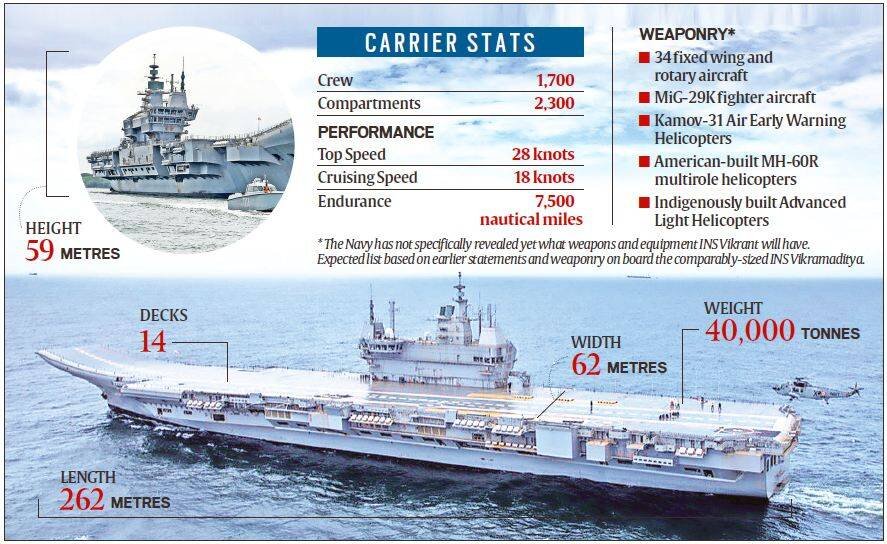
INS Vikrant: India's first indigenous aircraft career

  • INS Vikrant, one of the carriers, is indigenously designed and constructed.
  • It has a total area exceeding 12,450 m2, equivalent to about two and a half hockey fields.
  • Built at a cost of around ₹20,000 crore, it boasts 76% indigenous content.
  • Vikrant can accommodate an air wing of 30 aircraft, including MiG-29K fighter jets, Kamov-31, MH-60R multi-role helicopters, and indigenous Advanced Light Helicopters and Light Combat Aircraft (Navy).
  • It employs the STOBAR (Short Take-Off but Arrested Recovery) method for launching and recovering aircraft.

Leave a Reply

Your email address will not be published. Required fields are marked *