- Tribunals in India act as specialized quasi-judicial bodies ensuring speedy, cost-effective dispute resolution. The 10th All India CAT Conference in New Delhi highlighted reforms to strengthen justice delivery.
About Tribunals
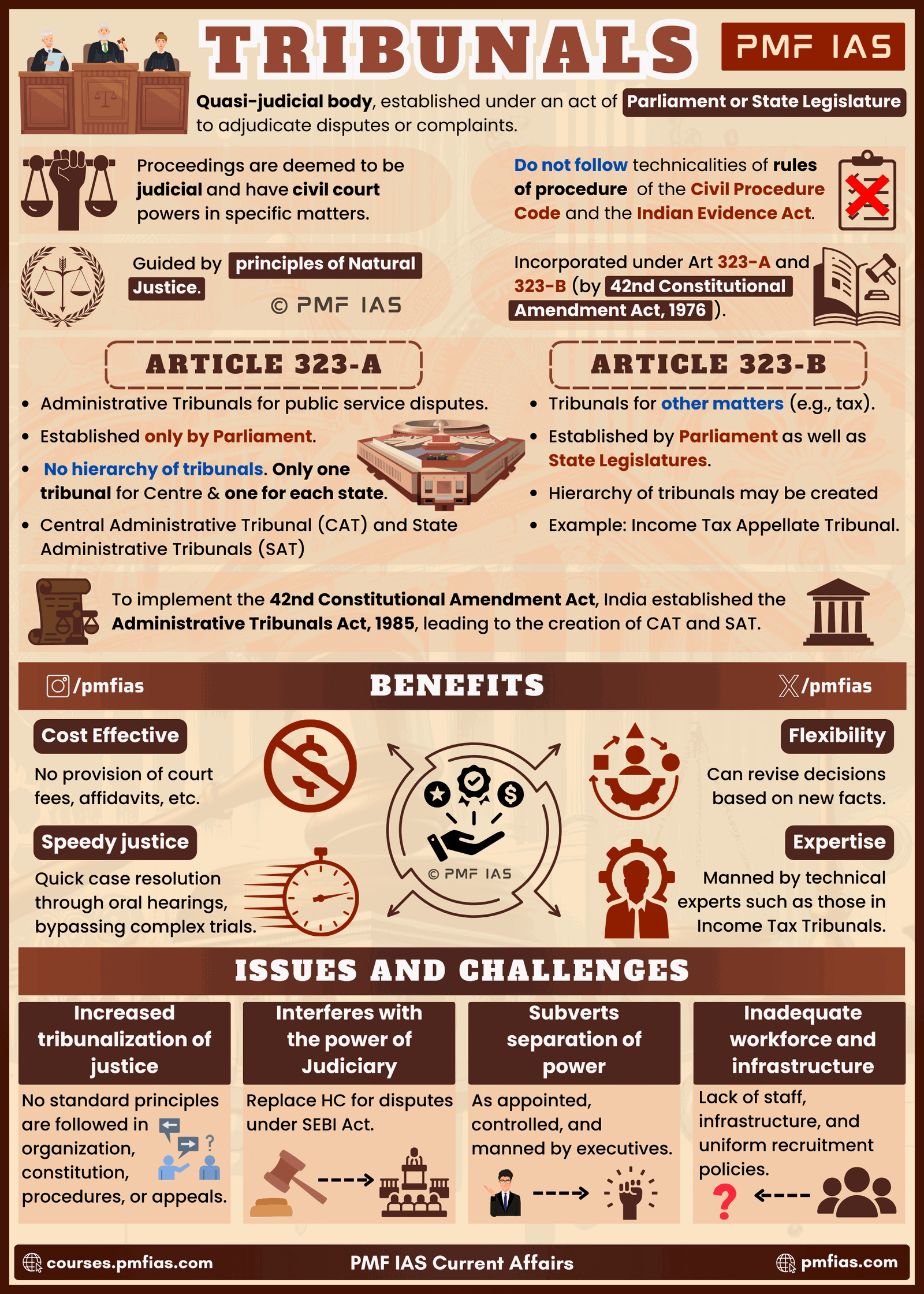
- A Tribunal is a quasi-judicial body, established under an act of Parliament or State Legislature, to adjudicate disputes or complaints.
- Proceedings of Tribunals are deemed to be judicial proceedings, and in certain matters they have the powers of a civil court, e.g. National Green Tribunal (NGT).
- They do not follow technicalities of rules of procedure or evidence as laid down under the Civil Procedure Code and the Indian Evidence Act but do follow the principles of Natural Justice.
Constitutional Status
- Tribunals are incorporated under Art 323-A and 323-B of the Indian Constitution (by the 42nd Constitutional Amendment Act, 1976).
- Article 323-A: Under this, Administrative Tribunals can be created only by Parliament, and in pursuance of this Central Administrative Tribunal (CAT) and State Administrative Tribunals (SAT) have been created.
- Article 323-B: Under this, Tribunals for all other matters can be created by Parliament as well as State Legislatures. E.g. Income Tax Appellate Tribunal (ITAT), etc.
- To operationalize the 42nd Constitutional Amendment Act, the GoI enacted the Administrative Tribunals Act, 1985, leading to the formation of CAT & SAT.
Benefits of Tribunals
- Ensures Speedy Justice: Faster case disposal due to oral hearing, no intricate procedure of pleading and trials, and no elaborate rules as to proof of facts or evidence.
- Manned by Experts: Participation of efficient and competent executives with special technical knowledge and rich experiences in the respective matters.
- Cost Effective: As there is no provision of court fees, affidavits, etc.
- Flexibility: They are not bound by previous decisions, they can revise their decisions in light of new facts, thus, keeping in tandem with the changing socio-economic, legal, technical and political environment.
- Reduces Pendency: It significantly reduces the burden on courts at all levels that is presently reeling under a huge pendency of more than 4.5 crore cases.
Tribunals Curtail the Jurisdiction of Ordinary Courts in India
- Exclusive Jurisdiction: Tribunals like CAT and NGT handle specialized disputes, easing the burden on regular courts.
- Court Limitation: Statutory provisions restrict ordinary courts from interfering in tribunal matters, limiting judicial review.
- Final Appeal: Tribunals such as Armed Forces Tribunal (AFT) serve as the final appellate authority, bypassing ordinary courts.
- Executive Control: Government appointments influence tribunal independence, potentially affecting impartial decision-making.
- Case Backlog: Tribunals help reduce the overburdened court system by resolving targeted disputes efficiently.
- Constitutional Backing: Articles 323-A and 323-B provide tribunals with separate jurisdiction from ordinary courts.
- Reform Rationalization: The 2021 Tribunal Reforms Act reduced tribunals from 26 to 19, enhancing efficiency and reducing overlap.
Issues and Challenges
- Judicial Independence: Executive controls appointments and tenure. E.g., SC in Rojer Mathew (2019) ruled that absence of judicial dominance in selection committees violates separation of powers.
- Case Backlog: Tribunals too face pendency. E.g., Armed Forces Tribunal reported 18,829 pending cases in 2021 (MoD).
- Short Tenure: Members often serve 3–4 years with reappointment dependence on the government, reducing autonomy. E.g., SC 2019 flagged this as executive overreach.
- Procedural Inconsistency: Different tribunals follow varying rules, leading to lack of uniformity and confusion for litigants (Law Commission).
- Jurisdictional Conflicts: Overlaps with High Courts and regular courts cause forum shopping and delays. E.g., NGT cases often reach SC directly.
- Member Expertise: Technical members sometimes lack legal training, affecting quality of adjudication.
- Executive Control: Many tribunals are administratively under the same ministries they review, creating conflict of interest. E.g., Telecom Disputes Tribunal under DoT.
Way Forward
- Appointment Reform: A Selection Committee headed by the Chief Justice of India to be created to be in charge of the appointments of Chairman, Vice-Chairman and Judicial Members of the various central tribunals.
- Timely Recruitment: Vacancy arising in the Tribunal should be filled up quickly by initiating the procedure well in time.
- Nodal Oversight: Single nodal agency under the Law Ministry, to both monitor the working of the tribunals and to ensure uniformity in the appointment, tenure, and service conditions.
- Judicial Review: Restoration of the HC’s power of Judicial review over the decisions of the tribunals (in line with Chandra Kumar Case, 1997).
- Pan-India Seats: Tribunals must have benches in different parts of the country (ideally where high courts are situated) so that people of every geographical area may have easy access to justice.
Tribunals ensure speedy, expert, and cost-effective justice, reducing court pendency; as Justice V.R. Krishna Iyer said, “Justice delayed is justice denied.” Strengthening appointments, oversight, and judicial review will uphold fairness, independence, and equitable access.
Reference: PIB
UPSC Mains PYQs – Theme – Tribunals
- [UPSC 2025] Comment on the need of administrative tribunals as compared to the court system. Assess the impact of the recent tribunal reforms through rationalization of tribunals made in 2021.
- [UPSC 2018] How far do you agree with the view that tribunals curtail the jurisdiction of ordinary courts? In view of the above, discuss the constitutional validity and competency of the tribunals in India.
PMF IAS Pathfinder for Mains – Question 353
Q. In the Indian context, tribunals are often seen as a mechanism to reduce the burden on ordinary courts. Critically analyse their constitutional validity and the challenges they face in balancing efficiency with judicial oversight. (250 Words) (15 Marks)
Approach
- Introduction: Write a brief introduction about Tribunals in India by mentioning the constitutional article.
- Body: Analyse the constitutional validity, challenges they face in balancing efficiency with judicial oversight and the way forward.
- Conclusion: Emphasis on a balanced approach by following Articles 323-A & B, and the Directive Principles of State Policy.


