- The External Affairs Minister’s first high-level engagement with China since the Galwan clash signals a shift toward structured normalisation, aimed at reviving the long-stalled Dragon-Elephant tango through calibrated diplomatic, economic, and military steps.
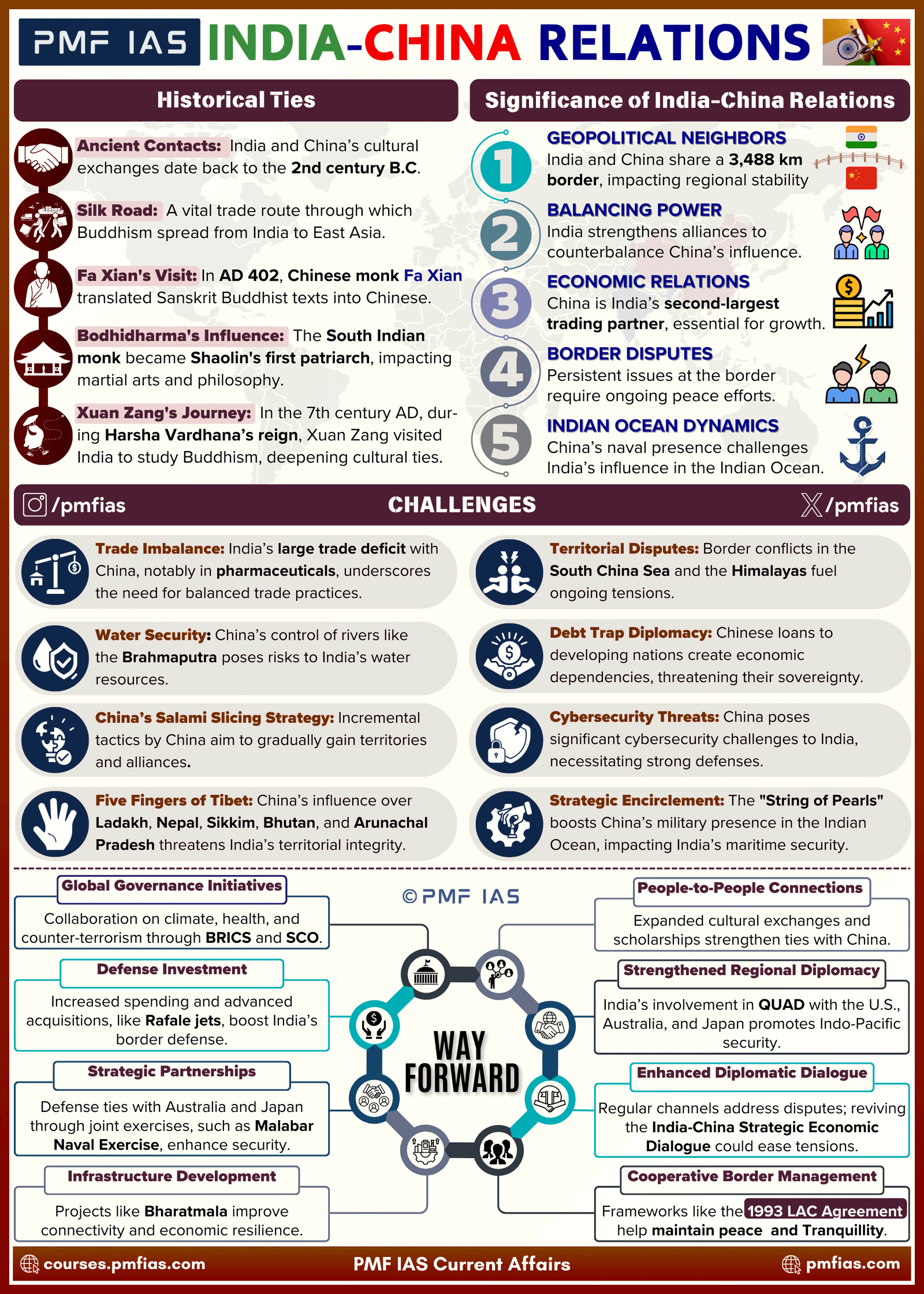
Why Stability Matters?
Economic Leverage
- Trade and Investment: Stable ties facilitate a $120 bn bilateral trade relationship and enable calibrated Chinese investment in non-sensitive sectors.
- Supply Chain Access: Normalisation secures critical input access APIs, chips, rare earths for industrial self-reliance.
- Diversification Push: Strategic calm enables supply chain diversification through China+1 shifts and Quad-led technology realignment.
Strategic Gains and Autonomy
- Border Dividend: Border tranquillity dividend eases two-front military pressure and restores India’s strategic planning bandwidth.
- Strategic Autonomy: Balanced engagement enables India to deepen Quad ties while maintaining a functional dialogue with China.
- Multilateral Leverage: Stability enables India to engage constructively with China in the BRICS and SCO, while safeguarding India’s normative space.
Connectivity, Water, and Climate Cooperation
- Border Trade: Border stability enabled the reopening of Nathu La trade and reinforced economic recovery in frontier regions.
- Hydro Cooperation: Hydro-diplomacy revived Brahmaputra flood data sharing and fostered a basic trust framework in water relations.
- Climate-Tech Link: Clean-tech collaboration supports India’s just energy transition and secures rare-earth access for net-zero ambitions.
Steps Toward Normalisation
- 75-Year Milestone: In 2025, India and China marked 75 years of diplomatic ties with renewed calls to revive Dragon-Elephant ties.
- LAC Disengagement: Military disengagement protocols at Depsang and Demchok were fully completed by late 2024.
- Border Trade: The Nathu La trade route in Sikkim officially reopened, signalling intent to stabilise frontier economies.
- SR Dialogue: The Special Representatives’ meeting in 2024 revived Track-I diplomatic engagement on border resolution.
- BRICS Interaction: The Modi-Xi meeting at the 2023 BRICS Kazan Summit marked the first structured leader-level dialogue since 2019.
- River Cooperation: China resumed Brahmaputra and Sutlej flood data sharing in 2025 under a renewed hydro-diplomatic framework.
- Pilgrimage Resumed: The Kailash Mansarovar Yatra resumed in April 2025 as a people-centric confidence-building initiative.
Key Roadblocks Ahead
- Border Tensions: Galwan clash and incremental encroachments reveal the fragility of disengagement protocols.
- Trust Deficit: China’s selective engagement, lack of transparency, and delayed responses undermine diplomatic confidence.
- Map Aggression: China’s cartographic assertion and Arunachal Pradesh renaming fuel territorial perception warfare.
- Trade Imbalance: India’s ~$100B trade deficit and Chinese restrictions on rare earth exports highlight an asymmetric trade relationship.
- Pakistan Nexus: China’s deep defence, nuclear, and economic relations with Pakistan directly undermine India’s primary security interests.
- Neighbourhood Pressure: Growing Chinese influence in Nepal, Myanmar, and Sri Lanka steadily limits India’s regional strategic space.
- Terrorism Divide: SCO talks continue to stall due to China’s reluctance to endorse zero-tolerance on Pakistan-linked terror groups.
Path to Stable Engagement
- Permit Chinese investment selectively in low-risk, non-strategic sectors to rebuild basic trust.
- Institutionalise joint border verification and hotline-based alert protocols to prevent miscalculation.
- Propose long-term water-sharing rules beyond seasonal data to build hydrological trust.
- Launch low-sensitivity trade packages to revive stalled economic ties without strategic concessions.
- Use BRICS-SCO to push functional cooperation while keeping border issues on a parallel track.
- Launch academic, media, and youth initiatives to counter entrenched threat narratives.
As India and China deepen diplomatic ties, sustained dialogue, strategic prudence, and multilateral collaboration are crucial. Harmonising shared interests with global responsibilities can enable a stable, multipolar Asia and a fairer world order. As Dr. S. Jaishankar remarked, “The Asian century will be shaped by how India and China manage their relationship.”
Reference: The Hindu
PMF IAS Pathfinder for Mains – Question 248
Q. Examine how stable and constructive ties between India and China are essential not only for bilateral relations but also for regional and global stability. In this context, analyse the roadblock in India-China relations and suggest a way forward. (250 Words) (15 Marks)
Approach
- Introduction: Write briefly about India-China relations by mentioning the fact.
- Body: Write the significance of stable India-China ties, the roadblocks in India-China relations and the way forward.
- Conclusion: Emphasis on sustained dialogue, strategic prudence, and multilateral cooperation is crucial for a stable, multipolar Asia and a fairer world order.


