- Context (TH): Recently, a Finance Ministry report to Rajya Sabha flagged rising money laundering cases, low PMLA conviction rates, and ED overreach concerns.
What is Money Laundering?
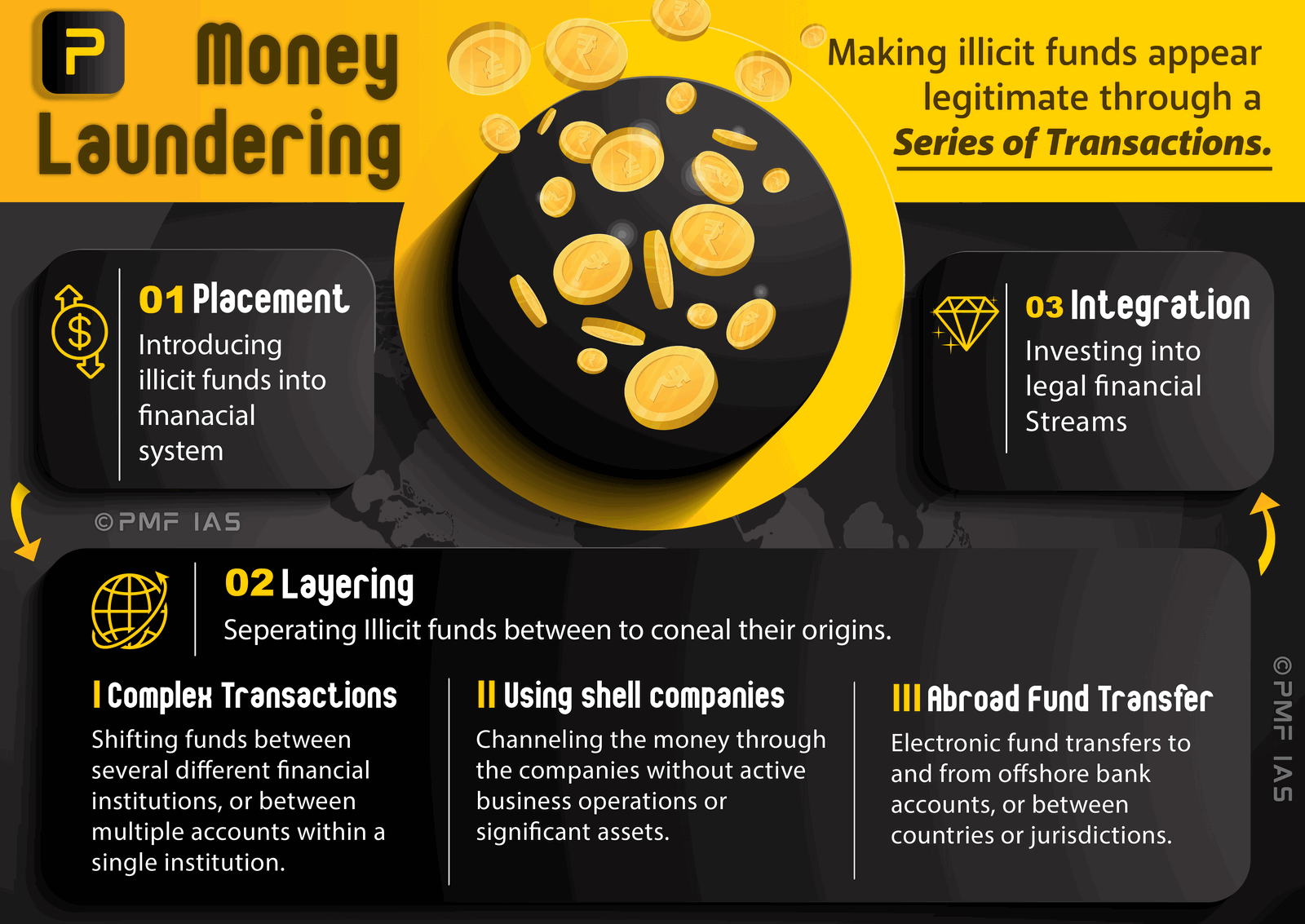
- Money laundering is a process used by individuals and organisations to conceal the origins of illegally obtained money.
- It involves making illicit funds appear legitimate through a series of transactions.
Stages of Money Laundering
- Placement is the stage where illicit funds are introduced into the financial system. This can involve deposits into bank accounts, currency exchanges, or purchases of valuable assets.
- Layering is the process of separating illicit funds from their source. This often involves transferring funds between accounts or across borders to obscure their origin.
- Integration is the final stage in which the laundered funds are reintroduced into the economy as legitimate funds. This involves investing in businesses, purchasing real estate, or other means of legitimising the funds.
Methods of Money Laundering
- Structuring (Smurfing): Breaking up large amounts of cash into smaller, less conspicuous amounts that are then deposited into bank accounts.
- Trade-Based Laundering: Using trade transactions to move value across borders and disguise the origins of illicit funds.
- Shell Companies: Creating companies with no legitimate business activity to funnel illicit funds through legitimate-looking transactions.
- Real Estate: Purchasing real estate with illicit funds and then selling it to convert the value into legitimate assets.
Money Laundering in India
Recent Data
- Prosecution Gap: ED registered 5,892 PMLA cases since 2015, but secured only 15 convictions.
- Enforcement Strain: Over 3,985 searches highlight scale, yet yield low prosecutorial success.
- Asset Seizures: Assets worth ~₹1.5 lakh crore provisionally attached under PMLA since inception.
- Shell Firms: ~1.2 lakh companies struck off for Companies Act violations, often linked to laundering.
Legal Framework in India
- Statutory Basis: Prevention of Money Laundering Act 2002 is India’s anti-money laundering legislation.
- Offence Definition: Section 3 defines laundering as concealing illicit proceeds as legitimate assets.
- Penal Provisions: Section 4 prescribes 3-7 years’ rigorous imprisonment and monetary fines.
- Procedural Trigger: ED can initiate a probe via Enforcement Case Information Report without a FIR.
- Key Institutions: ED and Financial Intelligence Unit (FIU) form core investigative and intelligence bodies.
Challenges in Enforcement
- Scope Creep: Inclusion of minor offences in the Schedule dilutes the PMLA’s economic crime focus.
- Bail Inversion: Section 45 reverses the innocence presumption by imposing a proof burden on the accused.
- Power Misuse: ED’s arrest and search powers risk arbitrary or politically influenced application.
- Federal Strain: PMLA allows ED to bypass state approval, impacting cooperative federalism.
- Legal Ambiguity: Broad ‘proceeds of crime’ definition enables disproportionate asset seizure powers.
- Efficacy Doubts: A high caseload but a low conviction rate undermines the credibility of enforcement.
International Cooperation Measures
- FATF Standards: India follows all 40 FATF recommendations on anti-money laundering compliance.
- Global Treaties: India has 85+ DTAAs to share tax and asset information internationally.
- Legal Basis: UNTOC and the Vienna Convention form a legal foundation for global cooperation.
- FIU Network: FIU-IND collaborates globally through the Egmont Group for intelligence exchange.
|
Government Initiatives
- Scope Widening: PMLA amended to cover conspiracy, possession, and financial intermediaries.
- Digital KYC: SEBI, RBI mandated Aadhaar-based KYC to detect identity misuse.
- Tech Deployment: AI tools deployed for transaction screening and red-flag alerts.
- Judicial Strengthening: New benches and improved case management for faster disposal.
- Benami Action: Enforcement of the Benami Act targets hidden ownership and asset proxies.
- Data Integration: FIU-IND integrates data with PAN, Aadhaar, and GSTN for real-time alerts.
- Expanded Reporting: Jewellery dealers, NGOs, & real estate agents brought under PMLA compliance.
- FATF: Financial Action Task Force sets global anti-money laundering and terror financing standards.
- DTAA: Double Taxation Avoidance Agreements allow cross-border financial information exchange.
- UNTOC: UN Convention against Transnational Organised Crime targets global illicit networks.
- Vienna Convention: UN Drug Convention promotes international legal cooperation on laundering.
- Egmont: Global forum of Financial Intelligence Units enabling sharing of laundering-related information.
|
Read in detail about the Prevention of Money Laundering Act (PMLA), 2002.


