- India launched its first National Geothermal Energy Policy under the Ministry of New and Renewable Energy to diversify the renewable energy mix. The policy aims to promote exploration, technology adoption, and sustainable geothermal power development across the country.
What is Geothermal Energy?
- Geothermal energy is a type of renewable energy taken from the Earth’s core. It comes from heat generated during the original formation of the planet and the radioactive decay of materials.
- Thermal energy is stored in rocks and fluids in the centre of the Earth and can be found from shallow depths right down to several miles below the Earth’s surface.
- The difference between the temperature in the Earth’s core and the surface drives a continuous conduction of thermal energy from the centre to the exterior of the planet.
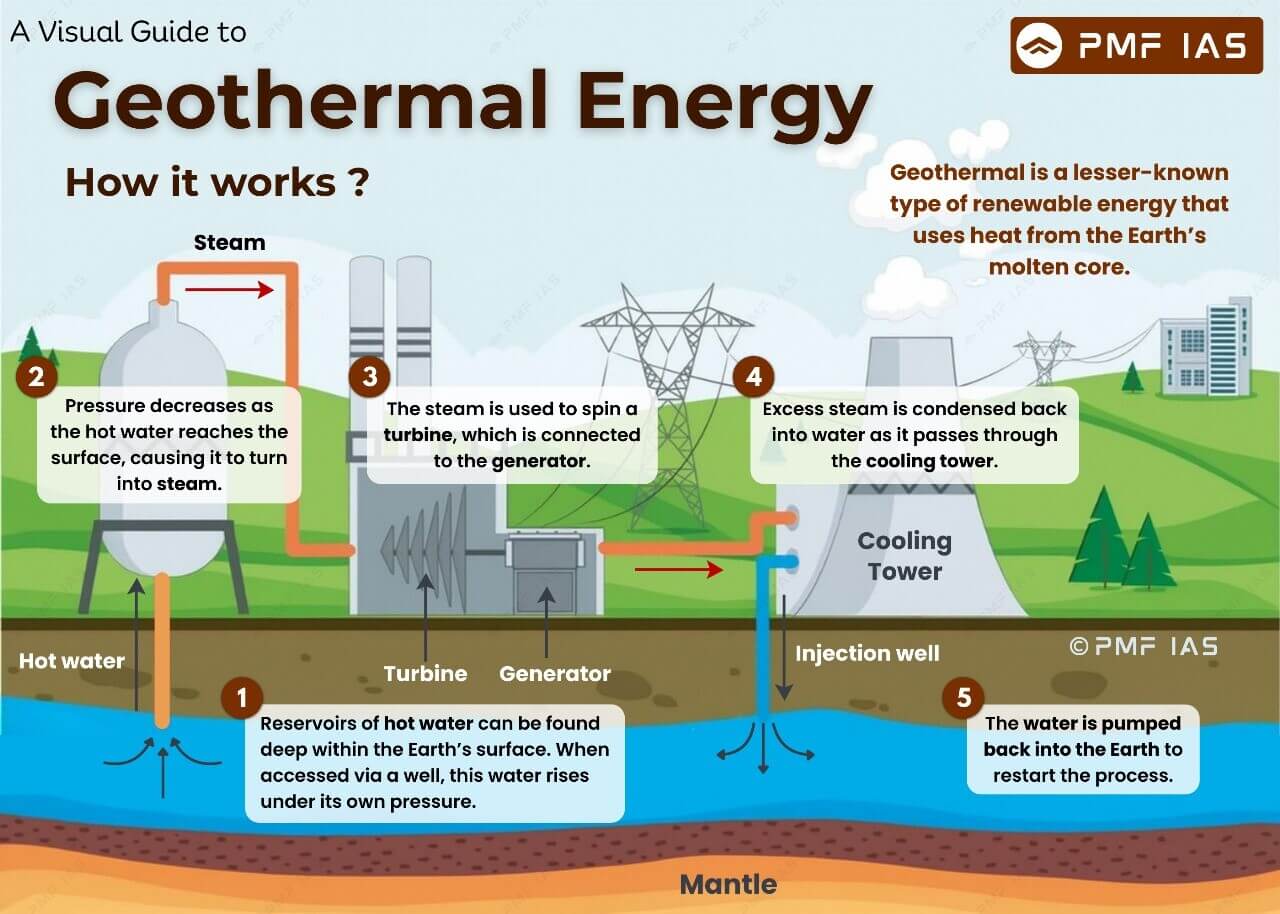
- Geothermal resource falls into three major categories: i) Geopressurized zones, ii) hot-rock zones and iii) Hydrothermal convection zones. Of these three, only the first is currently being exploited on a commercial basis.
- Global capacity stood at 15.4 GW (2024), led by the US, Indonesia, and the Philippines.
India’s Geothermal Energy Potential
- India has 381 thermally anomalous sites, identified by the Geological Survey of India (GSI), across 10 geothermal provinces, including Ladakh, Himachal Pradesh, and Gujarat, with potential for both electricity generation and direct-use applications.
- It has the potential to generate 10,600 MW, enough to power 10 million households.
- The Puga Valley project is India’s 1st geothermal venture in the Ladakh region, which is also the world’s highest at 14000 ft.

National Policy on Geothermal Energy: Key Features
- It covers both high-enthalpy resources for power generation and low-to-medium enthalpy resources for direct-use applications
- 100% foreign direct investment (FDI) is permitted in geothermal projects, with a focus on indigenous technology development to reduce import dependence.
- Fiscal incentives include tax holidays, import duty exemptions, concessional loans, & viability gap funding.
- Project support is provided for up to 30 years, extendable based on resource availability.
- The policy encourages joint ventures with oil, gas, and mineral companies for resource utilisation.
- Implementation will be carried out through international collaborations, pilot projects under the renewable energy R&D programme, and the establishment of Centres of Excellence in Geothermal Energy.
- It promotes repurposing abandoned oil and gas wells for geothermal use and deploying ground source heat pumps for heating and cooling.

Significance of Geothermal Energy
- Low Carbon Emissions: Geothermal power emits about 99% less carbon dioxide than fossil fuel-based power.
- Cost-effective: Geothermal is cheaper than conventional energy, with savings of as much as 80% compared with fossil fuels.
- Weather-Independent Consistency: Unlike solar and wind, geothermal energy is much more consistent (i.e. not dependent on weather or daily cycles).
- No Fuel requirement: Once installed, geothermal plants don’t require a continuous fuel supply (like coal, gas, etc.).
- Alignment with India’s Net-Zero Goals: Supports India’s commitment to net-zero by 2070 and reduces over-reliance on solar and wind.
Challenges Associated
- Location-specific: Production is limited to areas near tectonic plate boundaries. In addition, some locations may cool down after decades of use.
- Seismic risk: Enhanced geothermal systems (where water is injected to open up fractures) can trigger small earthquakes.
- High Initial Costs: Expensive resource to tap into, with high upfront costs ranging from around $2-$7 million for a plant with a 1 megawatt capacity.
- Environmental side effects: During drilling or exploiting geothermal reservoirs, some gases stored underground (e.g. CO₂, sulfur compounds) can be released.
Read More > Clean Energy Transition in India
Way Forward
- Expand Exploration: Accelerate mapping of geothermal sites across 10 provinces for energy potential.
- Advance Technology: Deploy ground-source heat pumps and EGS under MNRE pilot projects.
- Boost Investment: Attract private sector via 100% FDI, tax incentives, and concessional loans.
- Strengthen Infrastructure: Establish Centres of Excellence & demonstration plants to enhance capacity.
- Ensure Sustainability: Mitigate seismic risks and emissions while supporting net-zero 2070 goals.
Geothermal energy in India advances clean, sustainable, and secure energy access for all.
As PM Modi stated, “Our energy future must be clean, sustainable, and accessible to all,” reflecting this vision.
Reference: PIB | Clean Energy Transition in India
PMF IAS Pathfinder for Mains – Question 359
Q. With the launch of the first national geothermal policy, India seeks to diversify its renewable energy mix. Examine the benefits and policy challenges of expanding geothermal energy. (250 Words) (15 Marks)
Approach
- Introduction: Write a brief introduction about geothermal energy in India by mentioning its current status.
- Body: Examine the benefits of geothermal energy, policy challenges of expanding geothermal energy and the way forward.
- Conclusion: Emphasis on India’s vision of inclusive, secure, and clean energy for all through policy support and innovation in geothermal energy.


