- Context (IE): The Eta Aquariid meteor shower started on April 15.
- A meteor shower occurs when Earth passes through trails of particles left by comets.
- During a meteor shower, the sky lights up as debris interacts with Earth’s atmosphere.
About Eta Aquariid Meteor Shower
- The Eta Aquariid meteor shower happens when Earth passes through the trails of particles left by Halley’s Comet.
- It appears to originate from the Aquarius constellation, hence its name ‘Eta Aquariid‘.
- The Eta Aquariid meteor shower stands out for its high speed, resulting in long-lasting glowing tails.
- The shower will likely be visible across the entire sky. A clear night sky with minimal light pollution is preferable for observing the meteor shower. Under optimal conditions, the meteor shower can be observed even with the naked eye.
- They are most visible in countries like Indonesia and Australia in the Southern Hemisphere.
- These showers occur annually in May.
Comets
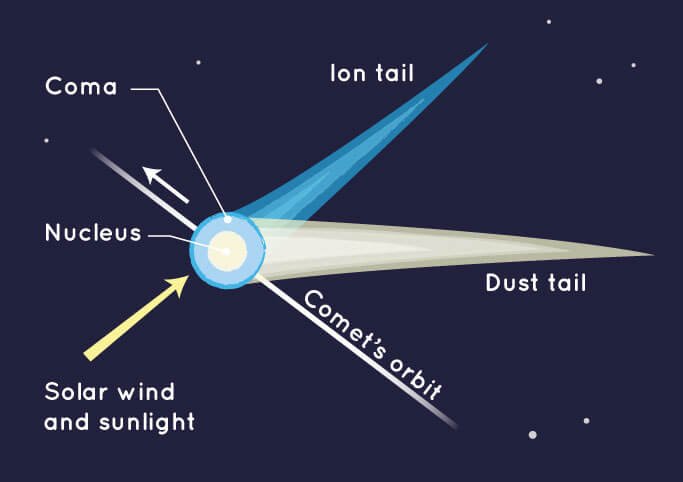
- Comets are frozen, ancient celestial bodies dating back approximately 4.6 billion years. A comet consists of a head and a tail.
- Comets orbit the Sun in highly elliptical paths. They consist of dust, rock, and ice.
- Comets can vary in size, although many are approximately 10 kilometres wide.
- As comets approach the Sun, they heat up and release gases and dust, forming a glowing head.
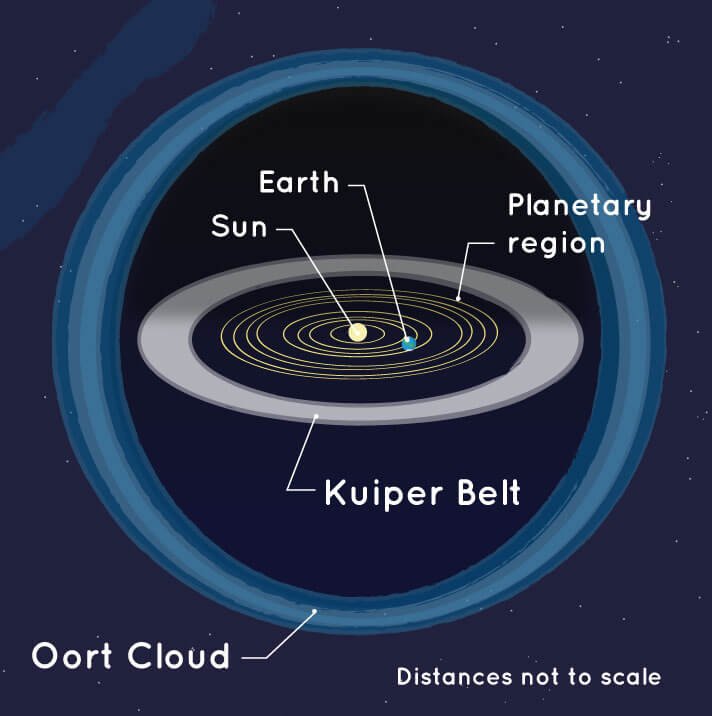
- While NASA has identified 3,910 comets, billions more are believed to exist beyond Neptune in regions such as the Kuiper Belt and the Oort Cloud.
Credits: NASA
Meteors
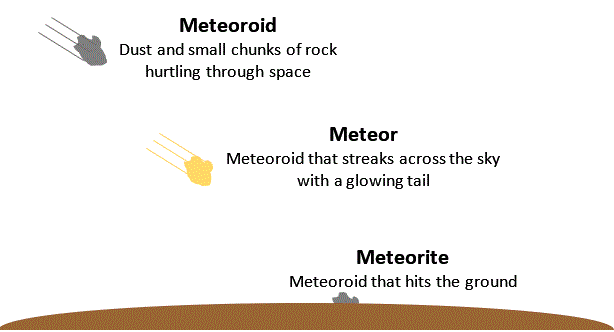
- They are small particles of dust or rock that burn up when they enter Earth’s atmosphere.
- Most meteors are tiny, about the size of a grain of sand, and completely burn up in the atmosphere.
- Occasionally, larger meteors survive the journey and reach the ground, becoming meteorites.
Credits: Forsyth Astronomical Society
- The Orionids meteor shower is also associated with Halley’s Comet and occurs annually in October.
Oort Cloud
- The Oort cloud is a shell of icy bodies that surrounds the solar system.
- It is the most distant region in our solar system. It begins beyond the Kuiper Belt.
- Many long-period comets originate from the Oort cloud.
Credits: NASA
|


