

Human Development in India
- India’s human development trajectory has shown gradual but steady progress. According to the Human Development Report 2023-2024, India’s HDI value for 2022 stood at 0.644, placing it in the medium human development category and ranking 134th out of 193 countries and territories — an improvement from 135th in 2021.
- This progress reflects India’s post-pandemic recovery across health, education, and income dimensions. However, the report also highlights the persistent challenges of inequality, gender disparity, and digital exclusion that risk diluting the developmental gains.
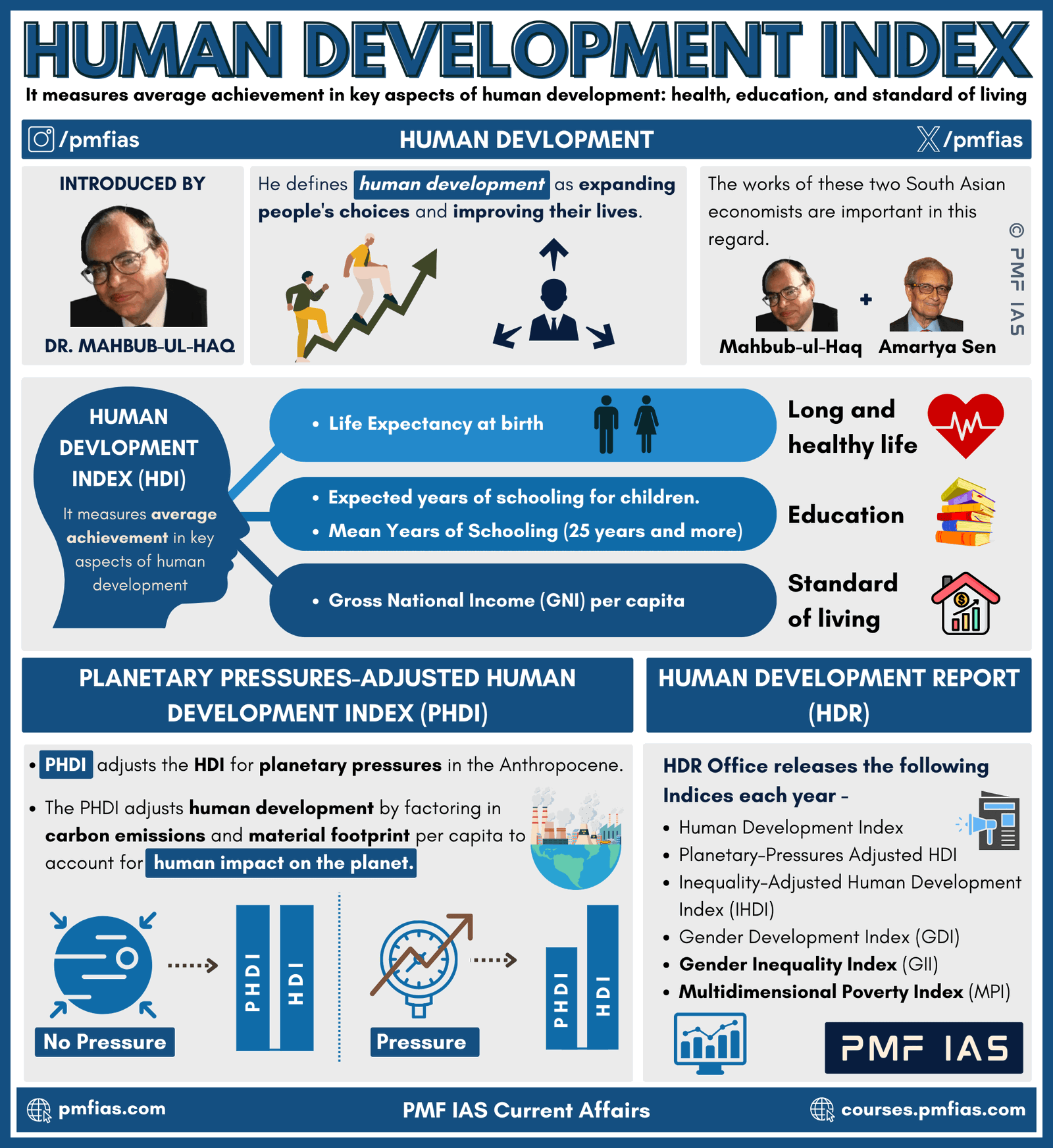
Key Findings of the Report
|
Dimension |
Details |
| India’s HDI Rank & Value | Ranked 130 out of 193 countries in 2023, improving from 133 in 2022; HDI value increased from 0.676 (2022) to 0.685 (2023), approaching the high human development threshold (≥0.700). |
| Health | Life expectancy at birth reached 72 years in 2023, the highest since the index was introduced in 1990. |
| Education | Expected years of schooling: 13 years; Mean years of schooling: 6.9 years. |
| Income | Gross National Income (GNI) per capita: $9,047 in 2023, up from $2,167 in 1990. |
| Gender & Inequality | Female labour force participation: 41.7%; however, income and gender disparities persist, leading to a 30.7% loss in HDI due to inequality. |
| Global Comparison | India shares its rank with Bangladesh (130); China (78), Sri Lanka (89), and Bhutan (125) rank higher; Nepal (145) and Pakistan (168) rank lower. |
| AI & Development | India retains 20% of global AI researchers, up from nearly zero in 2019, highlighting its growing role in AI development. |
| Multidimensional Poverty | 135 million Indians exited multidimensional poverty between 2015–16 and 2019–21; however, regional and social disparities remain significant. |
Significance of HDI for India
- Indicator of National Progress: HDI provides a comprehensive measure of India’s progress in health, education, and income, E.g., an HDI value of 0.685.
- Impact on Policy Formulation: HDI informs policy decisions by reflecting the effectiveness of health initiatives. E.g., life expectancy in India reached 72 years in 2023.
- Economic Development Measurement: India’s GNI per capita rose to $9,047 in 2023, up from $2,167 in 1990, indicating strong economic growth.
- Gender Equality and Social Inclusion: HDI highlights gender disparities, with India’s Gender Inequality Index (GII) improving from 108th to 102nd in 2023.
- Regional Development Disparities: India’s HDI Index shows disparities in development; Kerala and Tamil Nadu are advanced, while Bihar and Uttar Pradesh lag behind.
- Global Comparison and International Standing: India must advance human development policies to improve its global ranking, currently below neighbors China (75th) and Sri Lanka (78th).
Artificial Intelligence as a Catalyst for Human Development in India
- Boosting Economic Growth: AI supports automation in agriculture, manufacturing, and services. E.g., AI is projected to add ₹33.8 lakh crore to India’s GDP by 2030. (Google-NASSCOM)
- Advancing Healthcare: Enhance rural healthcare by facilitating early disease detection and ensuring accurate diagnostics, particularly in underserved areas. E.g., Microsoft’s AI Network and Qure.ai.
- Transforming Education: Offer real-time, adaptive learning experiences that help bridge learning gaps for students in underserved regions. E.g., ‘DIKSHA’ Platforms.
- Strengthening Governance: Helps to detect mule accounts in digital fraud and promotes inclusive e-governance through RBI’s MuleHunter.AI and Bhashini project.
- Promoting Inclusion: AI-driven dashboards in schemes like the Aspirational Districts Programme help identify service gaps and monitor development outcomes for marginalised communities.
Challenges to Human Development in India
- Income Inequality: Despite economic growth, India faces significant income inequality. E.g., India’s consumption-based Gini index was 25.5 in 2022-23. (PIB)
- Gender Inequality: Gender inequality remains a significant challenge. E.g., India ranks 102nd in the Gender Inequality Index (GII) 2023.
- Regional Disparities: Development is uneven across India. E.g., states like Kerala and Tamil Nadu perform well in HDI indicators, while states like Bihar and Uttar Pradesh lag behind.
- Poor Health Outcomes in Rural Areas: Although life expectancy has improved to 72 years nationally, rural areas continue to face significant health challenges.
- Multidimensional Poverty: 135 million people escaped multidimensional poverty, but 11.28% of India’s population still lives in poverty (2022-23, NITI Aayog).
- Environmental Sustainability: Environmental degradation is a growing challenge for human development in India. E.g., 13 of the world’s 20 most polluted cities are in India (World Air Quality Report 2024).
Government Initiatives for Human Development in India
|
Way Forward
- Improving Gender Equality and Economic Empowerment: Increase female labor force participation by developing skills and improving access to finance for women, such as through MUDRA Yojana and Stand-Up India.
- Focused Regional Development: Address regional disparities by investing in underperforming states like Bihar and Uttar Pradesh. E.g., the Aspirational Districts Programme (ADP).
- Boosting Healthcare and Rural Infrastructure: Improve healthcare access, particularly in rural areas, by raising the healthcare budget to 3% from the current 1.2%.
- Enhancing Education and Skill Development: Enhance education quality, especially in rural and underserved areas, to achieve a 50% Gross Enrollment Ratio in higher education by 2035.
- Promoting Sustainable Development: Invest in clean energy, climate-resilient agriculture, and water management for environmental sustainability. E.g., include the National Clean Energy Fund and Swachh Bharat Abhiyan.
India’s human development journey, fuelled by inclusive policies, improved life expectancy, education, and economic empowerment, requires a stronger focus on equitable and sustainable growth to achieve high human development status under the vision of “Sabka Saath, Sabka Vikas.”
Reference: The Hindu
PMF IAS Pathfinder for Mains – Question 191
Q. India’s rising Human Development Index (HDI), alongside widening inequalities, highlights the disconnect between growth and equity. What is the key factor responsible for this trend, and what policy measures can ensure inclusive growth? (250 Words) (15 Marks)
Approach
- Introduction: Briefly mention the context of the Human Development Index by mentioning the current HDI score and the inequality trend.
- Body: In the body, write the key responsible factors for this inequality trend and suggest policy measures for inclusive growth.
- Conclusion: Conclude by emphasising “Sabka Sath, Sabka Vikas, Sabka Vishwas” and on inclusive, participatory, and sustainable development.


