- The 20th G20 Leaders’ Summit 2025 was held for the first time in Africa, at Johannesburg, South Africa, embracing the spirit of ‘Ubuntu’, a Nguni Bantu philosophy meaning “I am because we are,” emphasising interconnectedness, human dignity, and collective well-being.
About G20
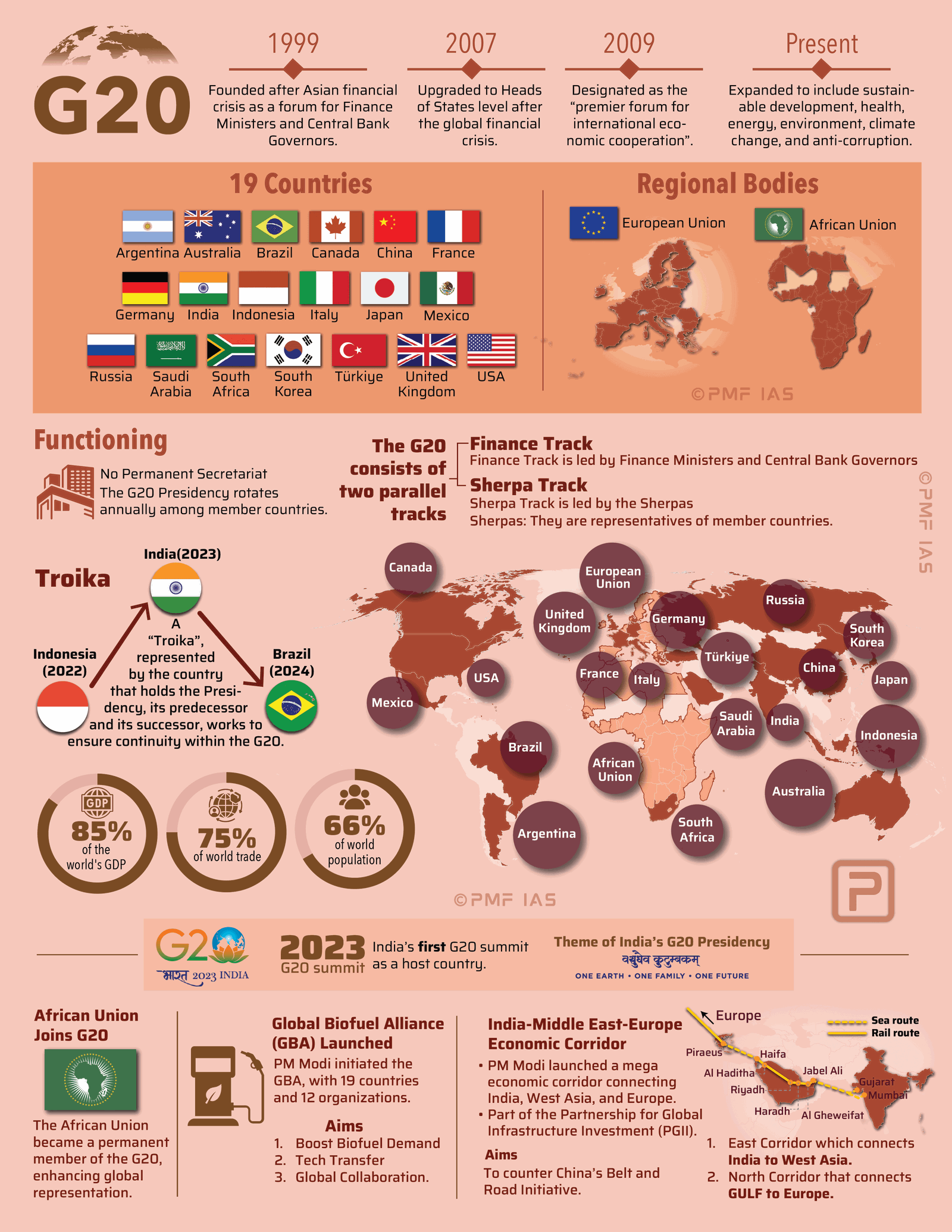
- The Group of Twenty (G20) is a forum for international economic cooperation consisting of 19 countries, the EU, and the African Union.
- G20 was founded in 1999 after the Asian financial crisis.
- It was started as a forum for Finance Ministers and Central Bank Governors to discuss global economic and financial issues.
- It was upgraded to the level of Heads of States in the wake of the 2007 global financial crisis.
- In 2009, it was designated the “premier forum for international economic cooperation”.
- It initially focused on broad macroeconomic issues but now expanded its agenda to include sustainable development, health, energy, environment, climate change, and anti-corruption.
Key Outcomes of the G20 Summit 2025
- Johannesburg Leaders’ Declaration: Adopted unusually early at the summit, it amplified the “Voice of the Global South” and prioritised development justice over geopolitical polarisation.
- Critical Minerals: Members adopted a landmark framework encouraging domestic value addition and processing within resource-origin nations (instead of exporting raw minerals).
- MDB Reform: Leaders approved a plan to reform Multilateral Development Banks (MDBs), including concessional financing and debt relief for low-income countries experiencing stagnation.
- African Union: This summit fully operationalised the African Union’s permanent membership, bringing African development priorities to the forefront of all working-group discussions.
- Digital Public Infrastructure (DPI): Countries pledged financial and technical support to help developing nations deploy DPI systems and narrow the global digital divide.
- AI Governance: The declaration endorsed a human-centric AI governance model that ensures fair access to technology and safeguards against digital risks.
- Debt Sustainability: The first standalone G20 declaration on debt since the COVID-19 pandemic recognised that increasing debt-servicing costs are restricting development expenditure in the Global South.
Other Working Group and Sidelines Outcomes
- Women Economic Empowerment: G20 Empowerment of Women Working Group (EWWG) established three pillars for advancing women’s economic empowerment.
- Care Economy: Recognition of unpaid care work as a barrier to women’s economic participation and a pledge to expand public care infrastructure.
- Gender-Based Violence (GBV): A unified commitment to eradicate GBV and femicide, treating it as both a human-rights and economic crisis.
- Financial Inclusion: A global target to close the gender gap in digital financial services by 2030.
- Digital Innovation Alliance: India, Brazil, and South Africa launched an alliance to jointly develop and share DPI as a “Global South alternative” to Western technology platforms.
- Restitution of Cultural Heritage: G20 members have, for the first time, officially recognised the need to repatriate cultural artefacts and heritage items to their countries of origin.
- Ubuntu Legacy Initiative: Announced by the South African Presidency and the African Development Bank (AfDB) to accelerate cross-border connectivity and infrastructure projects across Africa.
- Green Tourism: The Tourism Working Group introduced a “Tourism Financing Framework” to de-risk investments for MSMEs, help them access green bonds.
- Principles on Bioeconomy: Ten voluntary principles were adopted to establish a shared definition and policy framework for advancing the global bioeconomy.
- Disaster-Risk: Leaders endorsed new guidelines to shift disaster spending from reactive response to preventive planning, including integrating risk into budgets and prearranged financial tools.
Initiatives Proposed by India in Johannesburg G20 Leaders’ Summit
- Africa Skills Multiplier Initiative: To train one million certified trainers in Africa over the next decade using a “train-the-trainers” model.
- Initiative on Countering the Drug-Terror Nexus: A coordinated effort to monitor illicit financial flows, improve intelligence sharing, and combat drug trafficking and its links to terrorism.
- Global Traditional Knowledge Repository: To document, preserve, and disseminate traditional knowledge systems and prevent their misappropriation through patent regimes.
- Global Healthcare Response Team: A multinational roster of medical experts from G20 nations to serve as a “Health Peacekeeping Force” during future health emergencies and disasters.
- Open Satellite Data Partnership: To improve access to satellite data and expertise for developing countries in agriculture, disaster management, and climate monitoring.
- Critical Minerals Circularity Initiative: Promotes the recycling of critical minerals and ‘urban mining’ to lessen reliance on primary extraction and external supply chains.
|
Key Challenges at the G20 Summit
- US Absence: For the first time, the United States did not send a Presidential delegation, weakening the group’s cohesion and diluting Western-backed commitments.
- Critical Minerals: While the Critical Minerals Framework was agreed in principle, it lacked binding enforcement mechanisms to ensure investment in local processing.
- Geopolitical Statements: The summit’s stance on the Ukraine and Gaza conflicts was softer than in previous years; it emphasised humanitarian impacts rather than directly condemning aggression.
- Climate Finance: The summit failed to secure concrete financial commitments from developed nations for the New Collective Quantified Goal (NCQG) on climate finance.
- Fragmentation Risks: The absence of the US and the increased focus on the Global South could divide the G20 into rival blocs rather than serve as a unified global economic forum.
Way Forward
- Inclusive Governance: Ensure equitable representation of Global South nations in G20 decision-making.
- Enforcement: Translate summit declarations into actionable policies with binding mechanisms.
- Tech Equity: Expand DPI, AI governance, and satellite data access to bridge digital divides.
- Regional Cooperation: Support AU initiatives and skill development for sustainable growth.
- Conflict Consensus: Build agreement on geopolitical issues to maintain G20 unity and credibility.
The 20th G20 Summit 2025 highlighted the increasing influence of the Global South in shaping development and technology agendas. Ramaphosa stated, “Ubuntu reminds us that our collective future depends on shared responsibility and cooperation,” emphasising the importance of bridging divides and turning commitments into action.
Reference: The Hindu | PMFIAS: G20: Evolution, Members and Working
PMF IAS Pathfinder for Mains – Question 438
Approach
- Introduction: Write a brief introduction by mentioning the widening of the north-south divide.
- Body: Analyse India’s role in building bridges during the 20th G20 Summit, and also highlight key challenges and their implications for reforms in global governance.
- Conclusion: Emphasis on India’s role as a mediator of ‘inclusive multilateralism’ for a stable and balanced global order governance.


